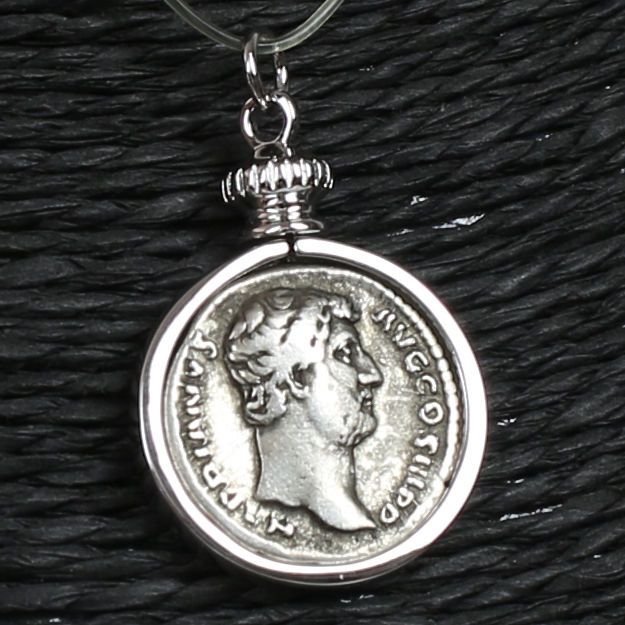
Bidspirit auction | Modern pendant with Hadrian denarius
Modern pendant with Hadrian denarius - ITEM: Modern pendant with Hadrian denarius MATERIAL: Silver CULTURE: Roman PERIOD: 2nd Century A.D DIMENSIONS: 19 mm diameter CONDITION: Good condition. Original coin within a modern handmade circular silver setting. PROVENANCE: Ex Belgian private collection, acquired in the 1990s Comes with Certificate of Authenticity and Export Licence. If you are from outside the European Union, we will have to apply for the export licence again for your country, this takes 3 to 5 weeks and has a cost of 5% of the hammer price, this amount will be added to the final invoice. COIN DESCRIPTION: Hadrian AD 117-138. Rome. Denarius. 134-138 AD. HADRIANVS AVG COS III P P, bare head right / TELLVS STABIL, Tellus Stabil standing left, holding plough and rake, corn growing to right.RIC 276 Sear 3543 RSC 1425. 18 mm, 3,43 g Hadrian (reigned 117–138 CE) was the third of the so-called Five Good Emperors and is remembered as a restless, brilliant, and contradictory ruler who fundamentally shifted the Roman Empire's focus from expansion to consolidation. Abandoning the aggressive expansionist policies of his predecessor, Trajan, Hadrian recognized that the empire had reached its maximum sustainable size. He ordered the withdrawal of Roman forces from the untenable eastern territories, instead dedicating his reign to strengthening, securing, and integrating the vast territory Rome already controlled. A tireless traveler, he spent over half his 21-year rule crisscrossing the provinces to personally inspect defenses, reform administration, and ensure the loyalty of the military and local governors, demonstrating an unparalleled level of imperial oversight. Hadrian's defining legacy lies in his extensive architectural and military fortifications, which symbolized his policy of ”peace through strength.” The most famous of these is Hadrian's Wall in northern Britain, a monumental 73-mile stone barrier built beginning in 122 CE to secure the empire's northwestern frontier against the northern tribes. Far more than a simple defensive structure, the Wall was a massive propaganda statement and a means to control and tax movement and trade across the border. Beyond the frontiers, his passion for architecture led him to oversee major projects in Rome, most notably the completely rebuilt Pantheon with its revolutionary, unreinforced concrete dome, and his vast, sprawling country residence, Hadrian's Villa at Tivoli. Beyond his military and architectural achievements, Hadrian was renowned as a profound Hellenophile, earning the nickname Graeculus (”Greekling”) for his deep admiration of Greek culture, art, and philosophy. This intellectual passion informed his reign, leading him to promote Greek arts throughout the empire and to adorn cities like Athens with grand public works. He also instituted significant legal reforms, consolidating the perpetual edict into a definitive body of law (Edictum Perpetuum). His reign, however, was not without conflict, marked by the brutal suppression of the Bar Kokhba revolt in Judea. In his personal life, his intense, well-documented relationship with the beautiful Greek youth Antinous, whom he deified after his untimely death, led to the widespread creation of Antinous’ cult, reflecting the emperor's highly aesthetic and unconventional nature.