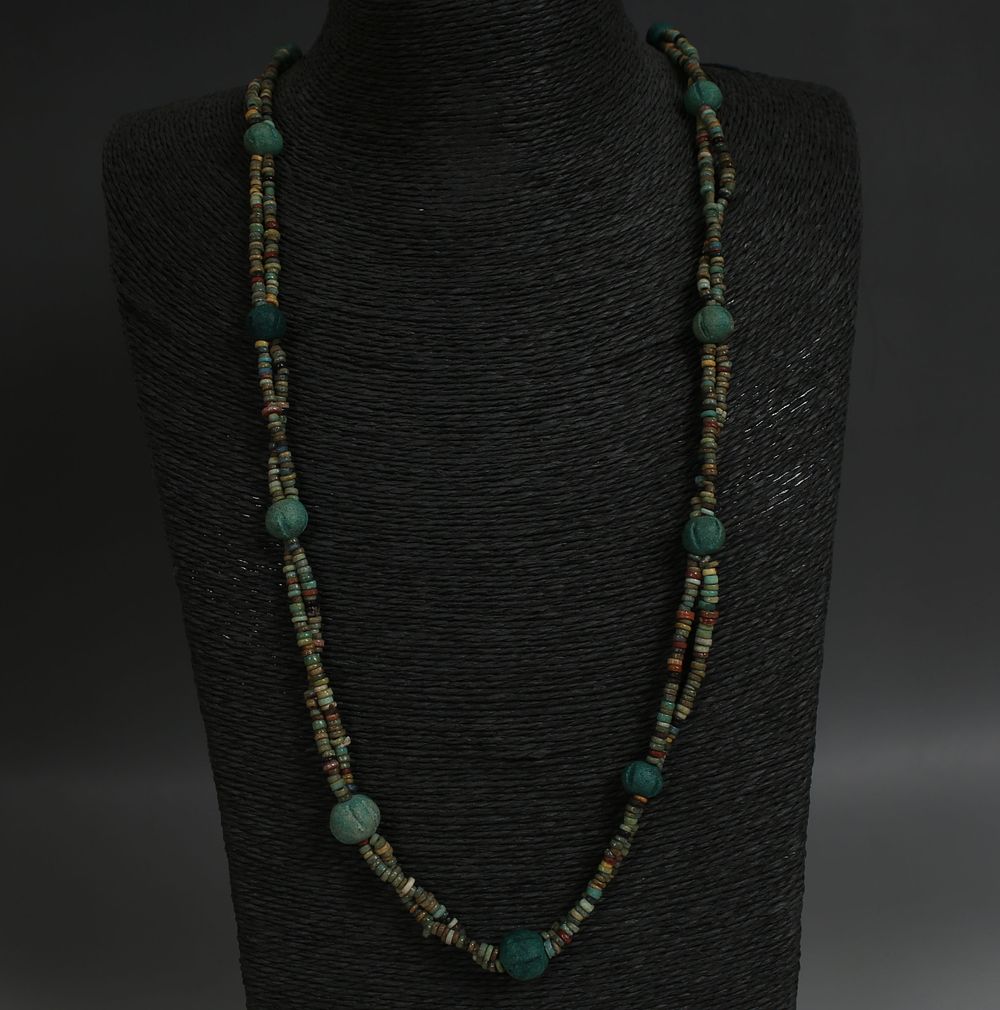
Bidspirit auction | Egyptian necklace
Egyptian necklace - ITEM: Necklace MATERIAL: Faience CULTURE: Egyptian PERIOD: Late period, 664 - 332 B.C DIMENSIONS: 780 mm CONDITION: Good condition, with metal closure PROVENANCE: Ex German private collection, K.H.S., acquired before 1990s Comes with Certificate of Authenticity and Export Licence. If you are from outside the European Union, we will have to apply for the export licence again for your country, this takes 3 to 5 weeks and has a cost of 5% of the hammer price, this amount will be added to the final invoice. Egyptian faience necklaces were among the most common and enduring forms of jewelry in ancient Egypt, prized not for their intrinsic material value, but for their vibrant color, protective symbolism, and ability to mimic semi-precious stones. Faience is not pottery, but a ceramic material made from quartz or sand, with a high alkali content that results in a self-glazing surface when fired. This glaze, typically a brilliant, saturated blue-green due to copper compounds, was highly evocative of two powerful Egyptian symbols: the Nile's fertility and the rejuvenating qualities of the sky. This color was associated with life, rebirth, and the gods, particularly the deity Osiris, linking the wearer to the promise of eternal existence. The construction of these necklaces utilized a mass-production technique ideal for creating elaborate, broad collars. Small faience beads—often in the shape of tubes, disks, rings, or stylized flora like lotus petals—were molded, strung, and sometimes even glued onto a backing. A popular type was the usekh collar, a wide, semicircular neckpiece that draped over the shoulders and chest. These collars replicated the floral garlands worn in life and were essential burial goods, believed to offer magical protection and a substitute for ephemeral flowers in the afterlife. The ability to churn out thousands of these uniform beads made faience accessible to nearly all classes, from pharaohs and nobility to common citizens, solidifying its place as a staple of Egyptian adornment. The symbolic power of the faience necklace extended through its use of protective amulets. Often incorporated into the strings were small pendants crafted from faience, molded into figures such as the dwarf god Bes (a protector of the household), the Eye of Horus (Udjat), or the Djed pillar (representing stability). When worn in life, the necklace provided a visible layer of magical defense; in death, it served as funerary equipment. The sheer number of faience necklaces recovered from tombs across millennia—from the Predynastic Period well into the Roman era—attests not only to their popularity but also to the enduring belief in the vibrant material’s apotropaic properties and its fundamental role in preparing the deceased for their journey into the next world.