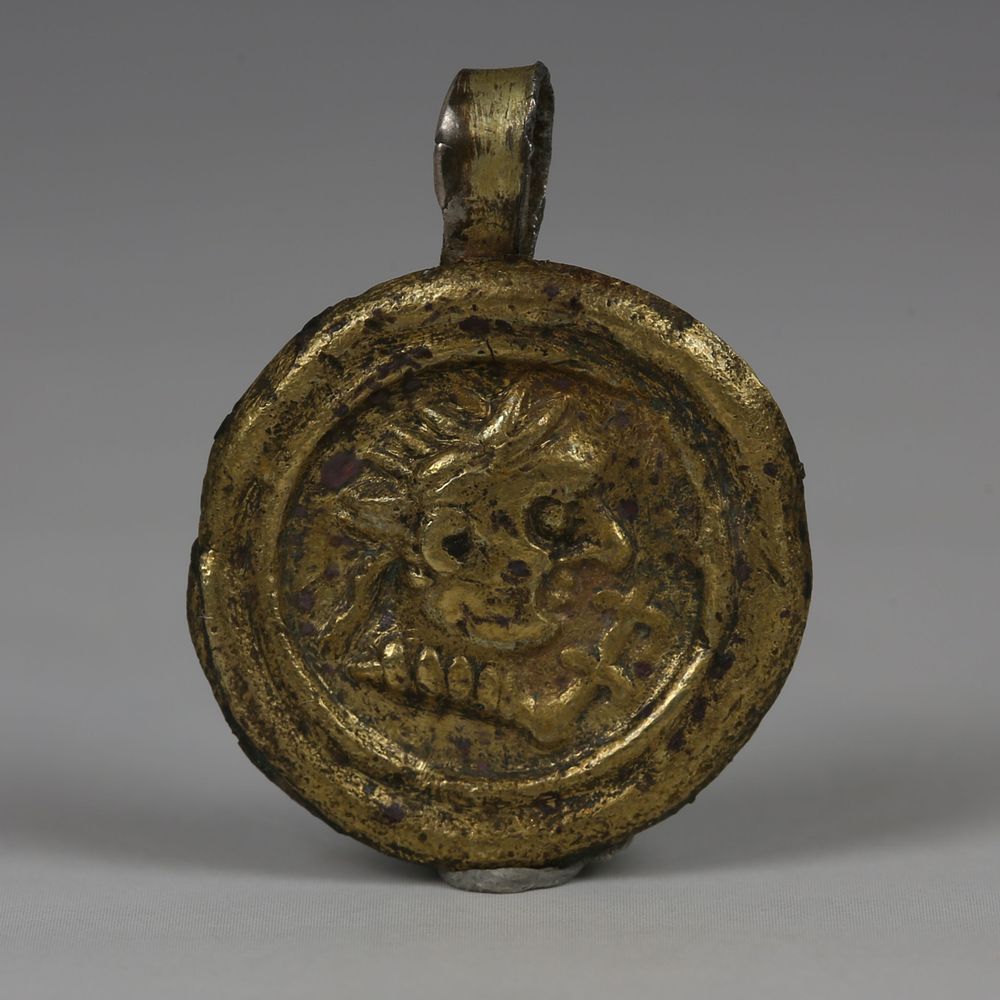
Bidspirit auction | Roman pendant, possibly Valentinian holding
Roman pendant, possibly Valentinian holding double cross - ITEM: Pendant, possibly Valentinian holding double cross MATERIAL: Gilded bronze CULTURE: Roman PERIOD: 4th Century A.D DIMENSIONS: 26 mm x 20 mm CONDITION: Good condition PROVENANCE: Ex European private collection, acquired between 1970 - 1990 Comes with Certificate of Authenticity and Export Licence. If you are from outside the European Union, we will have to apply for the export licence again for your country, this takes 3 to 5 weeks and has a cost of 5% of the hammer price, this amount will be added to the final invoice. Roman pendants, along with other jewelry, served vital functions that transcended mere aesthetic adornment, signaling the wearer's social status, wealth, and spiritual beliefs. While upper-class women famously wore elaborate pieces of gold, silver, pearls, and precious stones to display the family’s wealth and standing, men typically limited their jewelry to finger rings, fibulae (brooches), and certain military distinctions. The materials themselves were a sign of status: gold and carved gems were reserved for the elite, while bronze, bone, and glass were more common for the lower classes. A critical piece of symbolic jewelry was the bulla, a round locket-like pendant worn around the neck by male children of the aristocracy. This amulet, containing a protective charm, was worn until the boy came of age, underscoring the deep-seated belief in the protective, or apotropaic, power of Roman pendants. The history of Valentinian I is crucial to understanding the Late Roman Empire's shift towards military-focused, divided rule. A Pannonian soldier of humble origins, Valentinian was proclaimed Emperor by the army in 364 AD following the death of Jovian. Recognizing the immense challenges of governing the sprawling empire, he made the consequential decision to divide the administration, taking the Western Roman Empire for himself and appointing his younger brother, Valens, to rule the East. Valentinian was an energetic and capable military commander who spent most of his reign campaigning aggressively to secure the threatened frontiers, particularly along the Rhine and Danube rivers against threats from the Alamanni and other Germanic tribes. Valentinian I established his court primarily at Milan and Trier, focusing on administrative and military reform in the West. He was known for his dedication to justice for the lower classes and enacted legislation to protect the rights of the common people, which contrasted sharply with his reputation for extreme severity and a quick, violent temper toward officials who displeased him. His reign was a period of relative stability and military success for the West, achieved through his personal command and the work of highly competent generals. However, the division of the empire he formalized ultimately weakened Rome's overall position, and his unexpected death in 375 AD, caused by a stroke suffered during an angry outburst toward a delegation of Quadi, left the western throne to his young sons, leading to further instability in the years that followed.