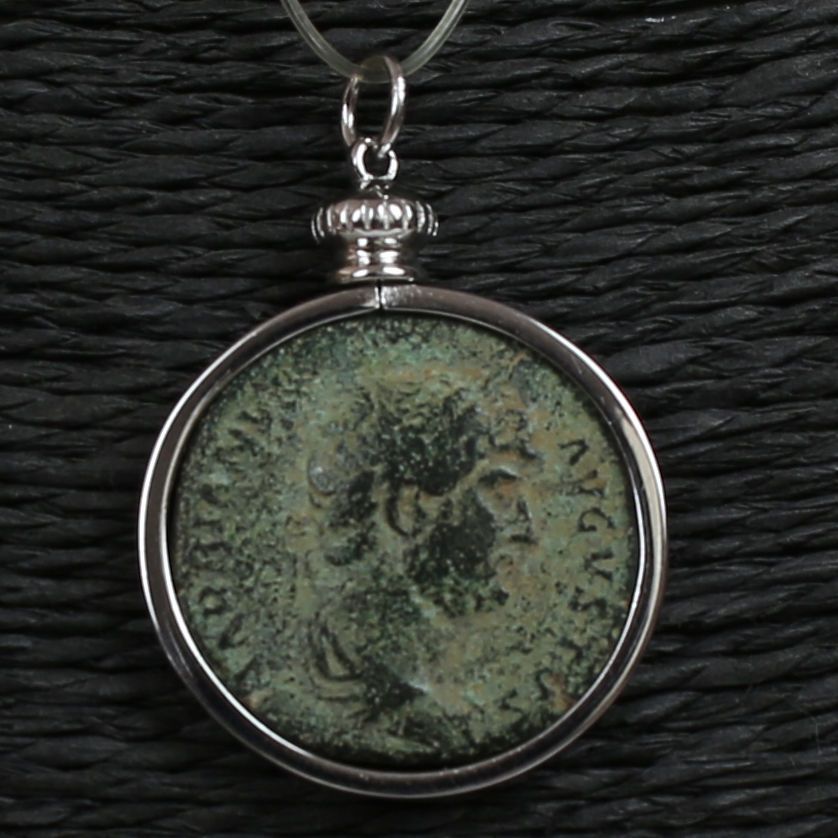
Bidspirit auction | Modern pendant with Hadrian As
Modern pendant with Hadrian As - ITEM: Modern pendant with Hadrian As MATERIAL: Silver and bronze CULTURE: Roman PERIOD: 2nd Century A.D DIMENSIONS: 25 mm diameter CONDITION: Good condition. Original coin within a modern handmade circular silver setting. PROVENANCE: Ex Belgian private collection, acquired in the 1990s (Coin) Comes with Certificate of Authenticity and Export Licence. If you are from outside the European Union, we will have to apply for the export licence again for your country, this takes 3 to 5 weeks and has a cost of 5% of the hammer price, this amount will be added to the final invoice. COIN DESCRIPTION: Hadrian AE As 24 mm 8,19 gr., Rome mint. AD 125-128. HADRIANVS AVGVSTVS, laureate and draped bust right, seen from the back / COS III around, S-C across fields, Tyche of Antioch seated left on rock, holding corn-ears, river-god Orontes swimming left below. RIC II 680; BMCRE 1350; McAlee 544. Publius Aelius Hadrianus (76–138 AD) was Roman Emperor from 117 to 138 AD, and is remembered as one of the ”Five Good Emperors.” Born in Italica, Hispania Baetica (modern Spain), he was a distant relative of his predecessor, Trajan, whose wife, Pompeia Plotina, played a key role in securing Hadrian's controversial adoption and succession. Early in his reign, Hadrian immediately reversed Trajan's expansionist policy, judging the new territories in Mesopotamia, Assyria, and Armenia to be unsustainable. Instead of conquest, he focused on consolidation and internal organization, prioritizing the defense of stable, defensible borders and the unification of the empire's diverse peoples. This strategic shift marked a pivotal change in Roman imperial policy, moving from perpetual expansion to sustained stability. Hadrian is perhaps most famous for his extensive travels and his architectural contributions throughout the empire. He spent more than half of his reign touring the provinces, personally inspecting troops, supervising administration, and commissioning major building projects. His most renowned project is Hadrian's Wall, a massive defensive fortification spanning 80 Roman miles across northern Britain, which symbolically and physically defined the northern frontier of the empire. A passionate admirer of Greek culture (earning him the nickname Graeculus or ”Little Greek”), he strongly promoted Athens as the cultural capital of the Roman world. In Rome itself, his architectural genius is immortalized in the reconstruction of the majestic Pantheon with its revolutionary dome, and the construction of his own monumental mausoleum, which is now Castel Sant'Angelo. Despite his benevolent reputation and achievements, Hadrian was also an enigmatic and contradictory figure whose reign was marked by both personal generosity and extreme cruelty. He had a tumultuous relationship with the Roman Senate, which he often bypassed and which resented his autocratic style. His final years were marred by chronic illness and the brutal suppression of the Bar Kokhba revolt in Judea, a conflict fueled by his Hellenizing policies and attempts to rebuild Jerusalem as a Roman city. Hadrian's legacy ultimately rests on his role as a brilliant administrator and builder who successfully stabilized the Roman Empire for a generation, ensuring the continuation of the peaceful Pax Romana by carefully managing his succession, adopting Antoninus Pius, who in turn adopted Marcus Aurelius.