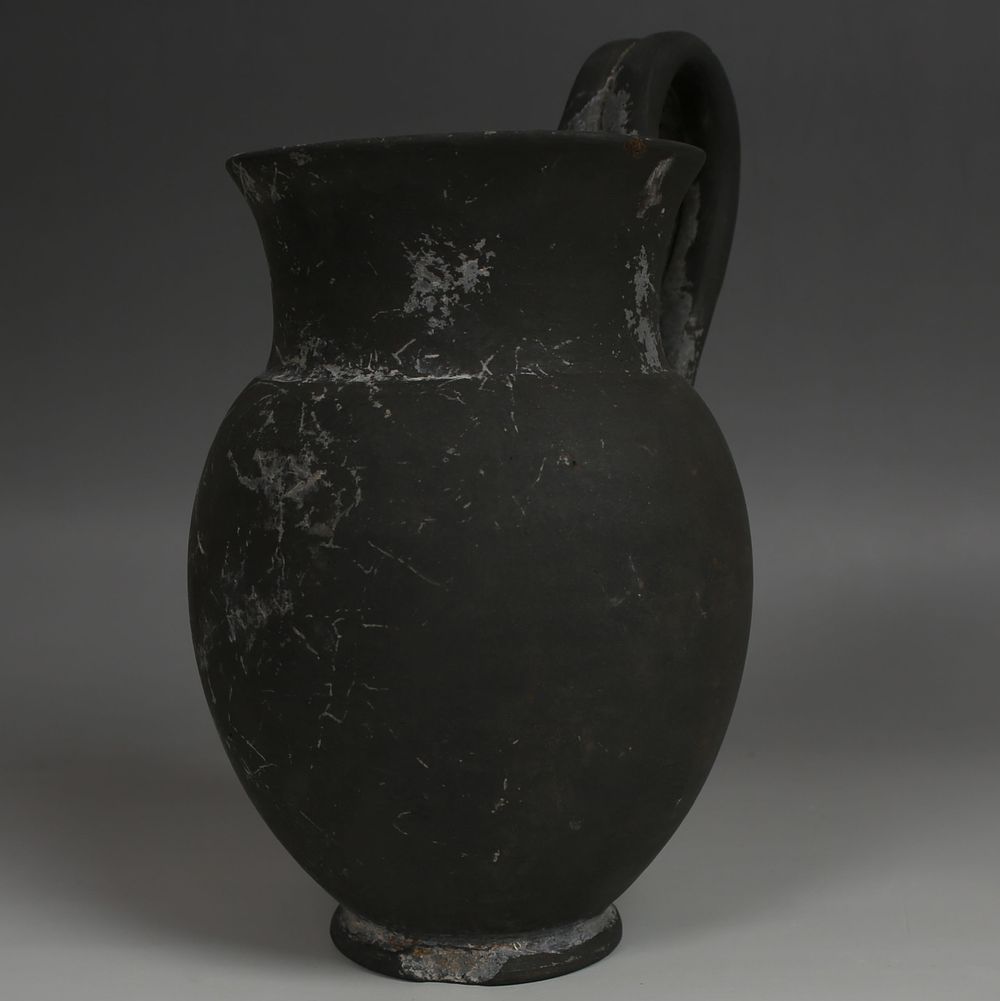
Bidspirit auction | Etruscan olpe
Etruscan olpe - ITEM: Olpe MATERIAL: Pottery, Bucchero ware CULTURE: Etruscan PERIOD: 7th - 6th Century B.C DIMENSIONS: 164 mm x 117 mm x 98 mm CONDITION: Good condition PROVENANCE: Ex European private collection, Ex H.A.C. Kunst der Antike (1984), Ex German private collection, Dr. K.D., Frankfurt (1983) Comes with Certificate of Authenticity and Export Licence. If you are from outside the European Union, we will have to apply for the export licence again for your country, this takes 3 to 5 weeks and has a cost of 5% of the hammer price, this amount will be added to the final invoice. Etruscan pottery reflects a dynamic blend of indigenous innovation and external influence, particularly from Greek and Near Eastern cultures. During the 7th century B.C., Etruscan potters developed the bucchero style—distinctive for its black, glossy surface achieved through a reducing firing technique. Bucchero vessels, often finely crafted and decorated with incised or relief patterns, served both everyday and ceremonial functions. Early examples were elegant and light, while later ones grew heavier and more elaborate, often mimicking metal prototypes. By the 6th century B.C., the influence of Greek pottery became more pronounced, especially through the importation of Corinthian and Attic ceramics. Etruscan artisans began producing their own painted wares, imitating Greek black-figure and later red-figure techniques. These locally made vases, especially from workshops in places like Vulci and Cerveteri, frequently depict mythological scenes, banquets, and athletic contests, sometimes with uniquely Etruscan interpretations. Shapes such as amphorae, kraters, and kylikes were common, reflecting the importance of symposium culture. In the 5th century B.C., Etruscan pottery production became increasingly regionalized and somewhat conservative compared to the innovations in Greek pottery. However, the continued production of impasto wares—coarse, hand-formed ceramics used for domestic purposes—demonstrates a parallel tradition alongside the finer, painted pieces.