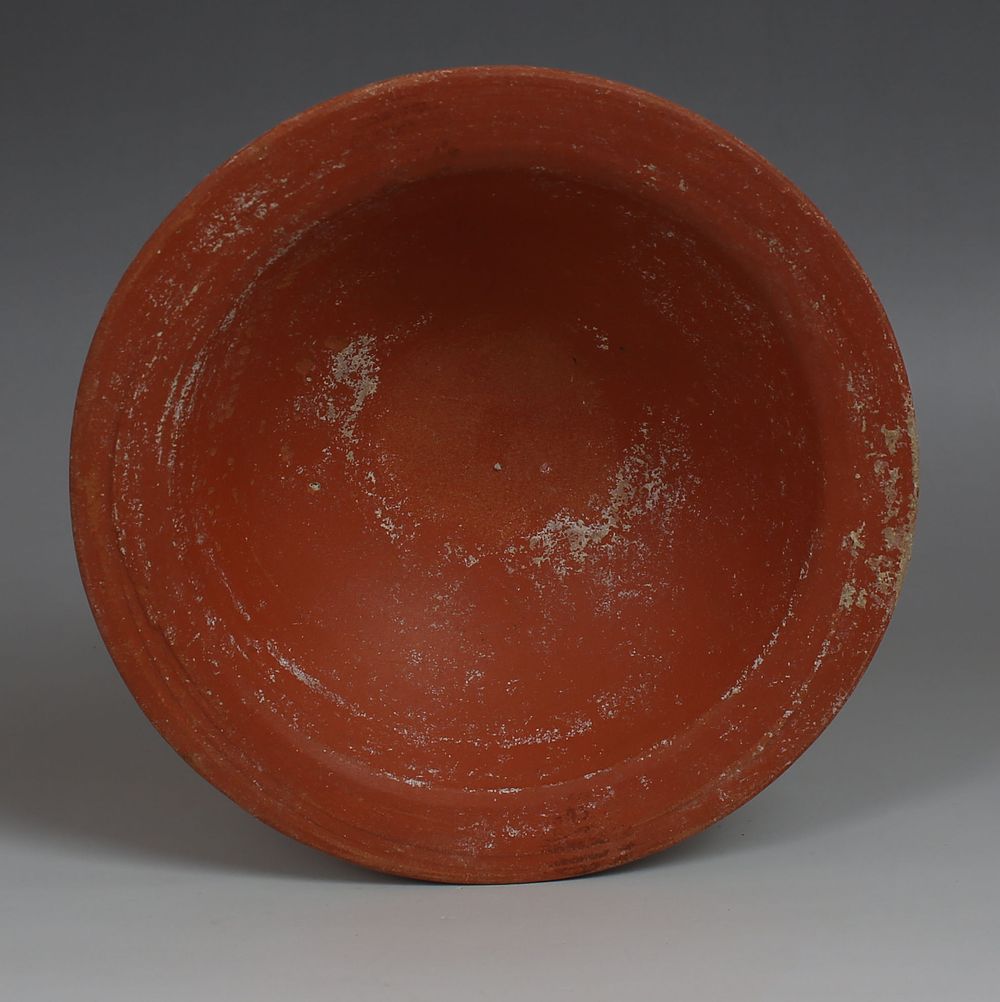
Bidspirit auction | Roman bowl
Roman bowl - ITEM: Bowl MATERIAL: Terra Sigillata CULTURE: Roman PERIOD: 2nd - 3rd Century A.D DIMENSIONS: 44 mm x 153 mm diameter CONDITION: Good condition PROVENANCE: Ex Dutch private collection, acquired between 1970 - 1990 Comes with Certificate of Authenticity and Export Licence. If you are from outside the European Union, we will have to apply for the export licence again for your country, this takes 3 to 5 weeks and has a cost of 5% of the hammer price, this amount will be added to the final invoice. Terra Sigillata is a distinctive type of high-quality Roman fine ware pottery, easily recognizable by its characteristic glossy, bright red surface and intricate molded decoration. The name, which literally means ”stamped earth” or, more accurately in the Roman context, ”clay with little images, ” refers both to the potters' trademark stamps pressed into the vessels and the relief designs that often adorned them. This ceramic style originated in the late 1st century BCE in Arretium (modern Arezzo, Italy), where it is known as Arretine Ware. Its superior appearance and durability allowed it to quickly supplant older ceramic traditions, becoming the dominant form of mass-produced tableware consumed by Roman soldiers, citizens, and elite populations across the Empire. The technique used to achieve the iconic finish of Terra Sigillata was technically advanced for its time. Vessels were thrown on a wheel and often pressed into molds that bore intricate decorative scenes, typically featuring mythological figures, hunting scenes, or floral designs, which appeared in relief on the finished product. The glossy surface was not a glaze, but rather a colloidal slip—an extremely fine slurry of clay particles applied to the dried vessel before firing. Fired in specialized kilns that carefully controlled the atmosphere and temperature, this slip vitrified to create the hard, brilliant sheen that distinguishes the ware. This combination of mass-production via molds and high-quality finish ensured a consistent product that could be shipped and traded economically across vast distances. As the popularity of Terra Sigillata grew, production centers shifted out of Italy. Gallic Sigillata, produced in large workshops in what is now France and Germany, eventually surpassed the Italian output and became the most widespread type, commonly referred to as Samian Ware by archaeologists in Britain. These Gallic workshops created their own distinct forms, such as the iconic bowl known as the Dragendorff 30. Later, African Red Slip Ware dominated the market and remained in production much longer than its European counterparts, continuing into the 7th century CE. The widespread presence of Terra Sigillata in archaeological sites, even as far as India (as suggested by finds in places like Pattanam), makes it an invaluable dating tool for archaeologists, offering precise chronological markers across the Roman world.