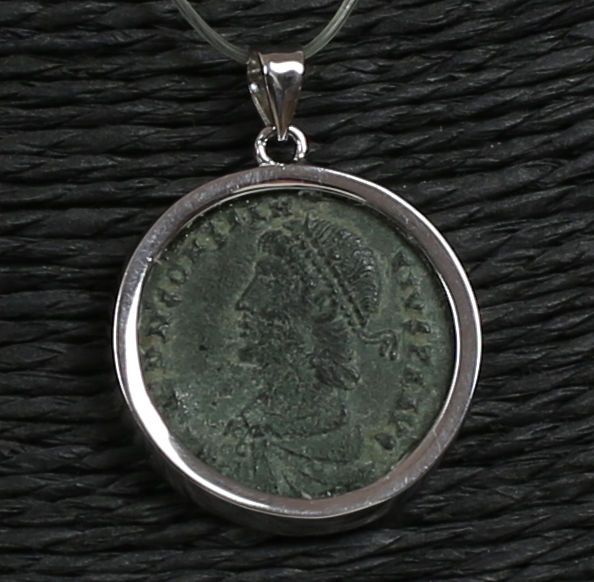
Bidspirit auction | Modern pendant with Constantius II
Modern pendant with Constantius II Follis - ITEM: Modern pendant with Constantius II Follis MATERIAL: Silver and bronze CULTURE: Roman PERIOD: 4th Century A.D DIMENSIONS: 22 mm diameter CONDITION: Good condition. Original coin within a modern handmade circular silver setting. PROVENANCE: Ex Belgian private collection, acquired in the 1990s Comes with Certificate of Authenticity and Export Licence. If you are from outside the European Union, we will have to apply for the export licence again for your country, this takes 3 to 5 weeks and has a cost of 5% of the hammer price, this amount will be added to the final invoice. COIN DESCRIPTION: Constantius II (337-361) AE Follis (Bronze, 3.99g, 20mm) Alexandria, A = 1st officina, 348-350. Obv: D N CONSTANTIVS P F AVG Laurel and rosette diademed, draped and cuirassed bust of Constantius II to left, holding globe in his right hand. Rev: FEL TEMP REPARATIO / ALEA Constantius standing left, holding labarum with his right hand and shield set on ground with his let; at his feet to left, two bound captives seated. Ref: LRBC 2815. RIC 55. Flavius Julius Constantius (317–361 AD) was the second surviving son of Constantine the Great and his wife Fausta, and an emperor of the Roman Empire for nearly a quarter-century. Born into the Constantinian dynasty, Constantius was elevated to the rank of Caesar at the age of seven. Upon his father's death in 337 AD, he initially inherited the eastern third of the empire, alongside his brothers, Constantine II (who ruled the West) and Constans (who ruled Italy and North Africa). The succession was immediately followed by a brutal purge of his male relatives from Constantine's extended family, in which Constantius is widely believed to have been complicit, leaving only himself, his brothers, and his cousins, Julian and Gallus, alive. This massacre secured the brothers' position but foreshadowed the intense political and military rivalries that would define Constantius's reign. Constantius II spent the initial years of his rule primarily engaged in the East against the formidable Sasanian Persian Empire, led by King Shapur II. This grueling and indecisive frontier war preoccupied him, preventing him from immediately intervening in the West when his brother Constantine II was killed in 340 AD and later when his last surviving brother, Constans, was overthrown and murdered by the usurper Magnentius in 350 AD. This revolt forced Constantius to eventually march west, where he crushed Magnentius in the bloody Battle of Mursa Major (351 AD), a Pyrrhic victory considered one of the largest and most devastating battles in Roman history. Having reunited the empire under his sole rule by 353 AD, Constantius was compelled to appoint his cousins, first Gallus and later Julian, as Caesares to help manage the vast, threatened frontiers, particularly in Gaul. The most lasting impact of Constantius II's reign was his deeply involved role in the Arian controversy, a major theological dispute within early Christianity. While his father, Constantine, had championed the Nicene Creed (which stated that the Son and Father were ”of the same substance”), Constantius strongly favored the Semi-Arian position, which viewed Christ as being like but not identical in substance to God the Father. He used his imperial authority to impose his theological views, exiling Nicene bishops, including the influential Athanasius of Alexandria, and attempting to enforce doctrinal unity through a series of church councils. In addition to his focus on Christian doctrine, Constantius also took aggressive steps against paganism, issuing laws that forbade pagan sacrifices and ordered the closing of temples, making him a pivotal figure in the growing institutionalization of Christianity within the Roman state.