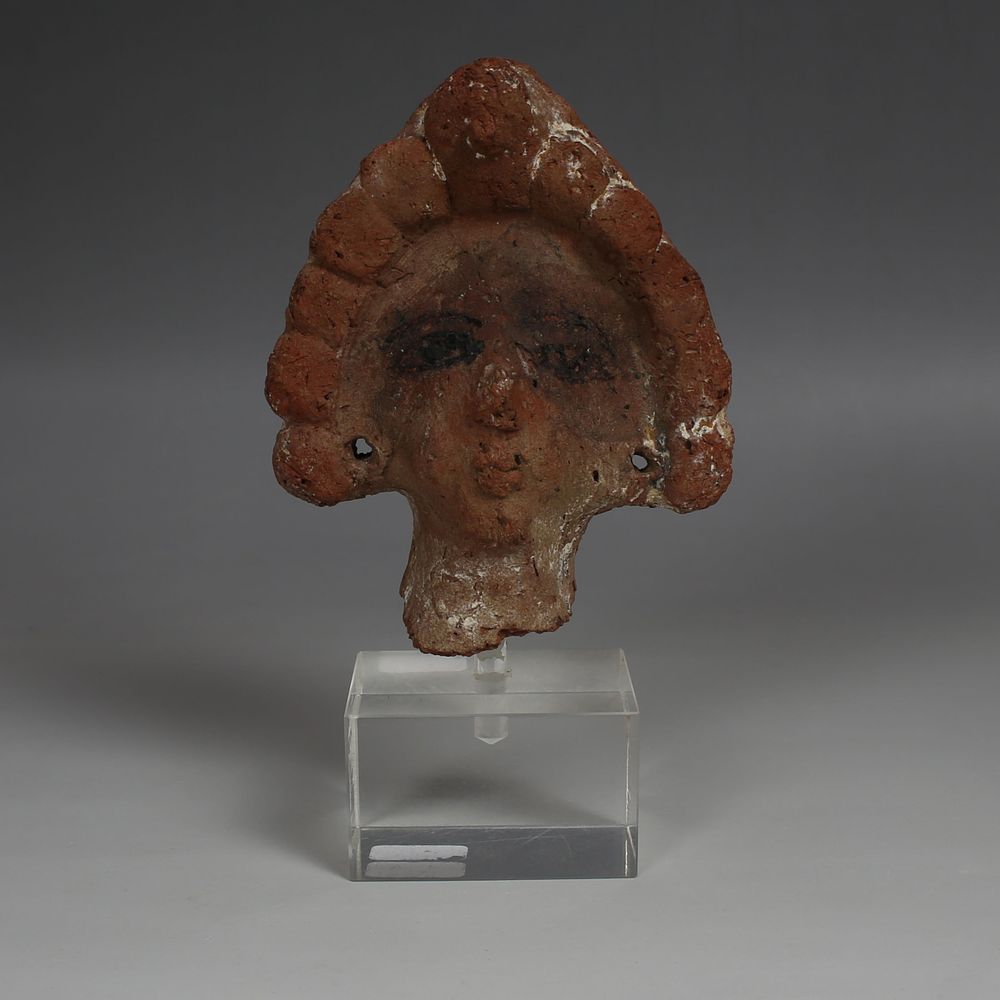
Bidspirit auction | Egyptian female head with pointed
Egyptian female head with pointed curls - ITEM: Female head with pointed curls MATERIAL: Pottery CULTURE: Egyptian, Coptic PERIOD: 4th - 5th Century A.D DIMENSIONS: 105 mm x 81 mm x 28 mm (without stand) CONDITION: Good condition. Includes stand PROVENANCE: Ex German private collection, W.F., acquired before 2000s Comes with Certificate of Authenticity and Export Licence. If you are from outside the European Union, we will have to apply for the export licence again for your country, this takes 3 to 5 weeks and has a cost of 5% of the hammer price, this amount will be added to the final invoice. Coptic is the most recent chronological stage of the indigenous Egyptian language, an Afroasiatic language with a recorded history spanning over four millennia, making it one of the longest-attested human languages. It emerged in the 3rd century AD and represents the evolution of Demotic Egyptian, written with a unique script primarily derived from the Greek alphabet, supplemented by seven characters borrowed from Demotic to represent sounds not found in Greek. While Coptic was once the vernacular language of Egypt's population, its use declined following the Arab conquest in the 7th century, eventually being completely supplanted by Arabic as the primary spoken tongue. Although Coptic has no modern-day native speakers, it remains in daily, active use as the liturgical language of the Coptic Orthodox Church of Alexandria and the smaller Coptic Catholic Church. This continued religious application has preserved the language and its cultural heritage for centuries. The Bohairic dialect, originally associated with the Nile Delta, gained prominence in the medieval period and is the dialect used today in Coptic church services, maintaining a living link to pre-Islamic Egyptian identity and Christianity. Texts written in Coptic, particularly in the older Sahidic dialect (the literary standard between roughly 325 and 800 AD), are profoundly significant, notably including the Nag Hammadi library of Gnostic gospels. The term Copt itself derives from the Greek word for 'Egyptian' and, over time, became associated specifically with the native Egyptian population that maintained their Christian faith following the Arabization and Islamization of the country. Consequently, Coptic culture is a distinctive blend of ancient Egyptian traditions and Christian monastic practices, expressed through unique art, architecture, and music. Today, efforts are underway to revive and teach Coptic as a cultural and identity marker within the Coptic community, emphasizing its value as a crucial part of Egyptian heritage and a direct linguistic descendant of the language of the Pharaohs.