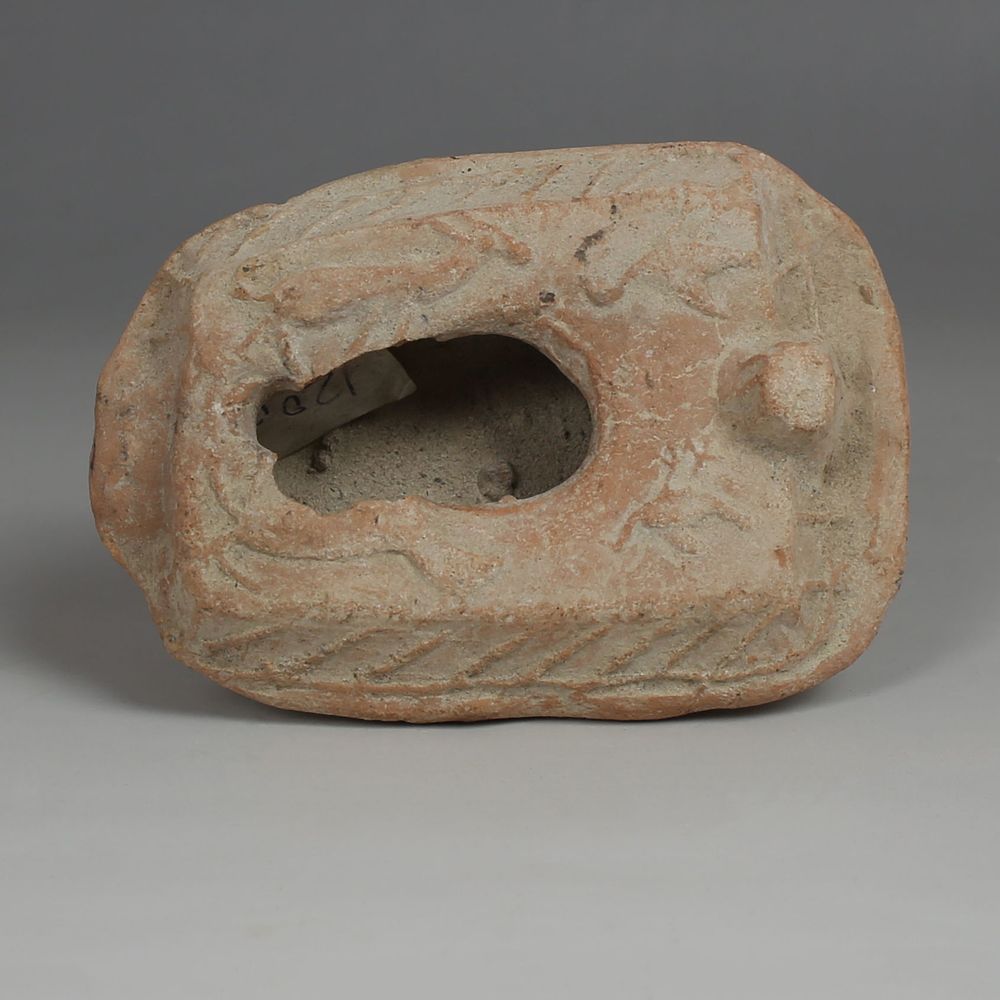
Bidspirit auction | Christian oil lamp depicting birds
Christian oil lamp depicting birds and donkey - ITEM: Oil lamp depicting birds and donkey MATERIAL: Pottery CULTURE: Christian PERIOD: 5th - 7th Century A.D DIMENSIONS: 28 mm x 62 mm x 89 mm CONDITION: Good condition PROVENANCE: Ex German private collection, H.L., acquired before 2000s Comes with Certificate of Authenticity and Export Licence. If you are from outside the European Union, we will have to apply for the export licence again for your country, this takes 3 to 5 weeks and has a cost of 5% of the hammer price, this amount will be added to the final invoice. Christian oil lamps, prominent artifacts from Late Antiquity (c. 3rd to 7th centuries AD), were a direct continuation of lighting technology used throughout the Greco-Roman and Jewish worlds. Before the advent of widespread electric lighting, the terracotta or bronze oil lamp was an essential utilitarian object for daily life, providing portable, artificial light in homes, workshops, and streets. For early Christians, who often met at night or in subterranean spaces like the catacombs due to persecution, lamps were a simple necessity for illumination during services. The continuity of this common household item allowed early believers to integrate their new faith's symbolism onto a familiar object without drawing undue attention from Roman authorities. The significance of the Christian oil lamp extends far beyond its practical function, as light and fire hold profound theological meaning in Christianity. Christ is frequently referred to as the ”Light of the World” (John 8:12), and lamps, therefore, served as tangible symbols of divine presence, guidance, and salvation. The lamps were decorated with a distinct set of Christian symbols, which gradually replaced the pagan motifs found on earlier Roman lamps. Common iconography included: the Chi-Rho, a monogram of the first two Greek letters of Christ's name; the cross; the fish (Ichthys), which is an acronym for ”Jesus Christ, God's Son, Savior”; and occasionally stylized palm branches or vine scrolls. These symbols were not only declarations of faith but were also sometimes believed to possess apotropaic powers—a belief that the signs of Christ could ward off evil. In addition to domestic and liturgical use, Christian lamps played roles in specific religious practices. Lamps were often placed in catacomb niches as a sign of respect or remembrance for the deceased, though evidence suggests this was not part of an initial funerary ritual but a later custom. Following the acceptance of Christianity, lamps began to be used ceremonially in churches, eventually evolving into the tradition of the sanctuary lamp (kandilo) that burns before the altar. Furthermore, during the Byzantine period, lamps became popular pilgrimage souvenirs, especially those made in the Holy Land. These lamps, often mass-produced and adorned with crosses or inscriptions like ”The Light of Christ Shines for All, ” allowed pilgrims to carry home a tangible connection to sacred sites, embodying the spiritual light experienced during their journey.