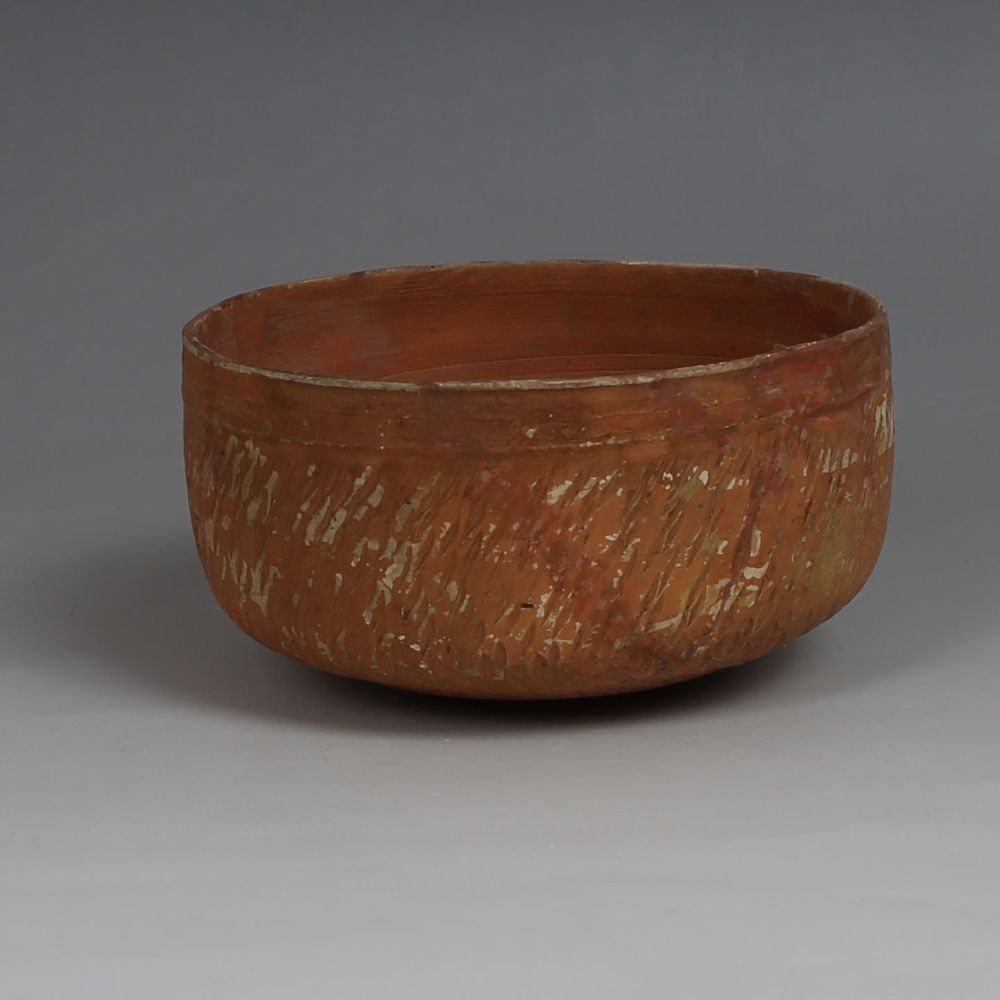
Bidspirit auction | Roman bowl with decoration
Roman bowl with decoration - ITEM: Bowl with decoration MATERIAL: Pottery CULTURE: Roman PERIOD: 1st - 2nd Century A.D DIMENSIONS: 48 mm x 95 mm CONDITION: Good condition, repaired PROVENANCE: Ex Dutch private collection, acquired between 1970 - 1990 Comes with Certificate of Authenticity and Export Licence. If you are from outside the European Union, we will have to apply for the export licence again for your country, this takes 3 to 5 weeks and has a cost of 5% of the hammer price, this amount will be added to the final invoice. Roman bowls, or paterae and scyphi in Latin depending on their shape and material, were ubiquitous items throughout the Roman Empire, reflecting the daily needs and varying social status of its vast population. These vessels were crafted from a variety of materials, most commonly terracotta (pottery), but also in bronze, silver, and glass for wealthier individuals. Their functions were just as diverse: plain, sturdy ceramic bowls were used for preparing, storing, and serving simple food like stews and porridge, while more elaborately decorated bowls were used as sophisticated tableware for banquets, drinking, or even for religious rituals, such as making libations to the gods. The most distinctive and significant type of Roman bowl is the Terra Sigillata, meaning ”stamped earth.” This highly standardized and widely exported fine ceramic ware, known for its smooth, bright red, glossy slip (a liquid suspension of clay) and molded relief decoration, became the premium tableware of the Roman world. Production centered in Italy (primarily at Arezzo, giving rise to ”Aretine Ware”) and later in Gaul, Spain, and North Africa. These bowls often featured complex decorative friezes—including mythological scenes, gladiators, or hunting motifs—which were created by pressing the clay into decorated molds. The uniformity of Terra Sigillata across the Empire demonstrates an early form of industrial-scale pottery production and trade. Roman bowls are invaluable to archaeologists because their styles, manufacturing techniques, and decorative patterns changed rapidly over time and across different production centers. Found in vast numbers at excavation sites—from military camps in Britain to domestic trash heaps in Egypt—they serve as crucial chronological indicators for dating the strata in which they are found. Furthermore, the presence of specific imported wares, like the fine red bowls from North Africa, illustrates the complexity of Roman trade networks and economic interactions. By studying the spread and distribution of these ceramics, historians can map Roman influence, cultural exchange, and the daily lives of the common people.