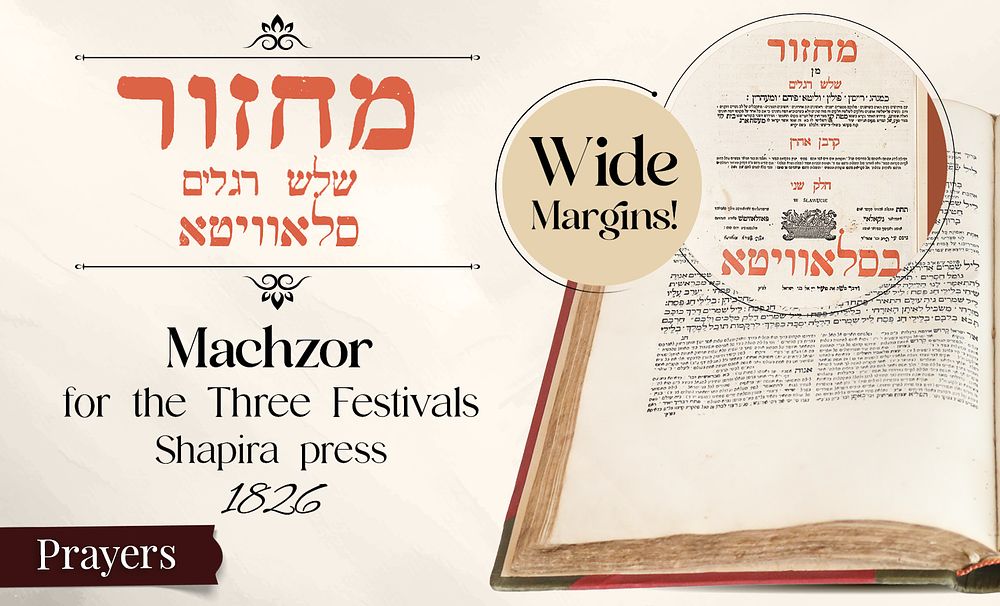
Bidspirit auction | Impressive Slavita Machzor with Wide
Impressive Slavita Machzor with Wide Margins! Machzor Korban Aharon for the Three Festivals Shapira Press Slavita, 1826 * The Korban Aharon machzor for the Three Festivals, in accordance with the custom practiced in Poland, Bohemia, and Russia, with basic kavanos (intentions) from the siddur Tefillas Nehora Hashalem. Printed with sanctity and purity by the holy Rabbi Moshe Shapira of Slavita, son of the holy Rabbi Pinchas of Koritz and father of the famed Shapira printing family. A special copy with wide margins!! Siddurim printed by the legendary Shapira family, especially by the holy Rabbi Moshe Shapira, were sought after by tzaddikim, Rebbes and chassidim. Many specifically wished to pray only from the siddurim and machzorim printed by the Shapira press, as they held their holiness and purity in high regard. “Every God-fearing person should strive to purchase sefarim printed by G-d-fearing men, and especially from the Slavita and Zhitomir Presses of the Admor of Koritz’s grandchildren, who were holy printers.” (Taharas Hakodesh Ch. 6 by the Shomer Emunim) It is exceedingly rare to find a machzor from the Slavita Press with wide margins like the present one! Slavita, 1826. Page Count: [1], 14, [1], leaves 5–172, 45–48. Condition: Good to fair. Holes and repairs throughout the volume, primarily in the margins. The title page is slightly smaller. Fine new binding. Includes illustrations of the zodiac signs in the Tefillas Geshem and Tefillas Tal. Part of the title page is printed in impressive red ink. This machzor is accompanied by the important commentary Korban Aharon, composed by Rabbi Aharon ben Yechiel Michal HaLevi of Makaylishok, author of the renowned siddurim Tefillas Nehora Hashalem and Seder Avodah uMoreh Derech. Korban Aharon is in fact a collective title for three commentaries printed on the page: Mateh Levi – a commentary on the piyutim presented in a clear and appealing manner, printed along the outer margin. Beis Levi – an explanation of the words and their sources, according to grammatical principles in shortened form, in the inner margin. Ma'aseh Oreg – variant texts, sources, gematrios, allusions, and more, printed at the bottom of the pages. The author incorporated Torah teachings he found in the Raavan, from an early manuscript that had been given to him by Rabbi Ephraim Zalman Margulies of Brody.