Bidspirit auction | Unique Illustrated Persian Ketubah .
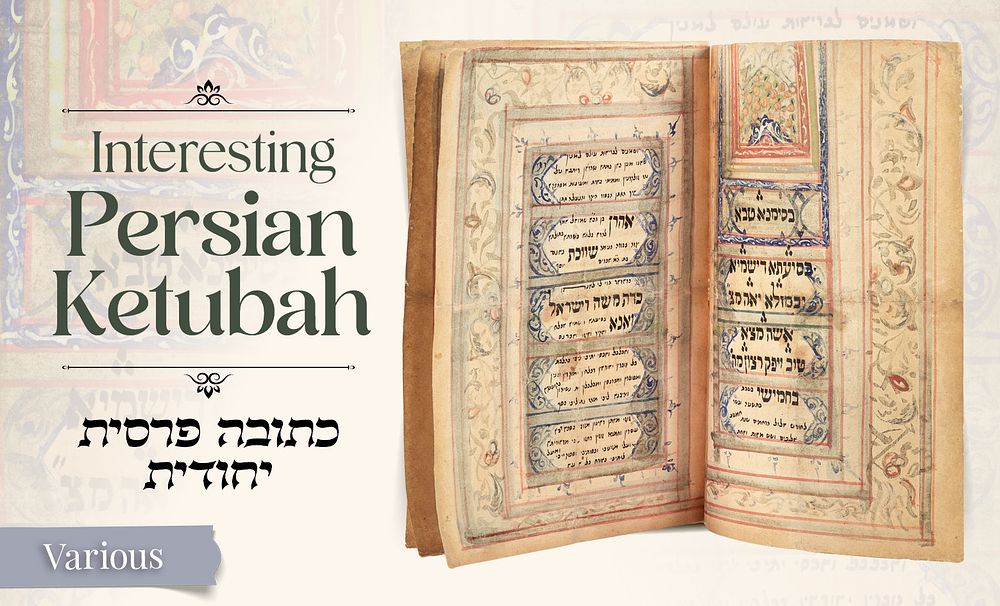
Unique Illustrated Persian Ketubah . Tehran, 1921 * Remarkable! Striking century-old ketubah illustrated in bright colors in conspicuous Persian style. This ketubah is written on 5 sides and bound as a leaflet rather than on a single large leaf as is customary. Each leaf of the ketubah is encased in a double border and adorned with geometric shapes and decorative leaves. The inner border features elliptical shapes inside rectangular borders containing the text of the ketubah written in classical Persian script, along with the signatures of the chassan and the witnesses. The deed documents the marriage of the chassan Aharon ben Shmuel to the kallah Shuweika bas Efraim Yosef. It was created on “the fifth day of the week, on the nineteenth of the month of Elul [the month of] compassion, during the year five thousand six hundred and eighty one to the creation of the world...here in the city of Tehran on the Zulqarnain River that draws from the waters of wells and rivers…” The ketubah was created and signed halachically by both the bridegroom and witnesses. The rare custom of writing the ketubah in booklet form originates from the influence of illustrated manuscripts traditionally bound as separate booklets within a larger volume (see the accompanying article by Professor Shalom Sabar, ”The Illustrated Ketubah in Iran”). The ketubah in the format of a booklet is found exclusively in the region of Persia; no known examples of this unique Kesubah style have been found in cities outside of Persia. The colorful ink used to decorate this handsome ketubah includes vibrant and magnificent colors, including gold, in a classic Persian style. Tehran, 1921 . 2 folded leaves forming 8 sides. The text is written on 5 of these sides. Tears with minor text missing at folds, professionally restored. Shalom Sabar, “The Illustrated Ketubbah in Iran, ” in Haim Saadoun, ed., Jewish Communities in the East in the Nineteenth and Twentieth Century: Iran (Jerusalem: Ministry of Education and Ben-Zvi Institute, 2006), 187-194 (Hebrew)