Bidspirit auction | Sefer Yesod on Dikduk Sefer
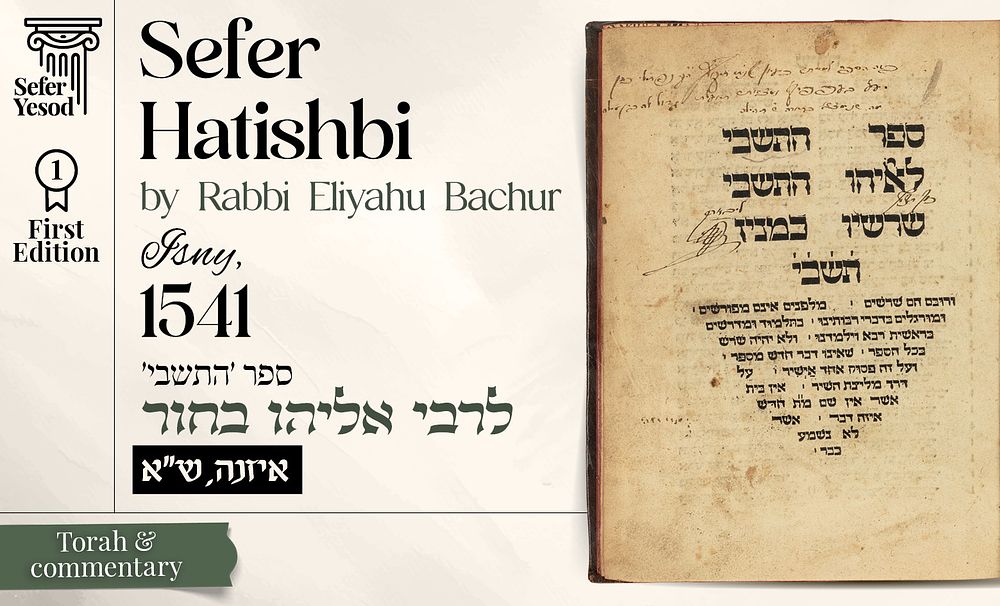
Sefer Yesod on Dikduk Sefer Hatishbi by Rabbi Eliyahu Bachur First Edition. Isny, 1541 * Sefer Hatishbi explains and translates the 712 rare words in Chazal that aren’t properly understood. The sefer was written by Rabbi Eliyahu Bachur Ashkenazi, one of the greatest grammarians and scholars of the Mesorah. Gedolei Hador greatly admired the Sefer Hatishbi, with the Rema referring to Rabbi Eliyahu Bachur as ”the great grammarian.” The Yaavetz wrote that Sefer Hatishbi is “the key for every Hebrew person, ” and the Vilna Gaon ”was inclined [to follow] Rabbi Eliyahu Bachur when it came to matters of grammar, ” (Tosefes Ma'aseh Rav page 14b). The Yaavetz and Rabbi Yeshaya Pick of Berlin wrote long glosses on this work. Details regarding the printing appear in the colophon on the final leaf: “And it was completed in the city of Isny, in the year five thousand three hundred and one since the Creation of the world [1541].” Printed on the same page are the letters פ and ב, an abbreviation for Paulus Bagius, the name of the printer. Featured beneath the colophon is the printer’s emblem, made from an unusual and striking illustration: a fruit tree, beneath which are frogs (!) and a stork feeding on the frogs… (see Diglei HaMadpisim HaIvriim, p. 128) Rabbi Eliyahu HaLevi Ashkenazi (1469-1549), also known as Rabbi Eliyahu Bachur, was one of the greatest grammarians and experts of the Mesorah. He compiled several sefarim on these subjects, but the most well-known is the Sefer Hatishbi, which was reprinted many times. Isny, 1541. First Edition. Page Count: [100] leaves. Size: 19.2 cm. Condition: Good, fine copy. A few stains. Bibliography: Stefansky, Sifrei Yesod, no. 519. The sefer is bound in a fine and delicate German leather binding from the late 18th century, together with an additional sefer: Shu”t HaRan by Rabbi Nissim of Gerona, one of the Rishonim. Metz 1778. Both sefarim bear the signature of Rabbi Leib Ahch, Av Beis Din of Hechingen, Germany, in the mid-18th century. On the front flyleaf is a foreign inscription from the Ahch family concerning the binding of the sefer. There are additional signatures of Rabbi Naftali Cohen of the community of Offenburg, Germany, and Rabbi “צביכונהרש”ץ [Tzvi known as Hersh, shliach tzibbur] and trustee here in Offenburg, ” dated 1746. ____________________ On the great value of studying Hebrew grammar, the Noda BiYehuda wrote in his eloquent style: “The discipline of grammar is of great necessity for prayer - to pray in a pure tongue; and also in the study of Scripture - to read correctly and to be careful with the proper pronunciation of מלעיל and מלרע (correct stress of a syllable).” He suggests setting aside regular time for young students to study books of grammar (in his approbation to Devek Tov, Prague 1786).