Bidspirit auction | “But I do not know
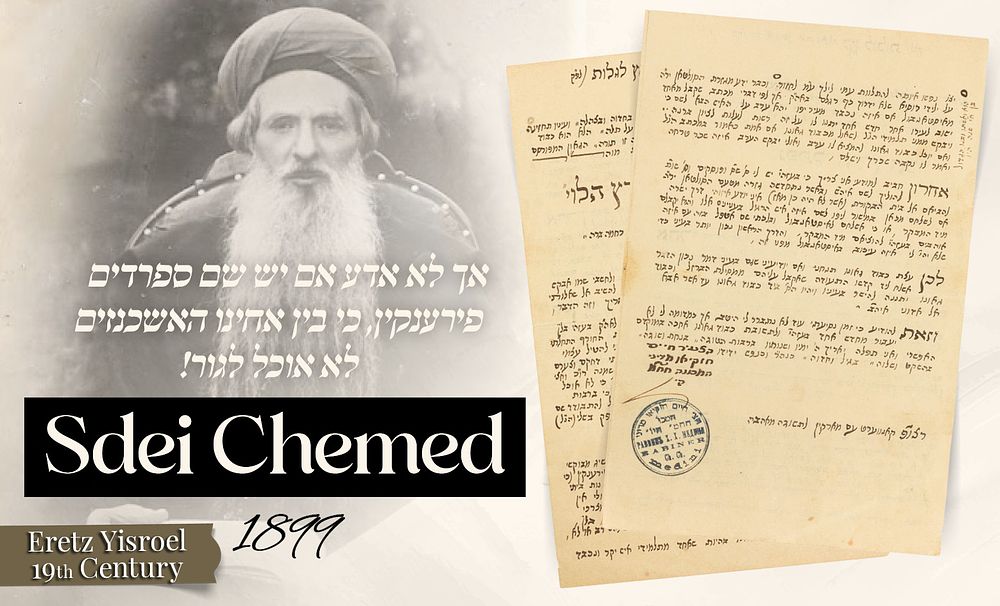
“But I do not know if there are Sephardic Frenkin there, for among our Ashkenazi brethren I cannot dwell!” Fascinating Historic letter from the Sdei Chemed. 1899 * This is a historic letter signed in the holy handwriting of the venerable and outstanding Gaon, Rabbi Chaim Chizkiyahu Medini, author of Sdei Chemed. Rabbi Medini was one of the greatest sages of Sephardic Jewry, “for whom the entire Torah lay spread out like the palm of his hand” [with perfect clarity and mastery]. In the present letter, the Sdei Chemed relates his desire to immigrate to the Land of Israel “and to seclude myself in solitude with my Creator” and not make a living from the public. Here he consults with the recipient of the letter - the Kabbalist Rabbi Naftali Hertz HaLevi, Av Beis Din of Jaffa – asking him whether the city of Jaffa would suit his nature. The Sdei Chemed writes: “And it seems to me that in the holy city of Jaffa, where there are few people, I can achieve this desire, but I do not know if there are Sephardic Frenkin there, ” (see below for an explanation of the term “Frenkin”) adding in parentheses, “for among our Ashkenazi brethren I cannot dwell because of the strangeness of their language.” The Sdei Chemed indeed immigrated to Eretz Yisrael barely two months after the writing of this letter, and soon after his arrival he visited Jaffa and was deeply impressed by the unity prevailing among the communities in the city. He almost settled in the city, but ultimately, he ended up settling in Jerusalem. Less than two years later he moved to Chevron, city of the patriarchs, where he passed away in 1905. Further in the letter, the Sdei Chemed consults with Rabbi Naftali Hertz HaLevi on other matters related to the journey, among them the transfer of his precious library to Eretz Yisrael. At the end of the letter, the Sdei Chemed signs in his own handwriting: “The young Chaim Chizkiyahu Medini, known as חח”מ, may he be protected.” This is a most fascinating historic letter, penned in the unique and direct style characteristic of the Sdei Chemed. Rabbi Chaim Chizkiyahu Medini (1833-1905) was one of the greatest Sephardic sages, authors and scholars of Torah literature. His magnum opus Sdei Chemed, which functions as a Talmudic encyclopedia, earned him international acclaim. The Sdei Chemed was so revered among both Sephardic and Ashkenazi Jews that, when it became known that he wished to leave Karasu-Bazar, the Polish community of Warsaw offered him the position of being the Rav of their community!! (HaMelitz, 1 Sivan 1899, p. 3) This letter was printed in the periodical Tzfunot, issue 6, pp. 61–62. Karasu-Bazar, Nissan 1899. The signature of the Sdei Chemed, at the end of two pages in a scribe’s hand in Rashi script (see below). Size: 13.5X20.3 cm. Condition: Good, minor tears at the margins. –––––––––––––– In the past, the term “Frenkin” was a neutral expression used by Ashkenazi Jews simply to describe Jews of Eastern descent, and the Eastern script was called by many Ashkenazim “Frenkish script.” Even the Sephardim themselves (such as the Sdei Chemed in the present letter), when writing to Ashkenazi Jews about Sephardic Jews, used the term “Frenk.” This term can be found in Ashkenazi rabbinic literature and various writings dating back to the 1740s, and it was used with great reverence, as befitting the illustrious Geonim and sages of Sephardic Jewry. –––––––––––––– The Sdei Chemed’s Relationship with Ashkenazi Rabbanim The Sdei Chemed was born in Jerusalem, learned as a youth in Constantinople, and subsequently served more than thirty-five years in the community of Karasu-Bazar, located in the Crimean Peninsula. While in Crimea, he became known to the Ashkenazi Rabbanim of Europe and was held by them in great and almost unparalleled esteem. He received from them many letters: questions in halacha, requests for semicha, requests for help, and more. The Sdei Chemed was almost unable to read or write in the Ashkenazi style of writing, and thus in his letters, he continually implored the Ashkenazim to send him letters written in Rashi script! He even had his own Ashkenazi scribe, Rabbi Asher Kaufman, who would write his letters in Rashi script for the Ashkenazim accustomed to such writing. (He might possibly be the scribe who wrote the present letter.)