Bidspirit auction | Significant! Manuscript of Customs and
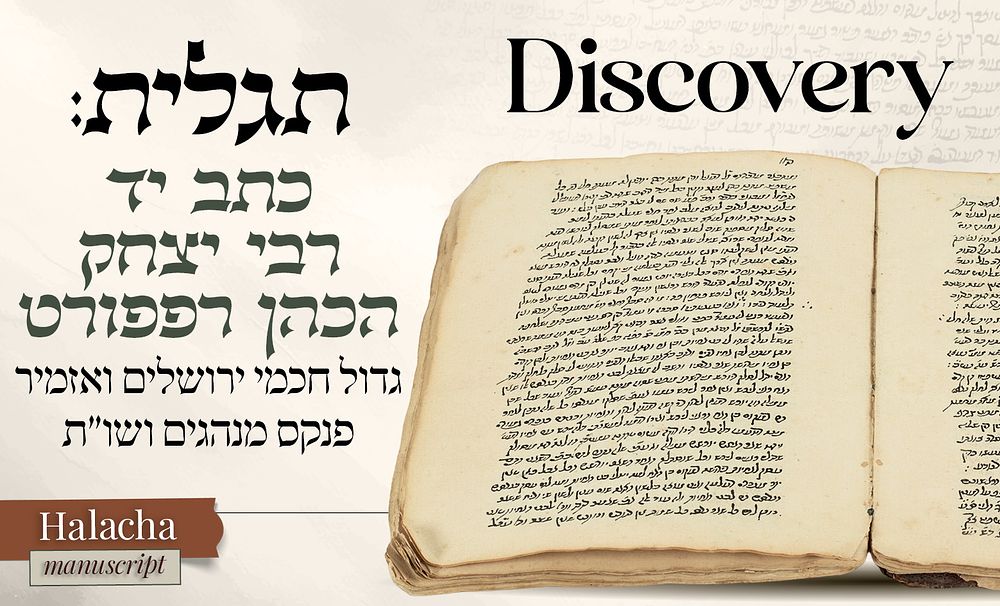
Significant! Manuscript of Customs and Teshuvos by Rabbi Yitzchak HaKohen Rappaport Circa 1730 and onwards * A manuscript of over 90 pages in the handwriting of the esteemed Rav, the Rishon LeTzion Rabbi Yitzchak HaKohen Rappaport, who served for many decades as Av Beis Din of Izmir and in his later years became the leading posek in Eretz Yisrael. The manuscript contains teshuvos on halachah and customs of the Izmir community, including matters of monetary law, marriage, and more. The Torah teachings of Rabbi Yitzchak HaKohen Rappaport received immense acclaim. Whenever the sages of the following generations cite his works or when his disciples quote what they heard ”from his holy mouth, ” there is hardly any praise that is not heaped upon him. Some of the teshuvos herein were printed by the Rav in his renowned sefer Batei Kehunah, both in Part I (Izmir 1736) and in Part II (Salonika 1754). In some cases, there are additions or variations from the printed versions! At a later point, the manuscript came into the hands of Rabbi Chaim Moda’i, who himself served for many years as Av Beis Din of Izmir. He wrote three glosses in his own handwriting on the manuscript, each beginning with “Chaim Medaber” (Chaim is speaking) or ”א”ח” [Amar Chaim] – (Chaim said). In one gloss, Rabbi Chaim Moda’i comments on the words of Rabbi Rappaport and concludes: “…And I was compelled to this because the words of the exalted Kohen, may he rest in peace, were not clearly explained.” We have seen handwritten glosses by Rabbi Chaim Modai on another book, in which he mentions the work Zikhronot Mahari”ch – Ktav Yad [“Our teacher, Rabbi Yitzchak HaKohen, manuscript”]—which, it appears, refers to the manuscript before us. Some of the Izmir customs appearing in this manuscript were printed by Rabbi Natan Amram in several places in his sefer Kinyan HaGuf, Part II (Livorno 1868). At the beginning of one excerpt, he writes: “Said the compiler… behold, I found this in the holy handwriting of a certain tzaddik, of blessed memory, who brought the customs of Izmir regarding the collection of the kesubah.” It is possible that there are several teshuvos and passages here that remain unpublished (a small portion has not yet been found in print). On the dating of the manuscript: The writing began around the year 1730 and continued thereafter. On leaf 37a there is a copied will dated 1730. On leaf 15b, he writes: “See in my sefer Batei Kehunah, siman 3,” and Part I of Batei Kehunah was printed in 1736. On leaf 53b, he adds a supplement to a teshuva that was printed in the sefer Zera Avraham (siman 9), which was printed in 1733. “Wonder of our generation, a pillar of light, a Gadol Hador, elder of justice, venerable sage” - these are but a few of the titles by which the Chida praises his revered teacher, Rabbi Yitzchak HaKohen Rappaport, the Batei Kehunah (1679–1755). He was born in Jerusalem to Rabbi Yehudah, who had immigrated to Eretz Yisrael from Lublin, Poland. His grandfather was Rabbi David HaKohen, author of Da’as Kedoshim, who also immigrated to Eretz Yisrael and served as dayan in the Beis Din of Rabbi Moshe Galanti. He was a primary disciple of the Pri Chadash and of Rabbi Avraham Yitzchaki, who loved him dearly “as a son and brother” (as noted in Shu”t Zera Avraham, Ch. 5). In 1714, he settled in Izmir and was appointed Av Beis Din and Rosh Yeshiva there for 35 years, responding to halachic queries from far and wide. In his later years, in 1749, he returned to Jerusalem and became its leading Rav. He was appointed Av Beis Din and Rishon LeTzion. He was the only Ashkenazi Rav to have held this prestigious position. He is especially renowned for his sefarim Batei Kehunah, in two volumes - “his esteemed and awe-inspiring work that lit up the world with its glory” (as the author of Pri HaAretz writes) - especially in the laws of Gittin, which he addressed extensively. It is rare to find a Sephardic posek who does not reference him in this area. Dozens of manuscripts exist containing copies of the sidrei gittin (divorce documents) he established. He had many disciples, the most prominent among them being the Chida, who mentions him in his sefarim with effusive praise, and who was the one to write the kesav harabanus (letter of appointment) for his appointment as Av Beis Din of Jerusalem. Rabbi Chaim Moda’i (c. 1720-1794) was a great Sephardic sage. Born in Tzfas, he journeyed across Europe as an emissary of the Tzfas Jewish community, eventually settling in Constantinople. When travelling through Prague, he met the Nodah B’Yehudah who praised him highly: “I was asked by the scholar and sage, our master Rabbi Chaim Moda’i… one of the sages of.... Constantinople, as he passed through on his sacred mission to support the holy community of Tzfas.” (Noda B’Yehudah, siman 88) He also maintained a close friendship with the Chida, with whom he corresponded frequently, as the Chida notes in his teshuvos (Chaim Sha’al, Part II,