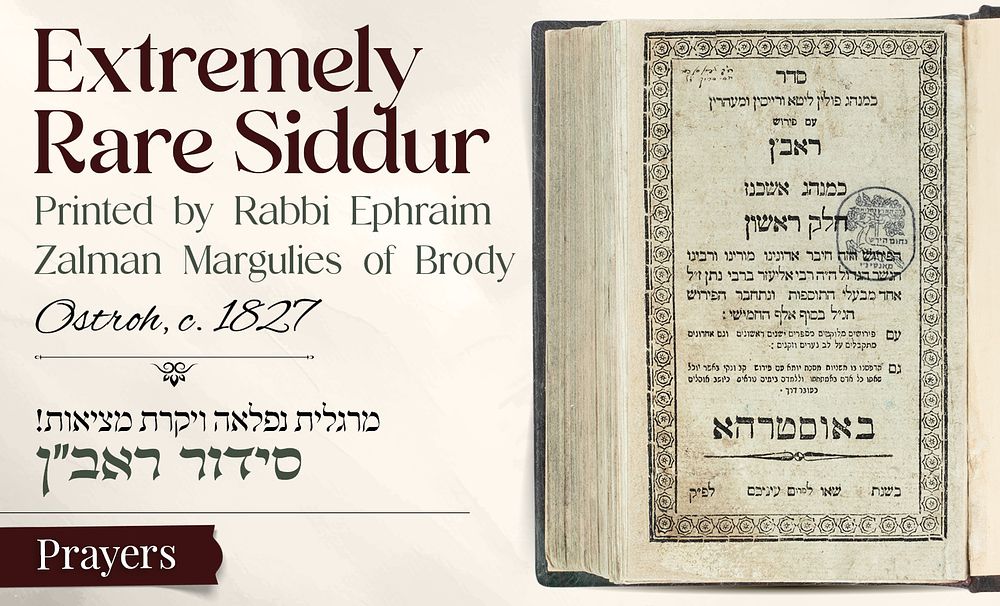
Bidspirit auction | Extremely Rare! Siddur HaRa’avan Printed
Extremely Rare! Siddur HaRa’avan Printed by Rabbi Ephraim Zalman Margulies of Brody Ostroh, c. 1827 * Siddur in two parts - for weekdays, Shabbos and festivals - according to the Ashkenazic rite, including commentary and elucidation. The commentaries of the Ra’avan - Rabbi Eliezer bar Nosson, one of the foremost Rishonim in Ashkenaz - are printed in it for the first time ever. A particularly important and exceedingly rare siddur, edited and brought to print by the renowned Torah luminary, Rabbi Ephraim Zalman Margulies of Brody! At the beginning of the siddur appears his approbation, where he writes: “Said Ephraim… it is from my hand that this siddur, with the commentary of the Ra’avan, has come to print.” Later, he requests that the siddur not be reprinted without his permission, in accordance with accepted practice. Rabbi Shemaria of Hrymailiv, a disciple of Rabbi Ephraim Zalman Margulies, also refers in his work Iyun Tefillah to the “siddur printed with the commentary of the Ra’avan, of blessed memory, which my teacher printed in Ostroh...” The Ra’avan is regarded as the first to expound upon the piyutim in Ashkenaz (see A. A. Urbach, Arugat HaBosem, p. 24). His commentary was intended both for the general public, to help them understand the prayers, and for scholars to “find the pearls” hidden within them. This commentary appears here for the first time, based on an early parchment manuscript dated to 5038 (1278 CE), which was in the possession of Rabbi Ephraim Zalman Margulies and, years later, passed into the library of Rabbi Yissachar Dov of Belz. Rabbi Ephraim Zalman refers to the manuscript several times in his writings and yearned to bring it to print. Indeed, in his later years he merited to do so, in the present siddur. Printed on leaves 11-18 is a booklet titled Beis Tefillah, awakening the heart to pray with kavanah, written by Rabbi Ephraim Zalman Margulies himself. In it, he records a wonderful chiddush that he heard firsthand in his younger years from the Me’or Einayim of Chernobyl! Throughout the siddur are commentaries, halachos, and collected teachings whose authorship remains unknown. It is reasonable to presume, however, that they too were compiled by Rabbi Ephraim Zalman Margulies, who alludes to them in his approbation: “One will also find delight in reading the compilations found here… and all the necessary halachos for the year… all are words of the living G-d.” (This is the assumption of bibliographic expert Yitzchak Yudlov; see attached material.) A particularly rare siddur! Only a handful of copies are known worldwide, all housed in prestigious libraries. Bibliographer Y. Yudlov wrote in Ali Sefer (vol. III, p. 131) that he knows of only four copies of the siddur! A few more have since surfaced, including a copy in the library of Rabbi Zalman Leib Farkash (New York). Ostroh, c. 1827. The date is estimated based on the calendar printed on leaf 154, which covers the years 1828–1831. Size: Small format, 15.8 cm. Page Count: Part I: [9], 11–32, [1] 33–36, 36–87, 92–95, 100–143, [2], 152–161, 164–165, 165–190 leaves. Part II: [1], 3–14, 13–70, [2], 23–30, [2], 81–88, [1], 89–97, 96–97, 129–154 leaves. Condition: Good. Minor repairs on some leaves, paper restoration at the margins of the title page. Typical signs of use, stains at the bottom of leaves. Some headers are trimmed. Magnificent new leather binding. See attached research material on the siddur. Ashkenazic and Sephardic Nusach According to the original plan, the siddur was going to appear in two separate editions: one following the Ashkenazic rite and the other according to the Sephardic rite. This is stated clearly on the two title pages printed in each edition and in the marks at the bottom of the booklets: “מ”א” for Ashkenaz and “מ”ס” for Sephardic. However, a fascinating discovery emerges from our investigation: despite the clear intent to differentiate between the rites, it appears that in practice, no such distinction was strictly observed in assembling the volumes. One can find in the same volume booklets with the Ashkenazic rite alongside the Sephardic rite! We examined nearly all known copies worldwide, and in every one, including the present copy, this same print pattern recurs: an interleaving of booklets from both versions. (Special thanks to Rabbi Zalman Leib Farkash for his generous assistance in this investigation.) Rabbi Ephraim Zalman Margulies (1761–1828) was one of the great Achronim and author of Beis Ephraim, Mateh Ephraim, Yad Ephraim, Sha’ar Ephraim, Rosh Ephraim and others. While he never accepted a rabbinic post, he was a leading posek and authored halachic teshuvos. The Chasam Sofer requested of Rabbi Margulies: “May you remember me in your prayers – Moshe ben Raizel”. In his eulogy, the Chasam Sofer proclaimed: “He was a giant of the world...... His teachings circulate, and every day his insights are heard in our Batei Midrash, from his many works.