Bidspirit auction | Chovos HaLevavos Bomberg Press. Venice,
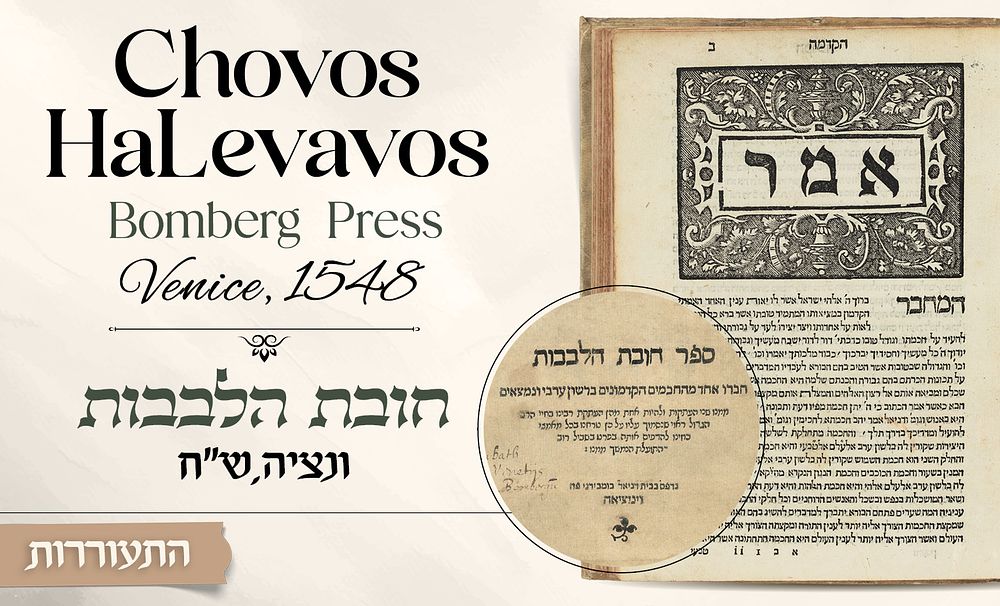
Chovos HaLevavos Bomberg Press. Venice, 1548 * A sefer yesod in mussar. Sefer Chovos HaLevavos by Rabbeinu Bachya ibn Pekuda (c.1050 - c. 1120) authored in Arabic and translated into Lashon Hakodesh by Rabbi Yehuda ibn Tabon. Chovos HaLevavos (Duties of the Heart) is the earliest and most fundamental work of Jewish ethics and philosophy, replete with principles in emunah, bitachon, mussar and Avodas Hashem. Throughout the ages, it has been praised effusively by Gedolim, many of whom made a point of learning from it every day. The Chasam Sofer, for instance, would read aloud a section from Chovos HaLevavos before beginning every shiur. It became customary to study this mussar sefer especially during the month of Elul. In his sefer Mo’ed Lechol Chai (Ch. 11, Sec. 13), Rabbi Chaim Palagi writes: “It is written in the sefer Ohr HaYashar [by the kabbalist Rabbi Meir Papirash] that one should read every day one section from the sefer Chovos HaLevavos, and at the very least, during the month of Elul, one should study Chovos HaLevavos from beginning to end.” The personal aide of the Admor Rabbi Yoel of Satmar attested that during the month of Elul, at mealtime, the Rebbe would learn from the Sha’ar HaTeshuvah in Chovos HaLevavos, while tears streamed from his eyes (Kovetz Ginas Vradim, Tishrei 2012, p. 72). The seventh chapter in Chovos HaLevavos is called Sha’ar HaTeshuvah, the Gate of Repentance, and it describes at length the essence and foundations of repentance. Also very well-known is the fourth chapter, Sha’ar HaBitachon, the Gate of Trust, which in recent years has been reprinted many times as a separate pamphlet. This is the second edition of the sefer. The first was printed in the incunabula period, Naples 1490, and is unattainable. To the best of Zaidy’s knowledge, a complete copy of the first edition has never appeared in public auctions. Venice, 1548. Daniel Bomberg Press. Page Count: 88 leaves. Size: 18.5 cm. The text on the title page is printed at the top. The lower section (the blank part) is missing and is supplemented with a paper fill. Condition: The title page and an additional leaf are darker than the other leaves of the sefer. Some stains. Good condition. Antique parchment binding. Bibliography: Stefansky, Sifrei Yesod, no. 458. ............................. “In these days of introspection, each person should establish boundaries for himself that will stand the test of time, for everything depends on boundaries. And the foremost of all boundaries is Torah study - especially setting aside a fixed time, even just an hour or half an hour daily, to learn sefarim of mussar, for this is a life-giving remedy.” (Ye’aros Devash, Drush for the month of Elul, Vol. II, Drush 1) ............................. The early sages extolled this holy and awe-inspiring work, saying that whoever studies it will behold Divine vision. It is explained in the sefer Maggid Meisharim (Parshas Behar) that an angel told the Beis Yosef to study daily a passage from Chovos HaLevavos to subdue and humble the Yetzer Hara, and the pious author of Reishis Chochma never parted from this sefer throughout his work. This is similarly found in Sefer HaYashar by Rabbeinu Tam, the Shlah, and others (from the introduction of the renowned commentary Marpeh L’Nefesh).