Bidspirit auction | Rabbeinu Yerucham Sefer Toldos Adam
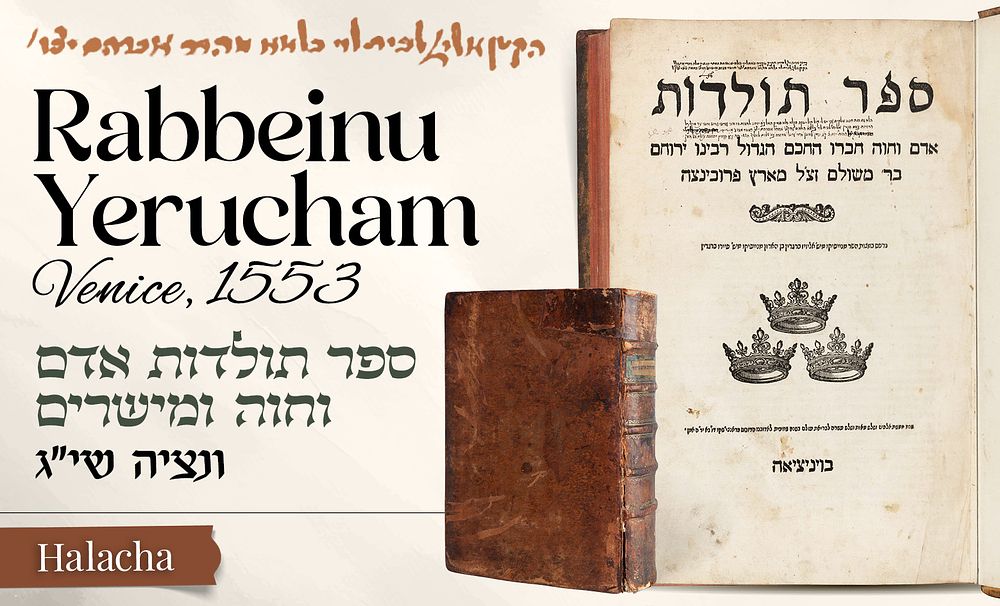
Rabbeinu Yerucham Sefer Toldos Adam V’Chavah Venice, 1553 * Halachic rulings and laws by Rabbeinu Yerucham ben Meshulam of Provence. Rabbeinu Yerucham was one of the great Rishonim, a disciple of the Rosh. His sefer Toldos Adam V’Chavah was accepted as one of the foundational works of halacha, and there is scarcely a leaf in the Beis Yosef where his words are not cited! The sefer is divided into three parts: ”Adam” – Laws pertaining to Orach Chaim and Yoreh Deah ”Chavah” – Laws relating to Even HaEzer ”Meisharim” – Laws of Choshen Mishpat The Chida writes in his sefer Shem HaGedolim about an extraordinary account passed down to him from the elders of Jerusalem — that this sefer is considered a hidden mystical work belonging to the hidden realm of “Alma DeIskasya” - (“World of Concealment”); see there. Likewise, the Maggid of the Beis Yosef refers to Rabbi Yerucham as ”Yerucham Tamiri”, meaning ”the concealed one” (see Maggid Meisharim, Parshas Vayakhel). The great significance of the sefer also lies in the fact that it serves as a primary source for properly understanding the words of the Rosh in their full context, as noted by Rabbi Chaim of Volozhin in his approbation to the Kapust edition, 1808. Venice, 1553. Second Edition. Page Count: 16, 13–238; 2–104 leaves. Separate title page for Meisharim. Size: Large format, thick volume. Condition: Stains, mostly in first and final leaves. Old leather binding (slightly loose at the spine). Reinforced with an attached leather strip. Provenance: Baranovich Sale (2008). Throughout the generations, Gedolei Yisrael yearned to study this sefer, which was exceedingly rare in their time. Rabbi Levi Yitzchak of Berditchev wrote that the sefer could not be obtained, “not even in a worn state.” Rabbi Chaim of Volozhin similarly attested, “There is not a single copy of this precious sefer to be found in the entire city” (in their approbations to the Kapust 1808 edition). Both title pages feature beautiful ownership signatures dated 1588 and 1589, from Rabbi Eliyahu HaLevi ben Avraham of the Ettingen family from Posen. He may be Rabbi Eliyahu HaLevi ben Avraham Ettingen, author of Bris HaLevi (Lublin 1645) and Minchas Yehudah (unpublished), son of the court official and royal advisor Rabbi Avraham Ries of Vienna, and grandson of Rabbi Eliyahu, Av Beis Din of Ettingen, patriarch of the Ettingen, Ettinga, and Ettinger families. He was a mechutan of Rabbi Meir Katzenellenbogen of Brisk and Tiktin, the eldest son of the legendary “king of Poland for one day, ” Rabbi Shaul Wahl (see Elef Margaliot, p. 176).