Bidspirit auction | Sefer Livyas Chen by the
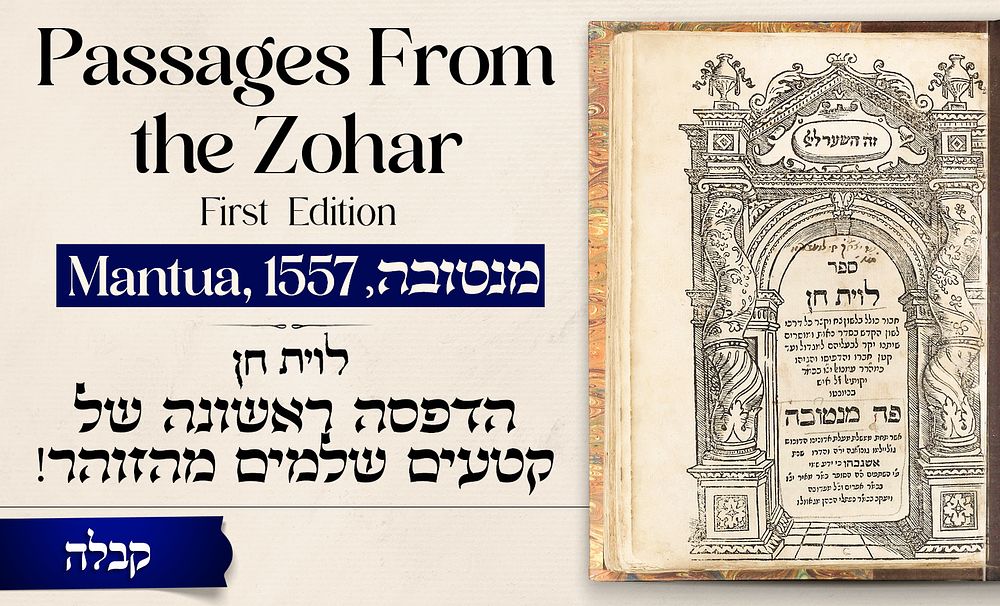
Sefer Livyas Chen by the Editor of the Zohar Containing Historic Accounts on the Printing of the Zohar Mantua, 1557 * Livyas Chen, a sefer on the rules of Hebrew grammar, by the sage Rabbi Immanuel Benveniste of Mantua, one of the leading figures supporting the printing of Kabbalistic works in Italy following the burning of the Talmud. In this remarkable work, the author provides the earliest known description in the world of the preparations for printing the Zohar , written about a year before the actual printing began (in 1558). The appearance of the printed Zohar brought about a revolutionary spiritual awakening throughout the Jewish world. Rabbi Immanuel himself had witnessed the heart-rending event of the burning of the Talmud in Ancona in 1554, and in the years following devoted himself to editing and preparing the most foundational Kabbalistic manuscripts for printing. Indeed, under his careful supervision, the Zohar, Tikkunei Zohar, and Ma’areches HaElokus were printed (all in Mantua, between 1558–1560). Background: The printing of the Zohar began in 1558. In 1557, news spread of the preparations for its printing (under Rabbi Immanuel Didan’s editorship), sparking a halachic controversy about whether the sacred text should be printed. Several teshuvos were written both permitting and opposing the printing; the most famous of the rulings permitting the printing was the 'Psak Rabbi Yitzchak Latish, ' printed at the beginning of the Mantua Zohar. At the beginning of the present sefer, Rabbi Immanuel instructs his son to engage in the study of Kabbalah and mentions the Zohar in the precise version he personally corrected from seven different manuscripts! It was according to this very version that the Zohar was later printed (leaf 3a). In the following four pages, he elaborates on his opinion of the ongoing debate over the printing. This was at a time when the Zohar had not yet been printed! “And a foolish speaker has written in his journal which he sent to the mighty shepherds of the King of kings, that the Zohar is not worthy of existing, and he blasphemed the hosts of the living G-d who engage in this wisdom, ” he writes sharply, going on to refute that opponent and cite the rulings of several sages who permitted the printing, including his teacher Rabbi Moshe Basula and Rabbi Yitzchak de Latish. At both the beginning and end of the sefer, Rabbi Immanuel printed several passages from the Zohar, among them the prayer Brich Shmei, whose source is in the Zohar. This is likely only the second time in history that this prayer was printed. Despite its immense historical value for understanding the Zohar printing controversy, most early scholars overlooked this work. The first to discuss it in this context was Yeshaya Tishby in his 1967 study, “The Controversy over the Printing of the Zohar” (Perakim, I, pp. 133–148). Description: A significant grammatical work frequently cited by later grammarians. The Chida writes of it: “Grammarians have praised him.” Mantua, 1557. First edition. Page Count: [8], 108 leaves. Condition: Good; a few stains. Repair and tear to one leaf. Fine new binding. - - - - - - - - - - - - - - A complete and rare copy, including the two opening leaves with the author’s lament over the burning of the Talmud in Ancona in 1554, which he himself witnessed and describes in moving words: “I am the man who saw affliction at the burning of my Talmud; I tore my garment and wept in bitterness of soul…” The burning of the Talmud was one of the primary causes and catalysts for the printing of Kabbalistic works, most of which had not been published until that time. The poem begins: “A heap of all my troubles, my sorrows and sighs…” These two leaves are lacking in most copies. See: Avraham Yaari, “The Burning of the Talmud in Italy, ” in his sefer Mechkarei Sefer (Jerusalem, 1958), pp. 219, 221–223. - - - - - - - - - - - - - - - Signatures on the title page and following leaf: ”שלי ע”ה יצחק חי לומברוזו ס”ט” (likely a descendant of Rabbi Yitzchak Lombroso, Av Beis Din of Tunis and progenitor of the Lombroso family line); “HaTza’ir Shlomo Yosef Parchi s’t”; and a dedication inscription to the beis medrash of the philanthropist Shemaya Engel.