Bidspirit auction | Sefer Yesod in Kabbalah Segulah
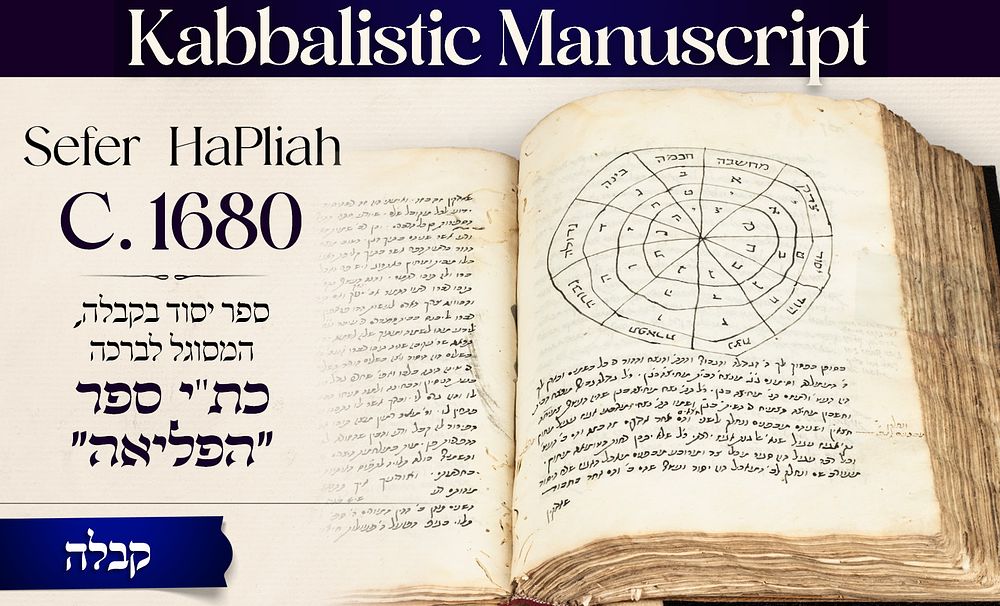
Sefer Yesod in Kabbalah Segulah Sefer Manuscript of Sefer HaPliah, with Variant Texts! Circa 17th/18th Century * A Sephardic manuscript of 434 pages, in which a significant portion of Sefer HaPliah has been copied. Sefer HaPliah is sometimes also called 'Sefer HaKaneh' and it was “revealed by Eliyahu HaNavi to a holy man” (as stated on the title page of the Koritz edition, 1784). This early composition is one of the most important sefarim in Kabbalah, containing “wondrous secrets and awesome Kabbalistic practices” (the Chidah quoting Seder HaDoros), with holy names and Kabbalistic illustrations, based entirely upon Parshas Bereishis! Owing to its great holiness, it is held that the very possession of Sefer HaPliah brings great segulos. Rabbi Aharon Halberstam of Sanz, son of the Divrei Chaim, writes, ”We have a tradition that this sefer is a segulah to bring blessing into one's home.” Rabbi Uri of Sambor writes, “Even though I do not understand anything from this holy sefer, it is worthwhile to acquire Sefer HaPliah just to see the holy letters from this sefer...” (in the approbations to the Przemysl edition, 1884). Sefer HaKaneh was first printed in Koritz, 1784; the present manuscript was written before the printing, and its version at times differs from the printed one! Additionally, throughout the sefer, over 50 textual annotations and hundreds of short corrections appear in the margins, in a different handwriting, most taken from comparison to another manuscript (which in part resembles the printed version). On the margin of leaf 75/b, the annotator notes: ”In other sefarim I found here an illustration… and I wrote the illustration above, as there was an empty space.” This illustration is not found in the Koritz edition, so the additions were also written based on a different manuscript. The nature of the textual changes in the manuscript and its annotations has not been studied in detail. In several places it appears that the annotations are the product of the writer himself and it is evident he studied the sefer with great care and diligence. (See, for example, p. 52/2: “It seems that up until here are the disciple’s words; from here onward, he resumes with a question on his teacher’s reasoning.”) The author’s identity is still uncertain. In early times, some attributed it to Kaneh, father of the tanna Rabbi Nechunya, but already the author of Seder HaDoros notes that sages from later generations are mentioned in the sefer (see also Chidah in Shem HaGedolim), which rules out the author from being in the times of the Tannaim. The Rema of Pano attributes it to Rabbi Avigdor Kara of Prague. 17th/18th century. Sephardic script, with many annotations (it appears most are from a single writer). The manuscript contains [217] leaves, comprising roughly half of Sefer HaPliah (reaching up to leaf 56, column a, in the Koritz, 1784 edition, printed in large format). The manuscript begins on leaf Aleph in its original numbering, but lacks the introduction printed in Koritz. Size: 20.2 cm. Condition: Medium to medium-good, many holes in the margins of the leaves, stains. New binding with parchment spine. - - - - - - - - - - The Riddle of Sefer HaPliah Sefer HaPliah is regarded to this day as an enigma in the eyes of scholars, in many respects: the identity of its author, the period and region of its composition, the determination of its precise text, and more. The researcher Y. Ta-Shma writes that the sefer is ”one of the most difficult literary riddles in the field of Hebrew anonymity.” Some kabbalists (such as the Ramak) opposed the sefer strongly, and some attribute this to the variant texts in different copies, in parts containing (or omitting) sections that might be understood as controversial. Rabbi Menachem Mendel Kasher devoted much effort to clarifying the matter of this sefer, and he writes in his sefer Torah Sheleimah (Bereishis, p. 52): ”Would that someone get to the root of the matter, from among the many manuscripts of HaPliah found in various libraries, so that we might produce a correct judgment regarding this precious sefer, unparalleled in its content and style throughout the entire literature of Torah.” In the present manuscript there are, as noted, many textual variations from the printed edition, as well as marginal notes taken from another manuscript copy of the sefer, and therefore it is of great importance for establishing the accurate text.