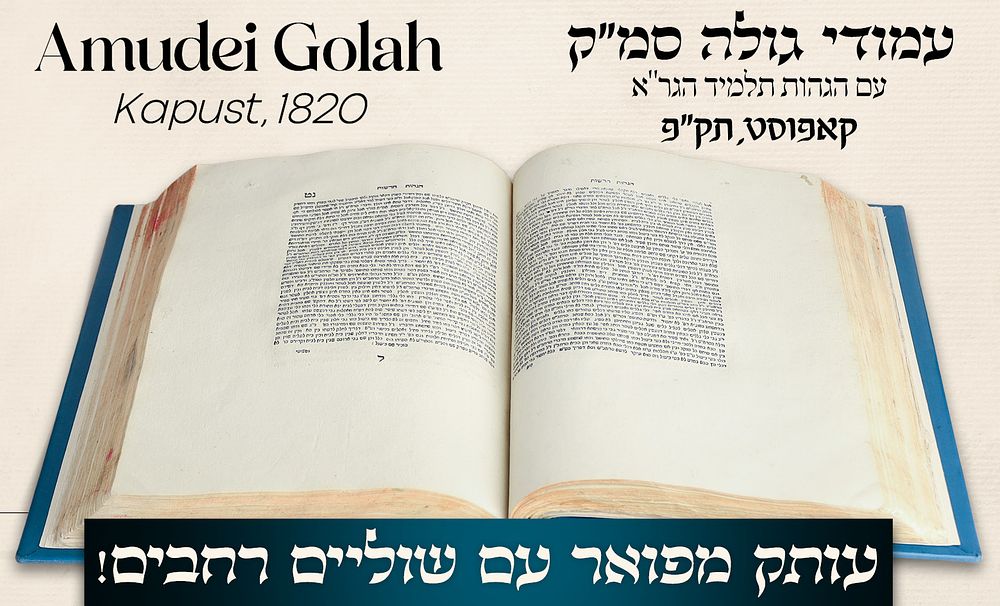
Bidspirit auction | Amudei Golah by the Smak
Amudei Golah by the Smak Magnificent Copy with Wide Margins! Kapust, 1820 * Halachic rulings written according to the mitzvos of the Torah, written in a brief and concise manner by Rabbeinu Yitzchak of Corbeil, one of the Baalei Tosfos. Amudei Golah is regarded as one of the most authoritative and widely-learned sefarim of halachah, already accepted during the era of the Rishonim as a sefer yesod. The Tashbetz wrote in his teshuvos (Vol. 1, Siman 51): “The words of this sefer are pure and precise, and worthy of being relied upon.” In this edition, ”new glosses” by the Gaon Rabbi Yehoshua Tzeitlin were printed here for the first time. Rabbi Yehoshua was a disciple of the Sha’agas Aryeh and was counted among the close circle of the Vilna Gaon. In addition to his vast scholarship, he was an eminent and influential philanthropist, and was publicly known by the title ”the minister from Ushitz.” He passed away in 1822. A distinguished copy with exceptionally wide margins. The margins are so spacious that in the upper corners of each leaf, the unique ‘holes’ that aided the printing process have been preserved, testifying that this very copy comes exactly as it left the press and was never trimmed by a binder! There are old testimonies indicating that during printing, the sheets were attached to the press by nails that pierced the leaves, so they would not shift during printing. (We have seen similar holes in several sefarim from the printing presses of Slavita, Zhitomir, and Vilna.) Not all copies of sefarim were originally distributed with wide margins. Even those that were — in the majority, the wide margins were trimmed by binders as the years passed, so that owners shouldn’t have to pay for a large cover, and they saw no value in preserving the margins. These unique punctures have survived in only a very limited number of books worldwide, throughout the entire history of Hebrew printing! Kapust, 1820. First edition of the ”new glosses.” Page Count: [4], 2-6, 93, 51, 40, 39-58 leaves. Condition: Repaired holes in the first and last leaves, a tear in the upper corner of the title page with slight loss of a few words on the verso. Stains. Fine new leather binding. Antique signature on the title page: ”HaKatan Yeshaya.” Bibliography: Stefansky Sifrei Yesod no. 215 in the notes. - - - - - - - - The sefer was printed by the tzaddik Rabbi Tzvi Hirsch Horowitz, son of Rabbi Aryeh Leibush, Av Beis Din of Stanislav (the first), a grandson of Rabbi Itzikl, Av Beis Din of Altona-Hamburg-Wandsbek. Rabbi Tzvi Hirsch was the son-in-law of the daughter of Rabbi Yehoshua Tzeitlin, author of the glosses. His son was Rabbi Elazar Moshe Horowitz, Av Beis Din of Pinsk. - - - - - - - - The author, Rabbi Yitzchak of Corbeil , was one of the greatest of the Baalei Tosfos at the close of the fifth millennium and the dawn of the sixth. He was the son-in-law of Rabbi Yechiel of Paris and the brother-in-law of the Mordechai. He composed this sefer so that Jews in the Diaspora would know the sources of the mitzvos and their halachos, and wrote letters requesting that the sefer be copied in as many copies as possible and disseminated throughout Jewish communities. The sefer was written around 1247, following a series of calamitous events that befell French Jewry, beginning with the confiscation of Jewish books in 1240, the public debate between the Jews of France and Christian representatives (in which the author took part), and the burning of the Talmud and all sifrei kodesh in 1242 and 1244 (see S.Schwartzfuchs, Yehudei Tzarfat B’Yemei Habeinayim pp. 211-218). Due to the terrible dearth of sifrei halachah that followed these tragic events, Rabbi Yitzchak wrote this sefer and divided it into seven amudim (pillars) in order to motivate Jews throughout the Diaspora to study one ‘pillar’ every day of the week; hence the name of his sefer Amudei Golah.