Bidspirit auction | The Vilna Gaon’s Commentary on
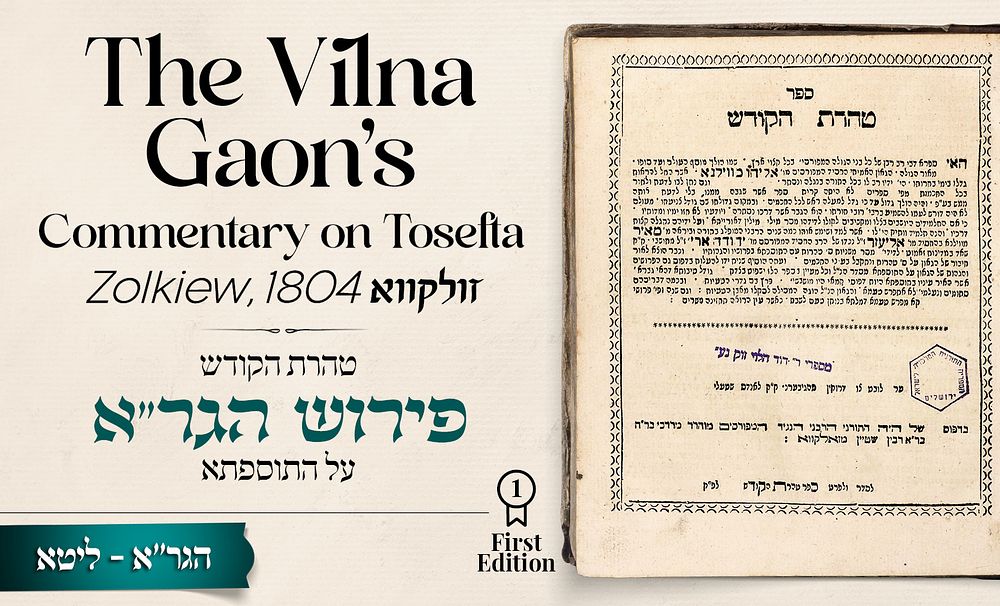
The Vilna Gaon’s Commentary on Tosefta, Seder Taharos Zolkiew, 1804. First Edition. * ”Let the pure come and engage in matters of purity.” Sefer Taharas HaKodesh, containing the text of the Tosefta to Seder Taharos, carefully edited according to the Vilna Gaon, together with his commentary on the Tosefta, known by the name Zer Zahav. The sefer was printed by the Vilna Gaon’s disciple, Rabbi Meir of Vilna, who had studied Seder Taharos together with his rebbi, the Vilna Gaon. After completing each Mishnah, they would learn the corresponding Tosefta. Two years earlier, Rabbi Meir printed the commentary he heard from the Vilna Gaon on the Mishnayos (Brno 1802), and here he published the commentary he heard on the Tosefta. The sefer was published only six years after the passing of the Vilna Gaon. At the beginning are approbations from leading Gedolei Hador, including Rabbi Mordechai Banet, Av Beis Din of Nikolsburg, Rabbi Yaakov Ornstein of Lvov, and others. Zolkiew, 1804. First edition. Page Count: [2], 72 leaves. Condition: Good. Bibliography: Otzar Sifrei HaGra, no. 281. - - - - - - - - - - - The Controversy Surrounding the Sefer As is known, many sought to publish works under the name of the Vilna Gaon. To preserve the authenticity of his teachings, the Beis Din, soon after his passing, issued a ban forbidding the publication of any of the Gaon’s writings without its express approval In the sefer Yonah with the Vilna Gaon’s commentary (Vilna, 1800), the author’s sons wrote on the verso of the title page a protest against an unnamed individual who intended to publish the Vilna Gaon’s commentary on Taharos, claiming that it was uncorrected and had not been approved by the beis din. Their reference was clearly to Rabbi Meir of Vilna, who was deeply involved in studying Seder Taharos. Rabbi Dovid Kamenetzky zt”l, in his sefer Toras HaGra, suggests that the manuscript was indeed faulty at first. However, there is a tradition that the sefer Eliahu Rabbah (Rabbi Meir’s first publication) was edited by Rabbi Yaakov Kahana, who had been a disciple of the Vilna Gaon for twenty-one years. It seems that, for this reason, the Vilna Gaon’s sons eventually withdrew their complaint against Rabbi Meir (see Toras HaGra, Jerusalem, 2018, pp. 384–385).