Bidspirit auction | A Segulah for Parnasa The
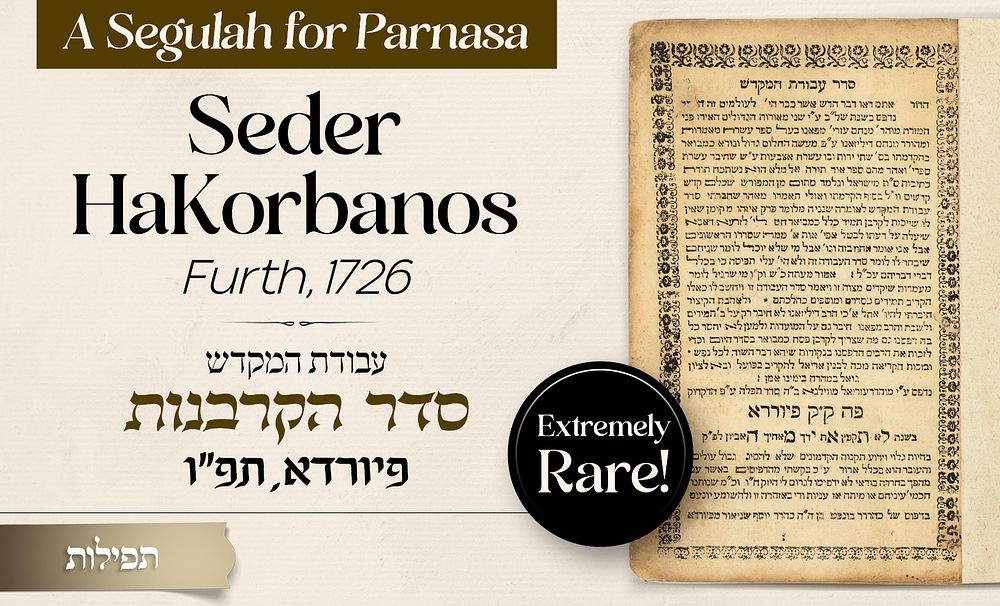
A Segulah for Parnasa The Prayers for Korbanot by the Rema of Pano Furth, 1726 * The order of the tefillah of the korbanos for weekdays and Shabbos, arranged by the saintly kabbalist Rabbi Menachem di Lonzano, together with the order of the korbanos for the festivals of the year and for the offering of the Korban Pesach, arranged by the renowned kabbalist Rabbi Menachem Azariah of Pano. An exceedingly rare booklet printed by the grammarian Rabbi Azriel of Vilna, famed for his popular Ashkenazic siddur (Frankfurt 1704), which became the foundational siddur for all subsequent Ashkenazic siddurim. Rabbi Menahem de Lonzano arranged the composition in a manner resembling the Seder of the Kohen Gadol’s avodah on Yom Kippur. While preparing the work in the year 5332 (1572), he experienced three dreams in which he felt a Heavenly affirmation of his undertaking (as he relates in the introduction to the first edition, Constantinople, 1575). The Seder HaKorbanos was embraced throughout the Jewish world and many recite it daily. The author of Pardes printed it in his siddur (Koenigsberg 1764), and it was included in numerous subsequent siddurim. The Yaabetz also printed a version in his siddur as a complement to this seder ha’avodah. The Chida extolled this seder, writing: “How good and pleasant are those who study each day the order of the Avodah arranged by Maharam di Lonzano, z”l” (Kikar LaEden §228). The Pele Yoetz quotes the Chida's praise in his sefer Oros Elim (§495) and again in his sefer Chesed La’alafim (§48:4): “This is the proper path for one who wishes to serve Hashem with complete devotion — to come early to shul and recite this Seder HaAvodah quietly to himself.” This unique edition differs from all previous editions and was never reprinted. It contains only the korbanos themselves, for ease of uninterrupted prayer (without commentary or piyutim), and the korbanos were printed in a different order, arranged according to the order of the festivals. An exceptionally rare sefer. To the best of Zaidy's knowledge, it has never before been offered at public auctions. According to the international catalog WorldCat, it is listed in only two libraries: one at the National Library of Israel in Jerusalem, and one at the British Library in London. As stated on the title page, this edition was printed by Rabbi Azriel of Vilna, who, together with his son Rabbi Eliyahu, prepared a most precise Ashkenazic siddur known as “Siddur Rabbi Azriel and Rabbi Eliyahu of Vilna.” So popular was this siddur that the Gedolei Hador instructed that school teachers and their pupils use only this version for study and prayer — an unprecedented phenomenon. From its second edition onward, the siddur became known as 'Derech Siach Hasadeh, ' and many aspects of its order and vocalization remain in use to this day. At the beginning and end of the sefer, Rabbi Azriel printed instructions in Yiddish, as well as Torah insights in Hebrew. Among them, he mentions a textual error he discovered in printed Chumashim, which he showed to Rabbi Yechezkel Katzenellenbogen, Av Beis Din of Altona-Hamburg-Wandsbek, as well as a chiddush he shared with Rabbi Moshe Chagiz in Hamburg, both of whom concurred with his conclusions. Furth, 1726. Singular edition of the seder in this form. Page Count: [14] leaves. Size: 17.5 cm. Condition: Good to fair; holes and stains, tear on one leaf. Soft cardboard binding (not original). Bibliography: See the introduction to Derech Chaim, Ahavas Shalom edition (Jerusalem, 2012), pp. 40–46.