Bidspirit auction | Sefer Yesod Shu”t Shaar Ephraim,
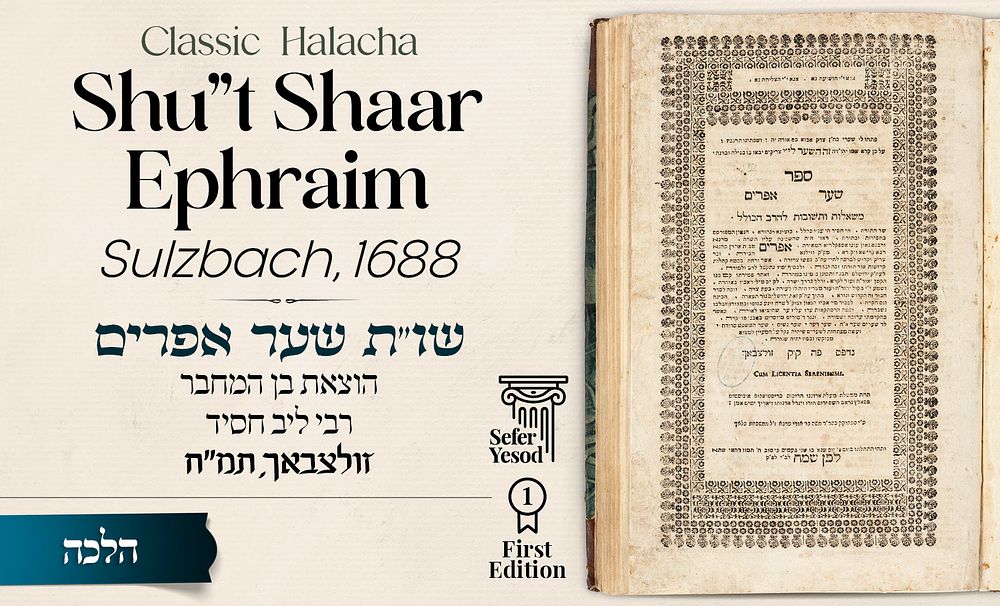
Sefer Yesod Shu”t Shaar Ephraim, First Edition Sulzbach, 1688 * Published by the Author’s Son, Rabbi Leib HaKohen Katz One hundred and seventy questions and answers by Rabbi Ephraim HaKohen of Vilna, among the leading poskim of his generation, close friend of the Shach, and grandfather of the Chacham Tzvi. Rabbi Ephraim, who “illuminated the eyes of all Yisrael with his rulings and judgments” (as stated in the approbations), was widely sought after for halachic decisions, and his sefer came to be regarded as one of the foremost halachic works of his era. The sefer was printed by his son, “the chassid among the kohanim” (in the words of the Chida), the Gaon Rabbi Aryeh Yehudah Leib HaKohen, who wrote an important and interesting introduction, added extensive glosses to the main body, and composed a Kuntres Acharon at the end of the sefer — all of which are quoted in later poskim, including the Shvus Yaakov. Rabbi Leib traveled to Jerusalem in 1686 and dedicated an entire year almost exclusively to preparing the sefer for print. On his journey he obtained rare and distinguished approbations from the rabbanim of Jerusalem, Chevron and Tzfas, Rabbi Moshe Zacuto of Mantua, and the rabbanim of Prague. In another lot of this catalog appear rare autograph glosses by Rabbi Leib HaChassid himself; in one of them he defends his father’s position in Shaar Ephraim, the very sefer before us. On leaf 47a, a small note has been affixed, containing five handwritten lines by an unidentified gaon. The author, Rabbi Ephraim HaKohen of Vilna (c. 1616–1678), was one of the disciples of the Chelkas Mechokek, and dayan in Vilna alongside his friend the Shach, Rabbi Aharon Shmuel Kaidanover (Birkas HaZevach), and the Beis Hillel. In 1655 he fled the Chmielnicki massacres to Moravia, serving there in several communities (Mezritch Gadol, Prague, and others), and ultimately settled in the city of Óbuda (Buda) in Hungary, where he passed away. Among his noted descendants are his son, the chassid Rabbi Leib mentioned above, his grandson the Chacham Tzvi, and his great-grandson the Yaabetz, from whom emerged a distinguished lineage of Torah luminaries. The author’s son, Rabbi Leib HaKohen Katz (after 1648 – before 1732) was the youngest son of the renowned posek Rabbi Ephraim HaKohen of Vilna, and studied Torah under him with his nephew, Rabbi Tzvi Ashkenazi, the Chacham Tzvi (who was a grandson of Rabbi Ephraim). He immigrated to Jerusalem in 1686, where he studied under Rabbi Moshe Galanti (HaMagen), and became one of the leading figures of the Ashkenazic community there. He was the one who proposed appointing Rabbi Dovid Oppenheim of Nikolsburg and Prague as “Nasi of Eretz Yisrael.” He also signed the Jerusalem cherem against remnants of the Sabbateans, together with his father-in-law, the chief rabbi of Jerusalem, Rabbi Avraham Yitzchaki. Sulzbach, 1688. First and rare edition. Page Count: 114 leaves. Size: 31.3 cm. Condition: Generally good; minor repair at margins of the first four leaves. Antique binding, slightly defective. On the title page appears the signature of Rabbi Yaakov Koppel Schaningen, dayan of the district of Würzburg, alongside Rabbi Avraham Bing, who passed away in 1816. Bibliography: Stefansky, Sifrei Yesod, no. 302.