Bidspirit auction | Handwritten Glosses by Rabbi Leib
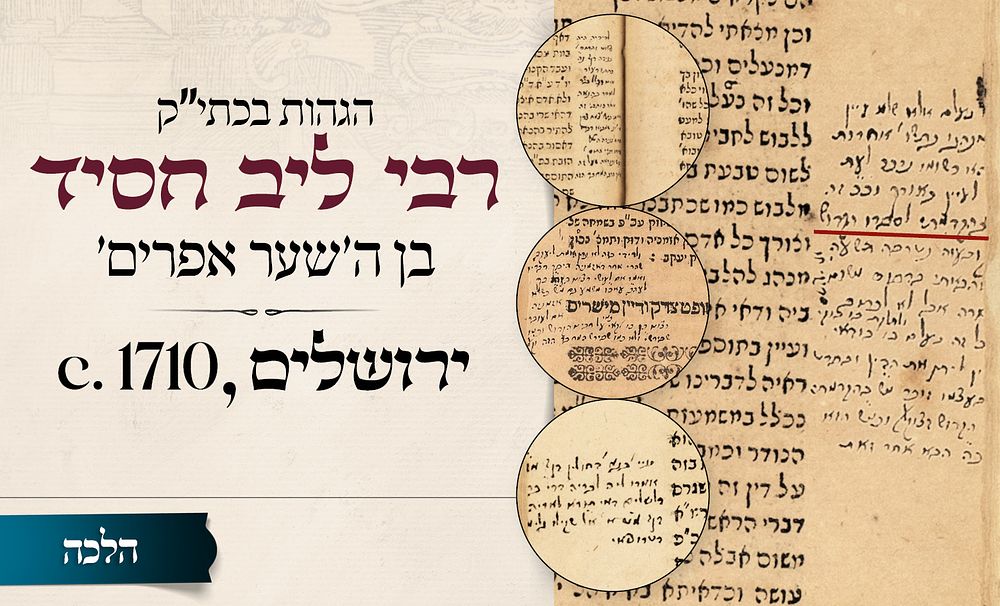
Handwritten Glosses by Rabbi Leib HaKohen Katz of Yerushalayim, Son of the Sha'ar Ephraim, on Shu”t Shevus Yaakov * Sefer Yesod: Shu”t Shevus Yaakov, vol. I, by the brilliant gaon Rabbi Yaakov Reischer, author of Shevus Yaakov, Chok Yaakov and other works. Among the most important and renowned foundational sefarim published in that generation, and from then until today it is frequently cited in the halachic works of the poskim. The sefer was gifted by the author Rabbi Yaakov Reischer to “the chassid among the kohanim” (as termed by the Chida) — Rabbi Aryeh Yehuda Leib HaKohen Katz, son of Rabbi Ephraim HaKohen of Vilna, author of Sha'ar Ephraim. He was also the printer of his father's sefer, to which he added his own foundational glosses, also cited in the halachic literature (his glosses are likewise mentioned in the present Shu”t Shevus Yaakov; see, for example, at the end of siman 25). He was the uncle and close associate of the Chacham Tzvi, grandson of the Sha'ar Ephraim, and together they absorbed Torah and wisdom through study under the Sha'ar Ephraim himself, as Rabbi Leib attests in his introduction. The Yaabetz, who was the great-grandson of the Sha'ar Ephraim, also mentions Rabbi Leib in Megillas Sefer, referring to him as ”the distinguished rav, our teacher Rabbi Yehuda Leib, of blessed memory…” In 1686, Rabbi Leib immigrated to Yerushalayim and remained there for a year, occupied with preparing Sha'ar Ephraim for print. He later returned to Europe and, in 1688, printed the Sha'ar Ephraim in Sulzbach. While in Eretz Yisrael, he adopted a Sephardic style of writing in addition to his Ashkenazic script — something most unusual among Ashkenazic sages (similar to the renowned kabbalist Rabbi Meir Papirash, and a select few others). On the title page, Rabbi Leib wrote an inscription in Sephardic script: “A gift of mishloach manos, as a remembrance from the author, may he be blessed with long life, here in Prague, Adar [5]473 (1713)..”. In the margins of the leaves, Rabbi Leib wrote six glosses in his handwriting, in Ashkenazic script, and a seventh gloss, half in Sephardic and the rest in Ashkenazic style! In the gloss on leaf 9b, Rabbi Leib refers to the introduction he himself wrote to Sha'ar Ephraim — “in my introduction to his holy sefer” — where he explains the method and style of Sha'ar Ephraim. Through this clarification, the comment of the Shevus Yaakov on that same leaf concerning his father, the Sha'ar Ephraim, is thereby resolved. In another gloss, on leaf 10b, Rabbi Leib cites what was written by the son-in-law of the Chacham Tzvi, Rabbi Aryeh Leib, Av Beis Din of Amsterdam (brother-in-law of the Yaabetz), at the end of Shu”t HaRema, which Rabbi Aryeh Leib himself printed in Amsterdam in 1711. It is interesting to note that in the very Shu”t Shevus Yaakov before us, in siman 22, there is a question sent by Rabbi Leib to the author, together with the author's response to him. The author likewise cites several times in his sefarim chiddushim that he heard from Rabbi Leib — see, for example, Chok Yaakov, §461:19. The eminent gaon and chassid Rabbi Leib HaKohen Katz (after 1648–before 1732) was the youngest son of the renowned posek Rabbi Ephraim HaKohen of Vilna. He studied under his illustrious father with his nephew, Rabbi Tzvi Ashkenazi — the Chacham Tzvi — grandson of Rabbi Ephraim. In 1686, he immigrated to Jerusalem, where he studied Torah under the saintly Rabbi Moshe Galanti (the Rav HaMagen). He became one of the leaders of the Ashkenazic community in Jerusalem and was the one who proposed appointing Rabbi David Oppenheim of Nikolsburg and Prague as 'Nasi Eretz Yisrael.' Rabbi Moshe Zacuto wrote of him in his approbation to Sha’ar Ephraim: “The strength of the son [Rabbi Leib] surpasses that of the father in wisdom twofold, for his father’s excellence rests upon him in double measure.” In 1688, Rabbi Leib printed his father’s famous sefer Sha'ar Ephraim, to which he added an extensive and interesting introduction, as well as numerous glosses that are cited by the poskim. He was a signatory to the Jerusalem cherem issued against remnants of the Sabbateans, together with his mechutan, Rabbi Avraham Yitzchaki, the chief Rabbi of Jerusalem. The Chida praises him greatly and notes in his entry: “And I have seen his handwritten glosses.” On the title page and several other leaves appear the signatures of the Rishon LeTzion, Rabbi Mordechai Yosef ben Rabbi Machlouf Meyuchas (1738–1805), author of Brachos HaMayim, son of the Pri HaAdamah, son-in-law of the Maharit Algazi, and close associate of the Chida. Most of the glosses are trimmed at the margins. They were published in the journal Moriah, journals no. 161–164, at the end of the new edition of Sha'ar Ephraim (Ashdod 2010), and in the Shevus Yaakov edition of Zichron Aharon (Jerusalem 2022). Description of the Sefer: Shu”t Shevus Yaakov, Part I, Halle 1709. First edition.