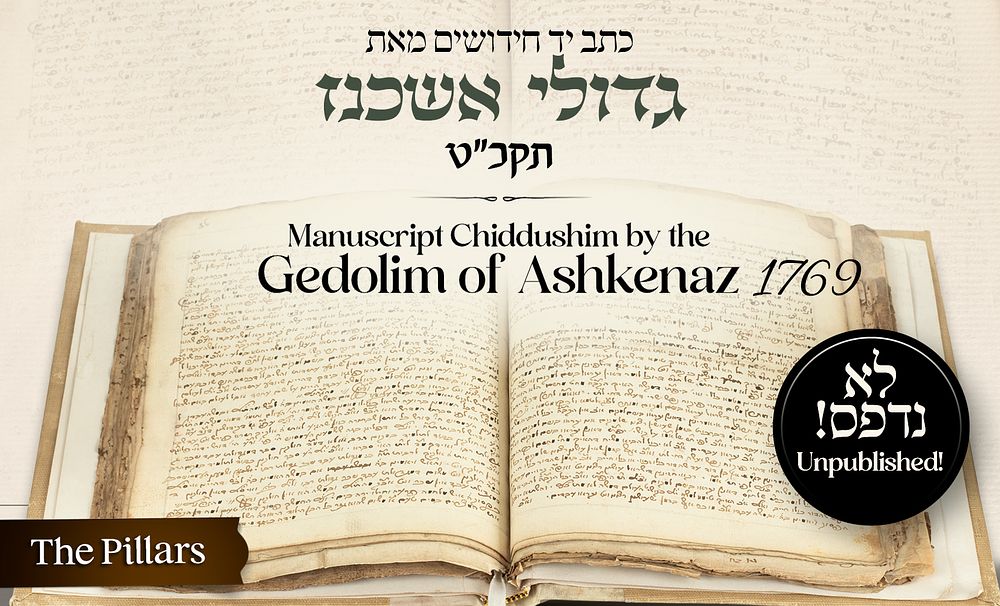
Bidspirit auction | Unpublished Manuscript from the Geonim
Unpublished Manuscript from the Geonim of Frankfurt and Altona-Hamburg-Wandsbek * A manuscript of 96 pages in the handwriting of disciples of the great Torah giants of Ashkenaz, containing chiddushim and drashos on the Chamisha Chumshei Torah, arranged according to the order of the parshiyos. Recorded at the beginning of each section is the name of its author, eminent rabbanim and roshei yeshivah of Frankfurt, the united communities of Altona-Hamburg-Wandsbek, and the surrounding regions: Rabbi Yitzchak Halevi Horowitz, Av Beis Din of Altona-Hamburg-Wandsbek, known as Rabbi Itzikel Hamburger Rabbi Avraham of Lissa, Av Beis Din of Frankfurt, known as Rabbi Avish Frankfurter Rabbi Taebly Shayar, may he live long Rabbi Zalman Chassid [Mirlesh], may he live long, of Frankfurt Rabbi Dovid Dishbak of Fuerth The renowned Gaon Mahari (it has not been ascertained whether this refers to Rabbi Yehonoson Eibeschutz, Rabbi Itzikel Hamburger, or another great Rav) Maharich — perhaps Rabbi Yaakov Popperash Katz, author of Shev Yaakov Rabbi A.B. — likely Rabbi Avraham Broda Rabbi Baruch Kahana Rappaport Maharam Brand-Segal, Av Beis Din of Mainz Rabbi Shmuel Halberstadt Rabbi Gavriel, Av Beis Din of Nikolsburg Rabbi Dovid Strauss, Av Beis Din of Fuerth (a rare remnant of his Torah) and others. The manuscript before us, in its present form, has never been published. A sample examination of the contents indicates that the majority of it has never been published, and even the chiddushim that have appeared in print (primarily the chiddushim of Rabbi Itzikel Hamburger, printed in the sefer Matamei Yitzchak) were generally printed with slight differences in wording. The majority of the manuscript was written by a single scribe, a disciple of Rabbi Taebly Shayar, Rosh Yeshivah of Mainz. One leaf was written by a disciple of Rabbi Itzikel Hamburger, and several additional leaves were written by various other scribes. It was written in the late 1760s — Rabbi Avish Frankfurter passed away in 1769, and he is frequently mentioned in the manuscript with the blessing “may he live long” (נר”ו), but once with the blessing for those who have passed away, “of blessed memory” (זצ”ל). Thus, the manuscript was written close to that year. “Kuntresim” on the Torah such as the present one would circulate from hand to hand among the select disciples of the yeshivos of Ashkenaz and, for the most part, became worn and fragmented. Therefore, almost no manuscripts of this nature have been printed in their original form. Consequently, this manuscript is a remnant both of the Torah of the great sages mentioned herein and of the atmosphere of the yeshivos of Ashkenaz some 250 years ago. Germany, c. 1769–1770. Page Count: [51] leaves, comprising [96] written pages. Primarily one handwriting, with several leaves in other handwriting. Kuntresim of varying sizes (several sections incomplete). Condition: Overall good, several leaves in fair-to-good condition with minor tears at the margins. Preserved binding with a vellum spine. At the end of the manuscript are three pages titled “Reshus LeDrashah” — a prepared introductory text seeking permission from the community leaders prior to delivering a drashah, indicating that this manuscript may have served a darshan for his drashos.