Bidspirit auction | Fifty Handwritten Glosses of the
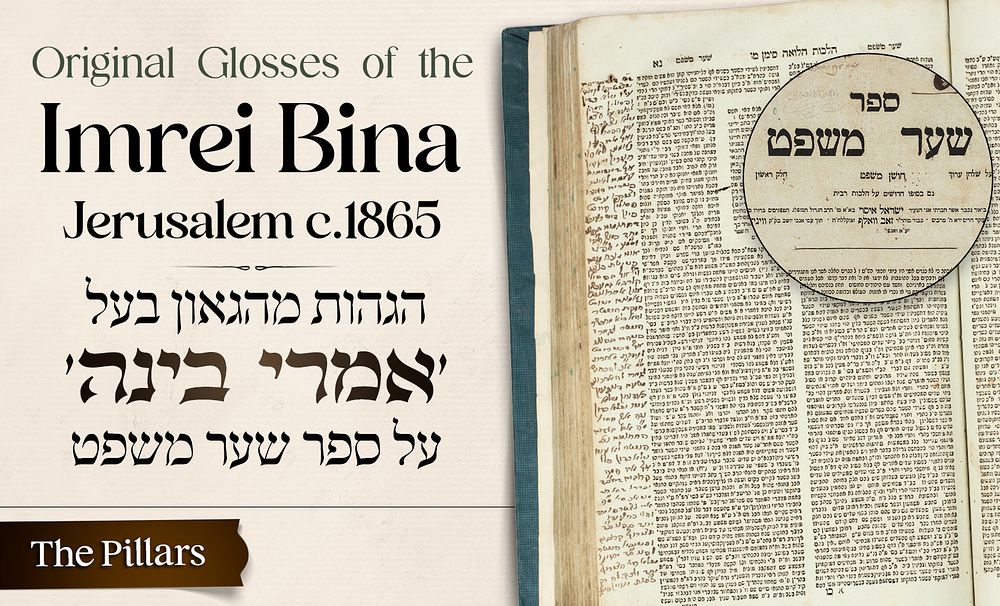
Fifty Handwritten Glosses of the Imrei Bina on the Sefer Sha’ar Mishpat * Sefer Yesod. Sha’ar Mishpat on Shulchan Aruch Choshen Mishpat by Rabbi Yisrael Isser, Av Beis Din of Venice, with dozens of glosses in the holy handwriting of Rabbi Meir Auerbach, Av Beis Din of Kalish and Ra’avad of the Ashkenazi community in Yerushalayim. On the title page of the sefer appears his autographed inscription: עליא עבר ותתאי גבר, מתת אלוקים היא לי מאיר אויערבאך. Throughout the margins of the sefer are approximately fifty annotations, most of them lengthy, in his own handwriting. The sefer Sha’ar Mishpat was regularly on the desk of the Imrei Bina, who toiled extensively in it while writing his own sefer Imrei Bina–Choshen Mishpat, mentioning it over one hundred times in his work! One can even find parallels between these glosses and his words in Imrei Bina — see, for example, the glosses on leaf 4a and Imrei Bina siman 9; leaf 41b and Imrei Bina siman 22, se’if katan 1; chelek beis leaf 53b and Imrei Bina, Kuntres HaKinyanim siman 22; leaf 56a and Imrei Bina ibid. siman 18. Also included are several glosses in the handwriting of his grandson, the gaon and kabbalist Rabbi Menachem Nosson Auerbach, author of Orach Ne’eman, usually signed: Menachem. In addition, there are several glosses in the handwriting of Rabbi Yoel Kluft, who also recorded on the inner binding notes regarding the identification of the glosses. Rabbi Meir Auerbach, author of Imrei Bina (1815–1878) , received his Torah from his father, Rabbi Yitzchak Auerbach, author of Divrei Chaim, and from his grandfather, author of Divrei Mishpat. He served as Rav of Kalish, and was known for the rest of his life in Yerushalayim as “the Rav from Kalish.” In 1855 he immigrated to Yerushalayim and was immediately accepted by the great rabbanim of the city as Rav and head of the Ashkenazi community. The Beis Din, which until then had been in the Churvah of R’ Yehuda HaChassid, was moved to “the courtyard of the Rav of Kalish.” The Maggid of Yerushalayim, Rabbi Yadler, in his book BeTuv Yerushalayim, writes that he was “one of the giants who stood on guard in Yerushalayim to ensure that all conducted themselves according to Torah and tradition.” He further wrote there that in Yerushalayim it was seen clearly by him the fulfillment of the saying, “A tzaddik decrees and Hakadosh Boruch Hu, fulfills [the decree].” The well-known prohibition, still in force today, not to play in Yerushalayim multiple musical instruments at weddings, was instituted by the Imrei Bina. See Shu”t Salmas Chaim by Rabbi Yosef Chaim Sonnenfeld, siman 101, where it is written: “And one who disregarded it and belittled it was severely punished.” Mohilev, 1810–1812. First edition. Vol. I: [2], 146, [14] leaves. Vol. II: 76 leaves. Size: 37 cm. Condition: Bluish paper, lacking lower half of the first title page. Holes in margins of leaves, mainly in vol. II. Stefansky, Sifrei Yesod, no. 201. ____________________________________ “To use my pen in telling his praises, his greatness in Torah and in righteousness, in order to recognize him and exalt his name in Yisrael, would surely be superfluous; for who has not heard his name? Was he not called Meir, and he indeed enlightened the eyes of the sages in halacha, and his sefarim, Imrei Bina, as their name so they are — filled with insight and wisdom.” (From the approbation of Rabbi Eliyahu Chaim Meisel to the second edition of Imrei Bina)