Bidspirit auction | Vayakhel Moshe by the Kabbalist
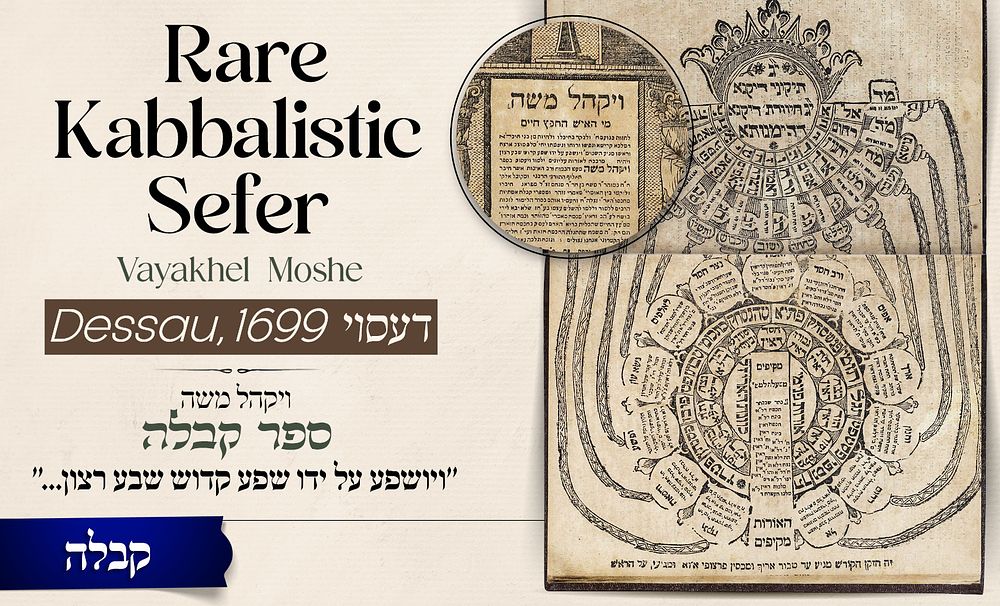
Vayakhel Moshe by the Kabbalist Rabbi Moshe Graff Dessau, 1699 * Sefer Vayakhel Moshe, written to awaken the hearts of men to study the wisdom of Kabbalah according to the teachings of the Arizal, by the kabbalist Rabbi Moshe ben Menachem Graff. The work includes Ma’amar Adam d’Atzilus by an unknown kabbalist, together with the commentary Masveh d’Moshe by Rabbi Moshe himself. Within Ma’amar Adam d’Atzilus appears a large kabbalistic diagram, spanning two pages, depicting the ‘Dikna d’Meheimnusa’ which is the mystical representation of the Thirteen Attributes of Divine Mercy through which compassion flows to all worlds. The author, Rabbi Moshe of Prague, was one of the great kabbalists of Ashkenaz, and his name became renowned throughout the world due to the “awesome event” of expelling a ‘dibbuk.’ A spirit, a dibbuk, entered the body of a young boy from Poland, tormenting him with madness and anguish. He wandered restlessly from place to place until he reached Nikolsburg. At that time, Rabbi Moshe had arrived in Nikolsburg seeking the approbation of the Gaon Rabbi Dovid Oppenheim for his sefer Vayakhel Moshe. Rabbi Dovid requested of him that, with the power of his Kabbalistic knowledge, he attempt to save the boy through hashbaos (incantations) and segulos. Rabbi Moshe gathered several kabbalists, and together they conducted awe-inspiring ceremonies over several days. They brought forth seven sifrei Torah and seven shofaros, in the presence of thousands of Jews and non-Jews alike. After the participants undertook to fast and to recite Kaddish for the elevation of the dibbuk’s soul, the spirit was appeased and left the boy’s body through his foot, piercing a hole in the synagogue windowpane where this extraordinary event took place. The story caused a tremendous sensation. It was printed during Rabbi Moshe’s lifetime at the end of his small sefer Zera Kodesh Matzavtah (Fuerth, 1696), signed for authentication by the rabbanim of Nikolsburg who had witnessed the event, foremost among them Rabbi Dovid Oppenheim, Av Beis Din of the city. The Chida also recounts the story in his entry on Rabbi Moshe in Shem HaGedolim. It was later reprinted numerous times under the title “Ma’aseh Nora” (“Awesome Account”). Rabbi Moshe also authored the sefer Chakal Tapuchin. He was known for his view that in this world the halacha follows Beis Hillel, whereas in the future era it will follow Beis Shammai. At the beginning of the sefer are approbations from many of the Gedolei Hador, including Rabbi Dovid Oppenheim himself, who knew Rabbi Moshe well, hosted him in his home for several years after Rabbi Moshe and his family fled Prague to Nikolsburg, and assisted him in publishing his writings. Dessau, 1699. First edition. Page Count: 14; 58 leaves. Condition: Good; well-preserved old binding.