Bidspirit auction | Manuscript Collection of Songs, Piyutim
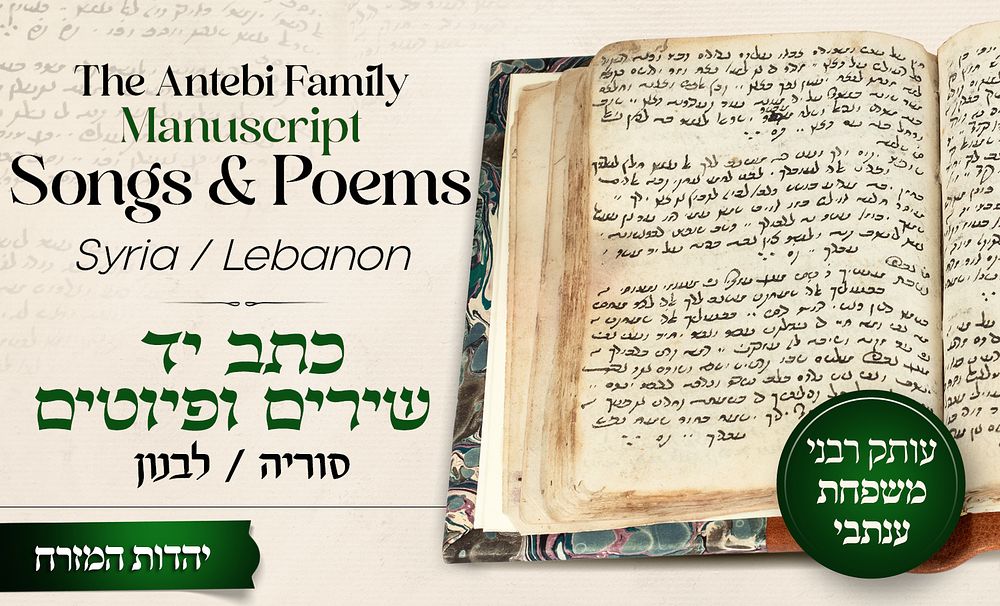
Manuscript Collection of Songs, Piyutim and Poems Copy of the Rabbinic Antebi Family Syria / Lebanon, late 19th–early 20th century * A pocket-sized manuscript containing approximately 140 written pages, with around two hundred songs, piyutim of faith, longing, prayer and supplication, authored by dozens of famed poets across generations, many of them sages from Syria or Lebanon. Each piyut records the name of its author, often encoded in an acrostic, usually his first name. Some authors are mentioned with their full names: Rabbi Yosef Romano, Rabbi Chaim Romano, Rabbi Yaakov Mishan, and Rabbi Aharon Cohen Tarab, as well as Rabbi Raphael Antebi from Tzfas and Sidon (see below). The Jewish communities of Syria and Lebanon produced extraordinary poets, whose piyutim were sung by congregations on Shabbos and festivals. They were men of learning and spirit, gifted with a rich and expressive language that beautifully conveyed the prayers and hopes of our nation. In their words, one can feel the heartfelt emotion that flows between the letters. Manuscript Description Part of the present manuscript was likely written in the vicinity of Syria in the 19th century. At a certain point, the manuscript came into the hands of Rabbi Yosef David Antebi from Tzfas and Lebanon, son of the poet Rabbi Yehuda Shabtai Raphael Antebi, (with an inscription indicating his ownership) and to Rabbi Yosef David’s son, Rabbi Raphael Antebi, author of Re’eh Anyi and Ger Anochi, whose signature appears several times. In this manuscript, Rabbi Raphael added in his own handwriting several piyutim he himself composed, likely never published, as well as some biographical notes about himself: “I composed a piyut at a time when I was alone without a companion, while my brother’s household was still in Beirut…” Elsewhere, he writes: “I composed the piyut while I was living in the city of Koubros…” — here, Rabbi Raphael alludes to the period of World War I, when he was exiled from Tzfas to the city of Koubros in Lebanon, near Beirut. At the end of the manuscript appears a composition, She’eris Yosef, about the Jewish calendar, molados, and various calculations. It contains 21 pages. Afterward there is a page listing the Torah portions of the year, and in which maqam (rich musical scale) the piyutim should be sung: Husseini, Rast, Ajam, and others. It is likely that some of the piyutim here have never been published! The poet and darshan Rabbi Raphael Antebi was born in Tzfas and was the son of Rabbi Yosef David Antebi of Tzfas and grandson of the sage and emissary Rabbi Yehuda Shabtai Raphael Antebi (known as Hayasha”r Antebi), himself a renowned poet famous for his song in honor of Rabbi Shimon bar Yochai. In 1915 he was exiled to Lebanon and settled there — first residing in Koubros, then in Beirut, and from there to Sidon. Several of his handwritten works are preserved in the New York Library: Ger Anochi, Re’eh Anyi, as well as a sefer of drashos. Syria / Lebanon, late 19th–early 20th century Page Count: Approx. [140] pages in manuscript, with one primary handwriting and some poems in other handwriting, some in pencil. Pocket size: 11.5 cm. Condition: Good to fair. Signs of use, some tears. New binding. - - - - - - - - - - - - - - - List of the first names of the authors of the piyutim whose piyutim appear here: The Rabbanim: Moshe, Avraham, Yosef, Yisrael, Mordechai, Shlomo, Yehuda, Yaakov, Yeshaya, Yitzchak, Ezra, Aharon, David, Eliyahu, Shmuel, Yedidya, Chaim, Yisrael bar Moshe, Eliyahu Chaim, Shimshon, Yom Tov, Nissim, Yosef, Elazar, Yosef David, Tzalich, and Meir.