Bidspirit auction | Manuscript Siddur HaAri Handwritten by
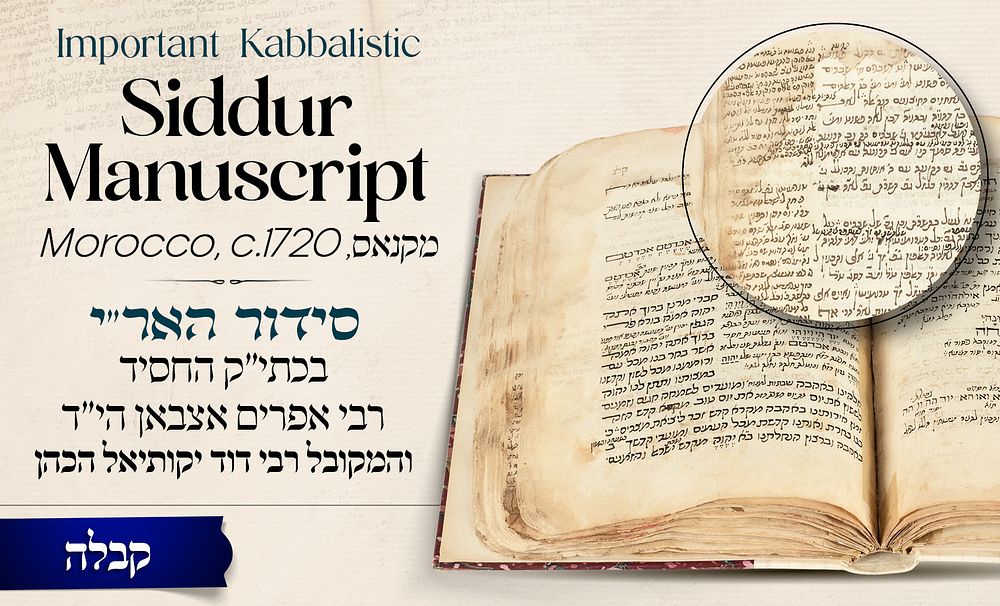
Manuscript Siddur HaAri Handwritten by Rabbi Ephraim Atsban of Meknes with Glosses in the Handwriting of Jerusalem Kabbalist Rabbi David Yekutiel HaKohen! Meknes, before 1728 * An important kabbalistic manuscript comprising around 250 pages, containing part of the Siddur HaAri with kabbalistic intentions in line with Moroccan customs. It includes prayers for Shabbos and festivals, as well as the Pesach Haggadah, and is adorned with kabbalistic illustrations. The body of the siddur was written by the kabbalist Rabbi Ephraim Atsban, one of the sages of Meknes, foremost disciple of the Rav HaMashbir Rabbi Moshe Berdugo, and a friend of the Yaavetz, Rabbi Yaakov Ibn Tzur. On leaf 166b, Rabbi Ephraim wrote a poetic colophon signed in his own hand (partially erased): “To the scribe, grant repose, His pains have multiplied like locusts; Blessed is He who gives strength to the weary, And to the powerless — abundant might. The young Ephraim Atsban.” Rabbi Ephraim Atsban was martyred al Kiddush Hashem in the year 1728, murdered by Arab rioters during a coup attempt that took place following the death of the King of Morocco at that time. As recorded in Mekitz Ben Chai (Constantinople, 1757, fol. 38a): “One of the scholars of the yeshiva [in Meknes], the righteous and pious sage, our teacher Rabbi Ephraim Atsban, of blessed memory, who was killed in that uprising, due to our sins.” ~ ~ ~ ~ ~ ~ ~ ~ ~ The siddur was subsequently owned and used for decades by the holy kabbalist Rabbi Dovid Yekutiel HaKohen, a leading sage and Kabbalist in Jerusalem nearly 300 years ago, who gave an approbation to the Ohr HaChaim HaKadosh on his sefer Rishon LeTzion. Rabbi Dovid Yekutiel added dozens of handwritten glosses in the margins, many of which are signed and introduce intriguing novel kabbalistic rulings such as permitting trimming the beard with scissors, allowing haircuts during the Sefiras Ha'omer, and the shape of marriage rings according to Kabbalah (see attached article). These glosses have never been published. In one gloss, he references his own work Yad Kaheh, consisting of notes on Tikkunei Zohar: “And in my glosses on the Tikkunim, called Yad Kaheh…” (112b). This work survives in manuscript but remains currently unpublished. In another gloss, he mentions a halachic ruling instituted in Jerusalem in 1750 by his cousin, Rabbi Yitzchak HaKohen, Av Beis Din of Jerusalem and author of Batei Kehunah; both were grandsons of Rabbi David HaKohen, author of Da’as Kedoshim (112b). The siddur most likely accompanied Rabbi Dovid Yekutiel HaKohen from the late 1720s, when he was in Morocco as an emissary, then journeyed with him through Egypt and back to Eretz Yisrael. Two glosses reference his missions to Morocco in 1724 and 1729, while two others mention his travels in Egypt, including one dated ”נא אמון ש'[נת] תצ”ב” (year 1732). Another gloss (mentioned above) notes a custom in Jerusalem in the year 1750. A unique and immensely valuable manuscript — truly a rare treasure! Meknes, c. 1727. The body of the siddur is in the handwriting and with the signature of Rabbi Ephraim Atsban, while more than fifty glosses, some lengthy, and at least seven of them signed, were written in the margins by Rabbi Dovid Yekutiel HaKohen. One full page is entirely in his handwriting. (A few other glosses appear to be by different writers.) Page Count: [128] leaves. Original page count: [71]–73, [1], 74–97, 99–104, 106–148, 148–[198]. Leaves missing at the beginning, end, and two in the middle (such siddurim are rarely found complete). Size: 20 cm. Condition: Extensive signs of use by the owner. About 8 leaves have tears with loss of text (some significant). With repairs and stains. Attractive new binding with parchment spine. Written based on the detailed assessment of Rabbi Moshe Hillel of the esteemed Ahavat Shalom Institute — many thanks to him. ~ ~ ~ ~ ~ ~ ~ ~ ~ The owner of the siddur, Jerusalem Kabbalist Rabbi Dovid Yekutiel HaKohen, was one of the great sages of Jerusalem in the generation preceding the Chida. He was a son of Rabbi Yaakov HaKohen, Av Beis Din of Tzfas, and grandson of Rabbi David HaKohen, author of Da’as Kedoshim. He was a cousin of Rabbi Yitzchak HaKohen Rappaport, author of Batei Kehunah (whom he refers to in one gloss as “my cousin”), and brother-in-law of Rabbi Yehudah Diwan. He signed numerous Jerusalem enactments alongside his cousin the Batei Kehunah, Rabbi Gedaliah Chayun, and others. He granted approbations to sefarim authored by his contemporaries, including: the holy Ohr HaChaim (Rishon LeTzion), Rabbi Yisrael Yaakov Algazi, Rabbi Yehudah Diwan (brother-in-law of Rabbi Dovid Yekutiel HaKohen), Rabbi David Chazan, Rabbi Raphael Moshe Bula, and others. He travelled as an emissary to North Africa in 1719 and in the following years visited Fez, Marrakesh, Algiers, and Alexandria in Egypt.