Bidspirit auction | Rare Polemic of the Sabbatean
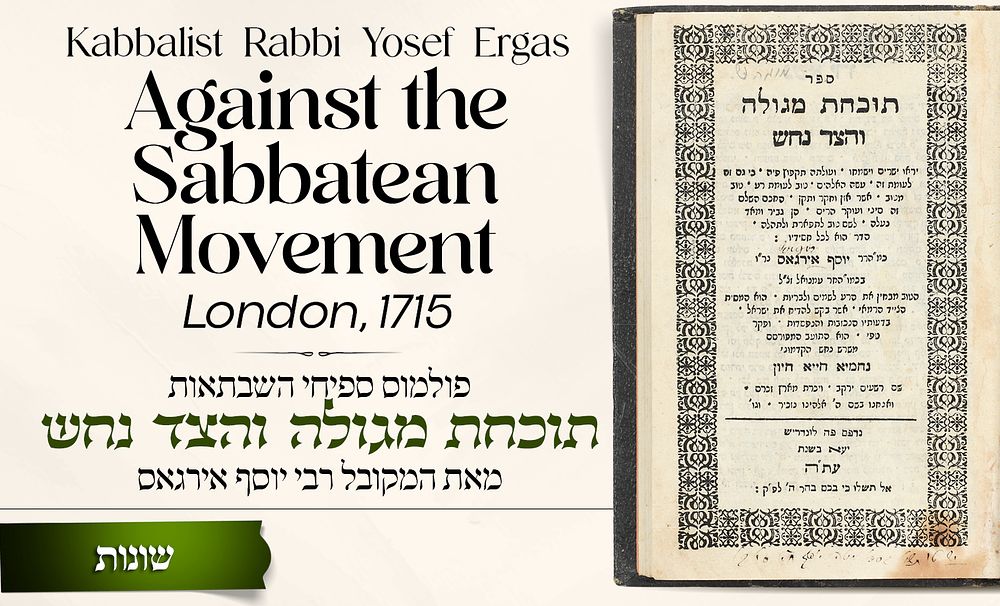
Rare Polemic of the Sabbatean Aftermath: Tochachas Megulah ve-Hatzad Nachash by the Kabbalist Rabbi Yosef Ergas Only Edition. London, 1715 * Tochachas Megulah ve-Hatzad Nachash is a sefer written in fierce opposition to “the infamous heretic” Nechemiah Chiya Chayun, one of the last figures of Sabbatean influence. It was authored by the holy Kabbalist Rabbi Yosef Ergas, author of the early sefer Shomer Emunim and one of the great rabbanim of Italy. The first part of the sefer contains a small pamphlet titled Tochachas Megulah, which discusses the method of Kabbalah in general and refutes Chayun. This pamphlet was initially published separately, and in response, Chayun wrote a pamphlet entitled Shalheves Kah. Rabbi Ergas responded to Shalheves Kah with an additional work, which comprises the majority of the present sefer, called Hatzad Nachash, in which he proves how Chayun distorted his words. At the beginning of the sefer is an introduction by the famous opponent of Sabbateanism, Rabbi Moshe Chagiz (the “Maniach”), who reviewed the sefer at the author’s request. A very rare polemical pamphlet! The Kabbalist Rabbi Yosef Ergas (1685-1730), author of Shomer Emunim, was one of the greatest scholars of Italy and an outstanding genius in Hidden and Revealed Torah, to the extent that Achronim such as the Mishneh LeMelech and the Machaneh Ephraim wrote about him: ”And all the people… shall not turn from him right or left” (Shu”t Divrei Yosef, end of siman 39). He was a fierce opponent of Nechemia Chayun, authoring the present sefer Tochachas Megulah ve-Hatzad Nachash in protest against him. London, 1715. Singular edition. Page Count : [2], 62 leaves. Size : 17.5 cm. Condition : Good, some holes. Repairs to the margins of the title page and additional leaves. Simple binding. Provenance : Mehlman collection (Ginzei Yisrael) William Gross collection, Tel-Aviv ------------------------- The ”Nachash” Controversy (Acronym for: Nechemiah Chiya Chayun) Before his Sabbatean identity became known, Nechemiah Chiya Chayun was held in high esteem by many Gedolei Hador across Europe and even received approbations for his writings from Rabbi Dovid Oppenheim of Prague and the Kabbalist Rabbi Naftali Katz, author of Semichas Chachamim. In 1713, he printed his work Oz LeElokim, which contained Sabbatean heresy. He later arrived in Amsterdam and only distributed the work to his close associates. After one copy was secretly smuggled to the Chacham Tzvi and Rabbi Moshe Chagiz for review, these Rabbanim began an intense campaign against him. From that point on, a fierce battle erupted between the opponents of Chayun on the one hand and the Portuguese community of Amsterdam, which supported Chayun, on the other. In the course of this conflict, the Chacham Tzvi was forced to resign from his position as Av Beis Din of the city’s Ashkenazi community. Eventually, Chayun too was compelled to leave the city, wandering through Europe until his death in 1730 in an unknown location. Although this helped subside the controversy, its repercussions persisted for many years. Throughout the heated dispute, numerous polemical pamphlets were printed, and impassioned letters were dispatched to rabbanim worldwide. Some writings were even subjected to halachic rulings requiring their burning, resulting in very few surviving original documents from this controversy. It appears that due to the strong control of the Portuguese community in Amsterdam, it was impossible to print works opposing Chayun locally, and therefore, these pamphlets were sent to London to be printed.