Bidspirit auction | Exile and Redemption: Sefer Siach
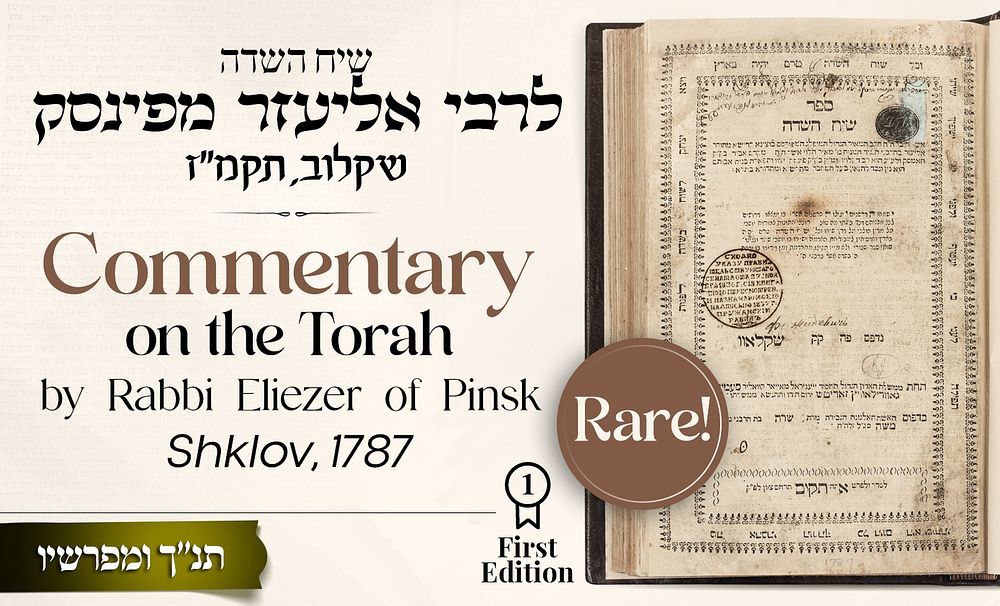
Exile and Redemption: Sefer Siach HaSadeh by Rabbi Eliezer of Pinsk Rare Shklov, 1787 * Sefer Siach HaSadeh is a collection of drashos on the weekly Torah portions, interwoven with parables, and is based in part on the Zohar and the teachings of the Shelah HaKadosh. The author is the gaon Rabbi Eliezer HaLevi, Rosh Yeshiva in Pinsk, who previously served as Av Beis Din of Chomsk. In many of his drashos, the author addresses matters relating to the coming of Mashiach and the end of the exile. He discusses Yaakov Avinu’s withholding of the revelation of the End, and in several places he alludes that the redemption may occur “close to the seventh millennium.” “And surely it is a great consolation… that we hope, with Hashem’s help, that the future redemption will be a complete and true redemption… and the matter depends solely on teshuva, for if Klal Yisrael performs complete teshuva, then Hakadosh Baruch Hu will bring about the downfall of the ministering angel of Edom and redeem us with a complete and true redemption, and the righteous redeemer will come to proclaim good tidings speedily in our days, amen” (Parshas Va’eschanan). The earlier redemptions were brought about through a shaliach (emissary), and therefore, they were not complete redemptions. But now, they will be redeemed by Hakadosh Baruch Hu Himself, and then there will be no travails afterward, only tranquility and calm, and a redeemer will come to Tzion speedily in our days, amen” (drasha for the Seventh Day of Pesach). A very rare sefer. Shklov, 1787. Singular edition (reprinted in recent years as a photographic facsimile). Page Count: 132; 29 leaves. Size: 31.5 cm. Condition: Good. Paper repairs to the title page and to several additional leaves. Several holes. Fine new leather binding. Bibliography : Yaari, HaDefus HaIvri BeShklov, pp. 15–16, no. 37. —---- In the past, the author of the sefer was identified with a chassidic tzaddik with the same name – Rabbi Eliezer HaLevi of Pinsk, regarding whom the Maggid of Mezritch referred to as “my beloved, the friend of Hashem, ” and who shared a strong bond of affection with his mechutan, Rabbi Levi Yitzchak of Berditchev (who himself served as Av Beis Din of Pinsk until 1785), as well as with Rabbi Pinchas of Koritz. As a result of this mistaken identification (originating in Chabad circles), the sefer was listed as a chassidic work in the exhibition catalogue marking the 300th anniversary of the Baal Shem Tov's birth (1998), p. 23, no. 46, and subsequently it was listed as such by Stefanski, Sifrei Chassidus, no. 576. —------------ At the beginning of the sefer appears the approbation of Rabbi Avigdor, Av Beis Din of Pinsk, one of the leading opponents of the Chassidic movement. Following Rabbi Avigdor’s denunciation to the authorities, the Alter Rebbe of Chabad was imprisoned and was in mortal danger. This approbation is one of only two approbations issued by Rabbi Avigdor (both for works by this same author), and beyond this, he is not mentioned in the Torah literature of that period, as far as is known.