Bidspirit auction | Special Printing for the Students
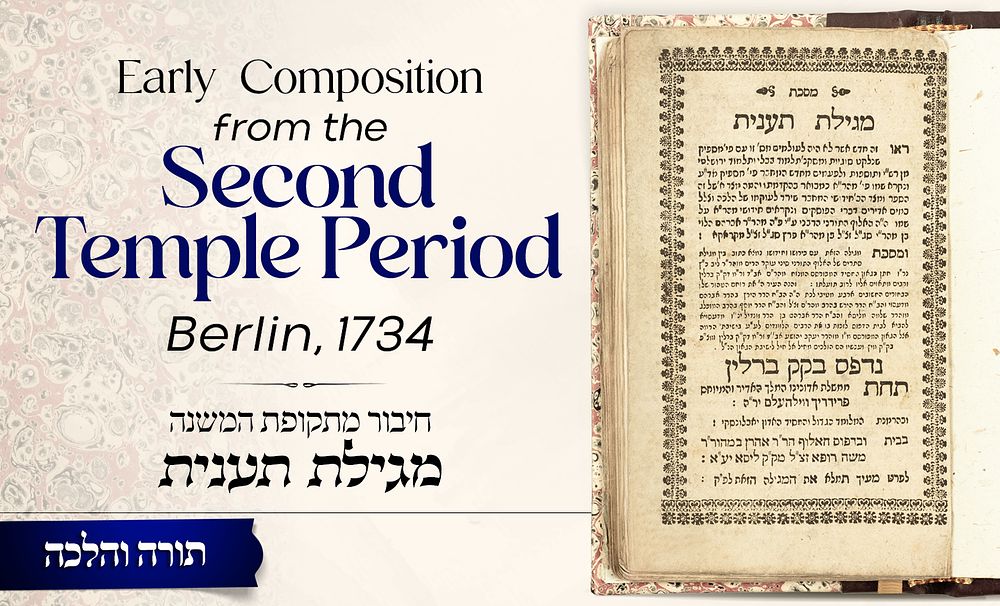
Special Printing for the Students of the Yeshiva of the Pnei Yehoshua – Maseches Megillas Taanis – Berlin, 1734 * The well-known maseches Megillas Taanis, written during the Second Temple period, containing a list of dozens of days throughout the year on which fasting is prohibited due to joyous events that occurred to the Jewish people. It includes commentaries of Rabbi Avraham Segal of Cracow. This remarkable and rare edition was printed specifically for the students studying in the yeshiva of the gadol hador, Rabbeinu Yaakov Yehoshua Falk, author of the Pnei Yehoshua. The sefer was printed by four distinguished young scholars who were disciples of the Pnei Yehoshua. On the title page, they wrote that their intention was ”to bring merit to the many who are presently studying in Yeshivas HaRama under the famed gaon, our teacher Rabbi Yaakov Yehoshua, Av Beis Din and Rosh Mesivta of the holy community of Berlin, and presently in the holy community of Metz.” From 1730 until 1734, the Pnei Yehoshua served as Rav of the Berlin community and as head of a large yeshiva there. He then moved to Metz, where he served as Rav until 1741, when he relocated to Frankfurt. In 1739, he printed the first part of his sefer yesod, Pnei Yehoshua, which became a permanent fixture in yeshivos. During his travels in Europe, the Chida personally met the Pnei Yehoshua in his later years. He wrote: ”His name spread throughout the entire world through his pure work Pnei Yehoshua, four parts on the Shas, and I, the young one, merited to receive the countenance of the Shechinah for several days, and his appearance was like that of an angel of Hashem…” (Shem HaGedolim). The names of the four aforementioned students who undertook this printing, who traveled with their rebbi to Metz, are: Rabbi Hirtz, son of Rabbi Avraham of Dessau; Rabbi Hirsch BeHarav Maharam zt” l; Rabbi Yosef, son of Rabbi Shlomo of Lissa; and Rabbi Avraham, son of Rabbi Zundel of Dessau. All are recorded in the list of the Pnei Yehoshua's disciples printed in the sefer Ataras Yehoshua (Bilgoraj 1936). The young men found this sefer in the library of Rabbi Leib Katz, son-in-law of the previous Rav of Berlin, Rabbi Yechiel Michel Chassid (who passed away in 1728). Rabbi Leib signed the document appointing the Pnei Yehoshua to the rabbinate of Berlin in 1730. The text of the commentaries of Rabbi Avraham Segal in this edition is shorter than in the first edition of the commentary (Amsterdam 1659), and the Institute for Hebrew Bibliography assesses that the aforementioned Rabbi Leib was the one who abridged it. A very rare sefer. Berlin, 1734. Second edition (shorter than the first edition). Page Count: 23 leaves. Size: 16.2 cm. Condition: Good, slight wear and creasing at the corners. New binding. ------------------------- The Commentaries of Rabbi Avraham Segal The sefer includes two important commentaries by the Gaon Rabbi Avraham Segal of Cracow: 1: Chiddushei Mahara containing a summary of the opinions of Rashi and Tosfos and textual variations on the masechta; 2: Commentary of Mahara expanding on the matters discussed. These commentaries were first printed in Amsterdam in 1659, with an introduction (omitted in the present edition) in which the author recounts the events of his life. Rabbi Avraham, one of the sages of Poland, fled his native city of Cracow following the Chmielnicki massacres of 1648–1649 and escaped to Hamburg. There, he encountered the sefer Megillas Taanis for the first time and immediately began writing commentaries on it. He writes there of his miraculous escape from the hands of the murderers: ”I was in the midst of the upheaval, and I was a hairsbreadth away from death... My heart grieves… for what I saw, when the enemies approached us. There were Jewish people who jumped into the water, Al Kiddush Hashem, and I was like a dove in the clefts of the rock, and Hashem saved me.....” He established the day of his rescue, Rosh Chodesh Iyar, as a day of fasting, with the following night as a night of thanksgiving and celebration.