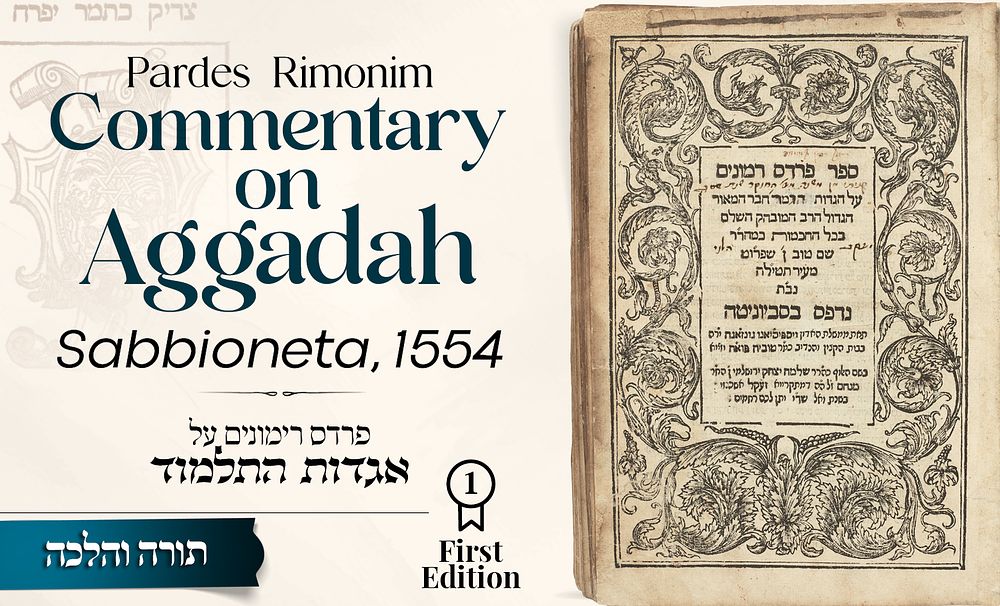
Bidspirit auction | Pardes Rimonim on the Aggados
Pardes Rimonim on the Aggados of the Talmud. Sabbioneta, 1554. First Edition. * The sefer Pardes Rimonim is a commentary composed in a rational, philosophically-inclined approach, on the aggados of Chazal in Talmud Bavli, arranged according to the order of the masechtos. It was authored by Rabbi Shem Tov ibn Shaprut, one of the sages of Spain in the fourteenth century. The intention of the author was to present an explanation of the aggados of Chazal in the manner of the great philosophical sages, such as the Rambam and Ibn Ezra, in contrast to the interpretations of the kabbalists of the aggados. Concerning this, he writes in his introduction: “I do not involve myself with hidden matters; rather, my intent is to give some form to the aggados, so that we may speak of them before the nations.” It appears that the Rema studied this sefer in depth, and in one place he writes, “As the author of Pardes Rimonim has written many times in his explanation of the aggados” (Torah HaOlah, Prague 1570, leaf 77a). Rabbi Yaakov Luzzatto likewise cites it several times in his sefer Kavanos HaAggados. The sefer was printed in the year 1554, the terrible year of the Burning of the Talmud, when thousands of sifrei kodesh were burnt. Kinos were composed over the burning, and grief was expressed through the pasuk, “The Almighty has dealt very bitterly with me.” Rabbi Avraham Menachem HaKohen Rappaport, author of Minchah Belulah, recounts the burning of sefarim in Venice over two consecutive days, and he established for himself those two days as fast days for the rest of his life. It is noteworthy that one of the central accusations leveled against the Talmud was directed specifically against the aggados of the Talmud. For this reason, the sefer Ein Yaakov, which deals entirely with the aggados of the Talmud, was among the sefarim most fiercely persecuted by the Christians. Conversely, the Rif was permitted to be printed and held in one's possession, among other reasons, because it does not include the aggados of the Talmud. The present sefer, printed in that very devastating year, is devoted in its entirety to the aggados of the Talmud. The publisher himself alludes to the burning in his closing words at the end of the sefer: “And since, because of our many sins, at this time there are no sefarim to be found here in these regions from which to correct this sefer, for ‘He has sent a word to Yaakov and it has fallen upon Yisrael; the crown of our head has fallen, and on pillars upon which hora'ah (instruction) was firmly established have ascended in flames to the heights of heaven… Does not our soul ache from hearing it; and to Hashem we plead, ‘Enough to the sufferings of His people Yisrael.’” The words constitute an important source regarding the burnings of the Talmud and have been cited in studies devoted to the subject (see “The Burning of the Talmud in Italy” by Ya”ri, pp. 24–25). The author, Rabbi Shem Tov ibn Shaprut, was a scholar and philosopher in Spain at the close of the Rishonim period , who engaged in disputes with Christians concerning the truth of Judaism. He is known for his sefer Even Bochan, in which he debates the Christians, but it has never been published. His work Tzofnas Paneach on the Ibn Ezra likewise remains in manuscript form. The present sefer, Pardes Rimonim, was also composed as part of his disputes with the Christians, as cited above from his own words, and it is the only one of his Hebrew works to have been published. Sabbioneta, 1554. First edition. Page Count : 51, [1] leaves. Size: 19.8 cm. Condition: Good condition; restorations to the title page and to several additional leaves. Repairs and small holes to a few leaves. New binding. The above-mentioned publisher was an Ashkenazi Jew from Jerusalem: Rabbi Shlomo Yitzchak Yerushalmi, son of Rabbi Menachem, known as Zekel Ashkenazi. (It is possible that he served as an emissary; see Shluchei Eretz Yisrael by Yaari, p. 224.)