Bidspirit auction | A Unique Printing Phenomenon: The
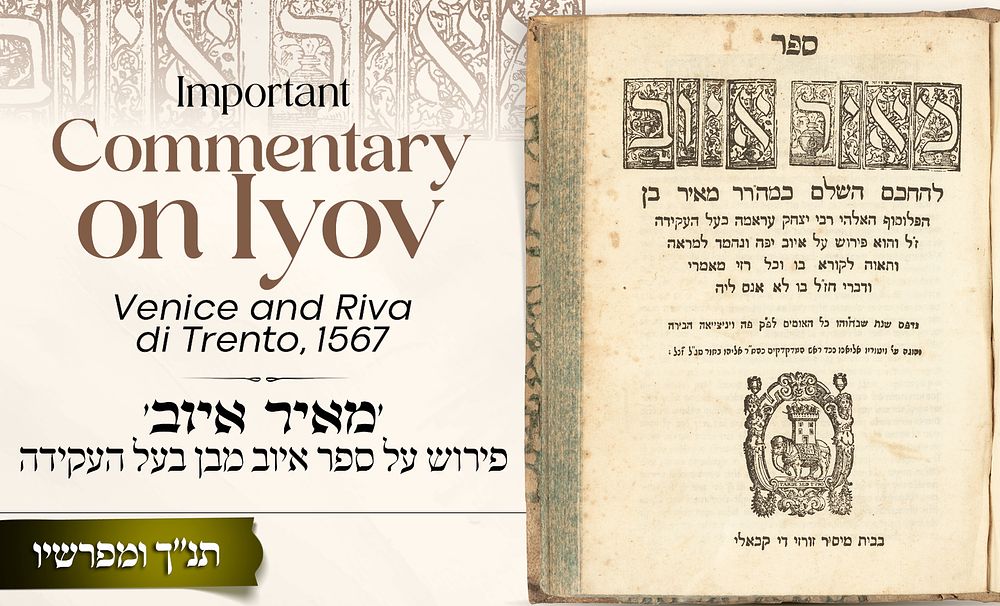
A Unique Printing Phenomenon: The Book of Iyov with the Commentary Meir Iyov – Printed in Two Different Cities! Venice and Riva di Trento, 1567 * The sefer Meir Iyov contains the Book of Iyov, fully vocalized and with ta'amim, together with a commentary by the accomplished sage Rabbi Meir Arama, son of the renowned gaon Rabbi Yitzchak Arama, author of HaAkeidah. He is cited among the commentators on the Book of Iyov in later generations, such as Rabbi Yisrael Najara. On every pasuk, there are two components: a brief section titled Biur HaMilos, which explains the words, and a longer section titled Peirush, which offers a more expansive interpretation. This is a remarkable sefer, notable for a rare and fascinating printing phenomenon, in that it was printed in two different cities! Approximately half of the sefer was printed in the city of Riva di Trento in 1562, while the remainder was completed in Venice in 1567 (see more details below). Rabbi Meir Arama was one of the sages of Spain and Portugal in the generation of the Spanish Expulsion. In his later years, he resided in Salonika where he served in the rabbinate. He is known for his following commentaries on the books of Nach: the present sefer Meir Iyov on the Book of Iyov, Meir Tehilos on Tehillim, and Urim VeTumim on Yeshayahu and Yirmiyahu. The Beis Yosef cites a halachic ruling in his name and writes, “and his words found favor in my eyes” (Orach Chaim, siman 486). Riva di Trento and Venice, 1562–1567 . Second edition. Page Count: 124 leaves. Size : 18.5 cm. Condition : Good. New binding. - - - - - - - - - - - Mystery of the Sefer’s Printing The sefer began being printed in the city of Riva di Trento in 1562, where approximately half of the sefer was completed. For reasons that remain unknown, the printing was not completed there, and only five years later the remainder was printed in Venice. There are clear differences between the Riva di Trento printing and the Venice printing. In the Riva di Trento printing, there are forty lines per page, while the Venice printing contains thirty-eight lines per page. In the Riva di Trento printing, the headings Biur and Peirush are marked with letters, whereas in the Venice printing, these markings are omitted. The first booklet, containing the title page, was printed twice: once in Riva di Trento and once in Venice, and the Venice printing is found in most copies, including the present copy. The present copy is collated as follows: Leaves [1]–4 are from the Venice printing. Leaves 5–44 are from the Riva di Trento printing. Leaves 45–48 are from the Venice printing, as is the case in all known copies; it is possible that this booklet was never printed in Riva di Trento, or that it was printed but did not survive. Leaves 49–64 are from the Riva di Trento printing. Leaves 65–124 are from the Venice printing. For more details, see: Aryeh Toiber, Mechkarim Bibliographim , Jerusalem 1932, pp. 83–85.