Bidspirit auction | Shulchan Aruch HaAri – First
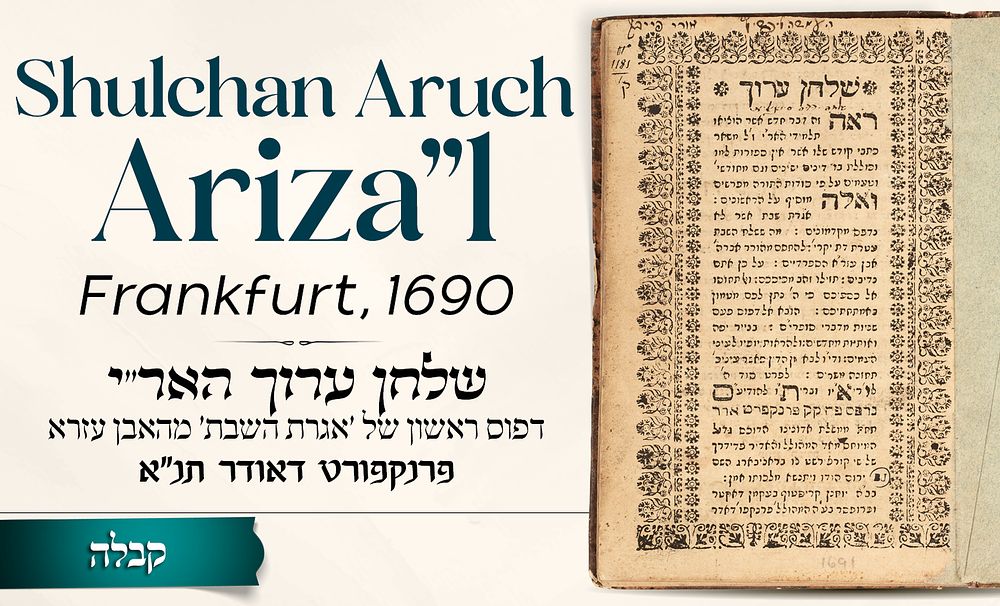
Shulchan Aruch HaAri – First Edition of the Remarkable Iggeres HaShabbos of the Ibn Ezra – Frankfurt an der Oder, 1690 * Sefer Shulchan Aruch HaAri, containing collections of halachos, customs, and kavanos according to Kabbalah, following the path of the Arizal. “Great importance is attributed to Shulchan Aruch HaAri, for through it, the customs of the Arizal entered the halachic sefarim” (Kabbalas HaAri by Rabbi Yosef Avivi, vol. II, p. 753). There, Rabbi Avivi demonstrates that, in all the many places where the Magen Avraham cites kabbalistic practices in halacha under the term “kesavim, ” he is referring to Shulchan Aruch HaAri. The first edition of the sefer was printed in Cracow or Prague around 1660, and is exceedingly scarce, virtually unobtainable. Before us is the second edition, itself extremely rare. Shulchan Aruch HaAri is founded on the writings of the kabbalist Rabbi Yaakov Tzemach. It is an edition upon edition, arranged in the manner of the Ashkenazic kabbalists, based on his sefer Nagid U’Metzaveh (whose most commonly known text was first printed only in 1712). Unlike the writings of the Arizal in Kabbalah, which are not transmitted or understood by everyone, Shulchan Aruch HaAri was widely embraced throughout Klal Yisrael because it is suited to everyone. It is one of the sefarim of Kabbalas HaAri that was published most frequently, appearing in more than twenty editions. Frankfurt an der Oder, 1690. First edition of Iggeres HaShabbos, and second edition of the main body of the sefer. Size : 15 cm. Condition : Good. Old binding ( spine is new). ~ ~ ~ ~ ~ ~ ~ “Who among all His servants is as faithful as I?” – Iggeres HaShabbos of the Ibn Ezra The famous Iggeres of the Ibn Ezra concerning the letter that Shabbos itself sent him was printed for the first time at the end of the sefer. The story of the Iggeres is as follows: On Friday night in the year 1159, the Ibn Ezra dreamed that a mysterious messenger came to him, “in the appearance of a man, ” holding a letter in his hand, and said to him: “Take this letter which Shabbos has sent to you.” At first, the Ibn Ezra greatly rejoiced, but after reading the letter, he was astounded and frightened, for it stated that an error had emerged from under his hand, that in his sefarim it was written to desecrate Shabbos, Heaven forbid. The Ibn Ezra did not understand where he had sinned, for he was extremely careful in observing Shabbos. He writes of his great love for Shabbos: “From the day I came to know the honored and awesome Name Who created me, and I learned His mitzvos, I have always loved Shabbos. Before its arrival, I would go out to greet it with all my heart, and when it departed, I would escort it with joy and with songs. Who among all His servants is as faithful as I?” After not understanding the matter, the messenger told him that the previous day, a student had brought the Ibn Ezra “books of commentaries on the Torah, ” and there it was written to desecrate Shabbos. At that moment, the Ibn Ezra awoke from his sleep and dream, and immediately hurried to examine the sefarim that a student had indeed brought him the previous day. He went outside his house and checked the sefarim by the light of the moon, and found that it was written there that the night follows the day! This would certainly cause desecration of Shabbos, for if the night belongs to the preceding day, then the night of Shabbos would belong to Friday, which is a weekday. Immediately, the Ibn Ezra tore the commentary, saying: “Better that I desecrate one Shabbos than that a Jew desecrate many Shabbosos.” After Shabbos, he wrote the present Iggeres, which includes the text of the letter he received in the dream from Shabbos, and sent it to all of Klal Yisrael to warn them regarding the sanctity of Shabbos. This Iggeres became widely known and was printed many times; melodies were even composed to its words for singing. At the top of the leaf is the title: “This is the writing that Shabbos sent to Rabbi Avraham Ibn Ezra, of blessed memory.” On the following leaf, the publisher recounts the unique manner in which the manuscript of the Iggeres reached him. He saw in the sefer Sifsei Yesheinim, printed only eleven years earlier, a listing of “Iggeres HaShabbos” without further details, and he wanted to understand what it was. He searched and searched for it until he found it, and he immediately set about printing it because of its great beauty. - - - - - - - - - - - - The signatures of two rabbanim of Modena appear on the title page: - “Hakatan Moshe Lipschitz” – this is Rabbi Moshe Lipschitz, Av Beis Din of Modena (d. 1755), a sage from the city of Hentchin in Poland who came to Italy and became a dayan and later Av Beis Din in Modena. The Chida relates in Ma'agal Tov that while in Modena, he saw a manuscript in practical Kabbalah authored by Rabbi Moshe. He wrote a sefer of drashos called Even Moshe (Brooklyn, 1980).