Bidspirit auction | Treasure from the Holy City
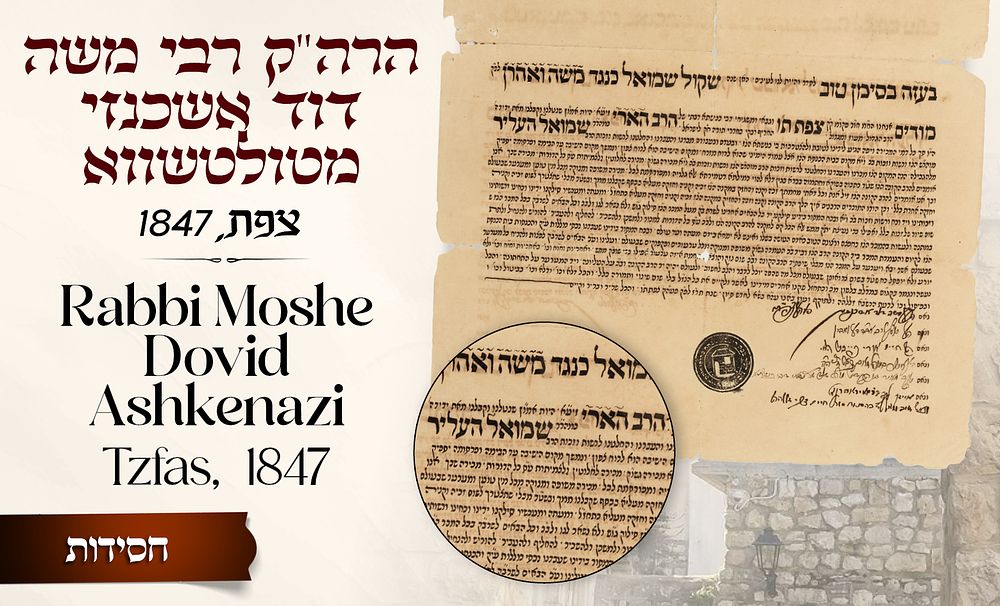
Treasure from the Holy City of Tzfas! Bill of Sale for a Seat in the Ari Synagogue for Rabbi Shmuel Heller, Signed by Rabbi Moshe Dovid Ashkenazi of Toltsheva – Tzfas, 1847 * A document attesting that Rabbi Shmuel Heller, one of the gedolim of Eretz Yisrael and later Av Beis Din of Tzfas, purchased a place for prayer in the Ari Synagogue in Tzfas. Foremost among the signatories is Rabbi Moshe Dovid Ashkenazi of Toltsheva, who at that time served as Av Beis Din of Tzfas. Rabbi Moshe Dovid of Toltsheva is one of the patriarchs of the Siget–Satmar dynasty; the Rebbe, the Yetev Lev of Siget, was his son-in-law. Rabbi Chaim Uri Feivish HaLevi, son of Rabbi Aryeh Leib of Valtshisk, is also a signatory. The following also signed: Rabbi Yosef Leib, Av Beis Din of Labin; Rabbi Chaim Uri Feivish HaLevi; Rabbi Asher son of Rabbi Ze’ev, zt”l; Rabbi Yaakov Meir son of the holy Rabbi Dovid, zt”l, gabbai of the beis knesses; Rabbi Isaac Leib son of Rabbi Meir Aharon, zt”l; and Rabbi Ze’ev Wolf son of the late Rabbi Chaim Tzvi, zt”l. A beautiful document, written by the community scribe. Inscribed in large letters at its head are the words: “Shakul Shmuel keneged Moshe ve’Aharon [=1847].” On the reverse of the leaf, Rabbi Shmuel Heller recorded in his own distinctive handwriting: “Acquisition of a place in the Arizal's Synagogue.” A unique historical item from Tzfas, the city of kabbalists, connected to the Ari Synagogue and to two of the city’s great rabbanim — Rabbi Shmuel Heller and Rabbi Moshe Dovid Ashkenazi. Tzfas, 1847. Paper leaf, 17.2 x 23.5 cm. Condition : Moderate; tears at the margins and along the fold lines, primarily on the doubled reverse side. It was printed based on this manuscript in the sefer Shemen LaMaor, Sofrei HaMelech II, pp. 30–31 (where an erroneous identification was made regarding the identity of Rabbi Chaim Uri Feivish Segal). ------------------------ The Ari Ashkenazi Synagogue in Tzfas The Ari Ashkenazi Synagogue, founded in the late 16th century, was rebuilt in 1816 and became the central synagogue of the Ashkenazic community in the holy city of Tzfas. It is also known as “Chakal Tapuchin Kadishin, ” a kabbalistic term for the holiness of Shabbos, so called because of the tradition that, upon the very spot where it stands, the Arizal would go out to greet the Shabbos Queen. The synagogue became known for a controversy that arose when G-d-fearing artisans sought to adorn its Aron Kodesh with images of animals and birds, which, according to some poskim, raised a halachic concern. Rabbi Shmuel Heller wrote a treatise on the matter entitled Taharas HaKodesh, which he printed in Tzfas in 1864. --------------------------- The gaon, tzaddik, and kabbalist Rabbi Shmuel Heller, Av Beis Din of Tzfas (c. 1803–1884) , visited the Chozeh of Lublin several times in his youth, and the Chozeh himself placed tefillin upon him and blessed him. He moved with his father to Tzfas and, over time, became the mainstay and leader of the Jewish community in Tzfas. Rabbi Moshe Dovid Ashkenazi of Toltsheva (1774–1856) , author of Toldos Adam, served for forty years as Rav of Toltsheva. He corresponded with the Chasam Sofer and with his mechutan, the Yismach Moshe. When he reached the age of seventy, he asked his son-in-law, the Yetev Lev, whether he should move to the Holy Land or print his sefarim, and the Yetev Lev advised him to move to the Holy Land, where he also merited to print his sefarim. In 1843, he moved to Yerushalayim, and in 1844, he moved to Tzfas, where he served as Rav of the Ashkenazic community until his passing on the 18th of Tammuz 1856. His printed works are: Toldos Adam on Shas (Jerusalem 1845) and Be’er Sheva on the Torah (ibid., 1853). Rabbi Chaim Uri Feivish Segal was the son of Rabbi Aryeh Leib of Valtshisk . In his first marriage, he was the son-in-law of Rabbi Yaakov Shimshon of Shpitovka, and in his second marriage, he was the son-in-law of Rabbi Moshe Ephraim, nephew of the Bas Ayin. He was a mechutan of Rabbi Naftali Tzvi of Teveria, a grandson of the Baal Shem Tov. See: Likutei B'Inyanei Torah U’Tefillah VeAvodas Hashem, vol. 7, issue 280, p. 131.