Bidspirit auction | Sha'arei Torah by the Renowned
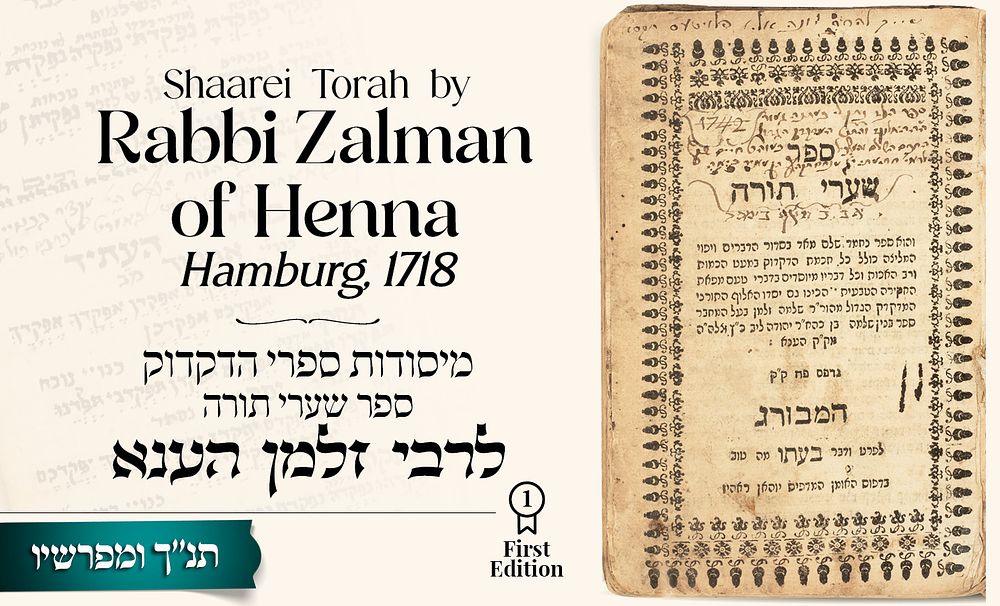
Sha'arei Torah by the Renowned Grammarian Rabbi Zalman of Henna Hamburg, 1718. First Edition. * A comprehensive work on Hebrew grammar, dealing with the letters, the rules of vowels and dageishim, verbs, pronouns, and related subjects. The sefer was authored by the famous grammarian Rabbi Zalman of Henna, author of Binyan Shlomo, one of the greatest Ashkenazic grammarians of the last several centuries, whose teachings are essential to all who engage in this field. Printed at the end of the volume is the sefer Sha’arei Zimrah on ta’amim (cantillation marks) of the Mikrah (leaves 70–78), which the Vilna Gaon followed, as recorded in Tosefes Maaseh Rav: “In the cantillation marks and melodies, [the Vilna Gaon] followed Sha'arei Zimrah of R’ Zalman of Hanne” (Tosefes Ma'aseh Rav, Jerusalem 1896, leaf 14b). A decade earlier, when he was only about twenty-one years old, Rabbi Zalman of Henna published his first sefer, Binyan Shlomo, but there was opposition to his grammatical approach. In the present work, Rabbi Zalman retracts some of his earlier positions, as he himself notes in the introduction, and he defines this sefer as his later, revised edition. At the beginning of this volume, there is a fascinating approbation by Rabbi Moshe Chagiz, in which he responds to the opponents of Rabbi Zalman of Henna, comparing him to an expert physician for whom even if “in one or two cases he does not succeed, it is of no consequence, ” and he goes on to praise Rabbi Zalman of Henna at length. The Baal Shem of Michelstadt also recommended studying this sefer, as recorded in Kuntres HaYedi’os printed in the sefer Baal Shem of Michelstadt (Machon Yerushalayim edition). At the end of the volume are several leaves in Ashkenazic handwriting by an important grammarian from the decades close to the time of printing, whose identity is unknown. Rabbi Shlomo Zalman Henna (1687-1746) , the Razah, was one of the greatest Hebrew grammarians of his era. He is well known for his siddur Beis Tefillah and for his notes on the nusach tefillah, which were printed many times. He was born in the city of Henna (Hanau), near Frankfurt, and from a very young age began studying the rules of dikduk. There were those who argued against him, most notably the Yaabetz, but most regarded his work ambivalently — with great respect, alongside halachic critiques of his grammatical method. See the wording of the approbation of the Noda B’Yehuda to the sefer Kuntres Hasagos on the siddur of the Razah. Hamburg, 1718. First edition. Page Count: [4], 78 leaves + [16] manuscript pages. Condition : Good, with slight wear to the first and last leaves. Minor loss to leaves 70–71.