Bidspirit auction | Certificate of Chaver Signed by
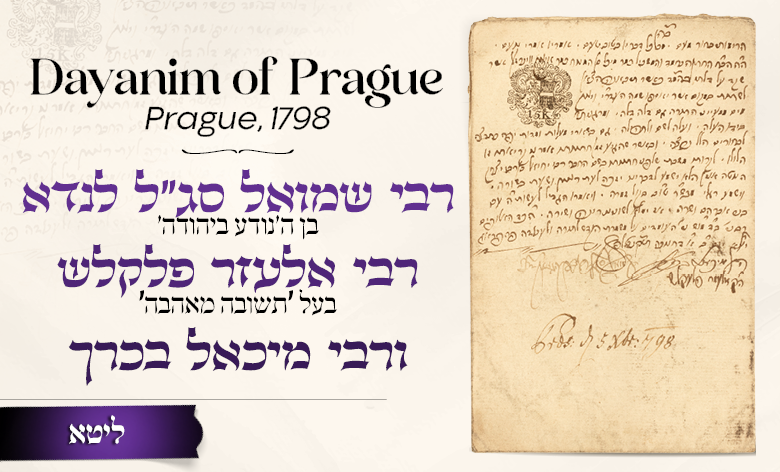
Certificate of Chaver Signed by the Av Beis Din and Dayanim of Prague – Prague, 1798 * A certificate of semichah for the title of “chaver, ” bearing the signatures of the Geonim of Prague who succeeded the great Noda B’Yehuda in the city’s leadership: His son, Rabbi Shmuel Segal Landau; Rabbi Elazar Fleckeles, author of Teshuvah Me’Ahavah; and Rabbi Michael Bacharach, Raavad of Prague. The certificate was issued to the chassan R’ Yechiel Michel Wiener, from the prominent and long-established Wiener family of the Prague Jewish community. Rabbi Shmuel Segal Landau, Av Beis Din of Prague (c. 1750–1838), was the son of the renowned gaon Rabbi Yechezkel Landau, author of Noda B’Yehuda. He succeeded his father as Rav and Rosh Yeshiva of Prague, continuing his path in Torah leadership. He was one of the great Torah figures of his generation, author of Doresh LeTzion and Shu”t Shivas Tzion. Rabbi Elazar Fleckeles, Raavad of Prague (1754–1826), was one of the greatest disciples of the Noda B’Yehuda and one of the foremost rabbanim of Prague in his generation, author of Shu”t Teshuvah Me’Ahavah. Rabbi Michael Bacharach (1730–1801) , a descendant of the Chavas Yair, was one of the leading sages of Prague and its Rosh Yeshiva. For nearly fifteen years, he served as dayan in the Beis Din of the Noda B’Yehuda and maintained a close personal friendship with him. He later became Raavad of Prague. His letters were later published in Sefer Arugas HaBosem. Prague, Chanukah 1798. Official stationery, recognized by the government. Folded double leaf, 12×18 cm. Condition : Good. Provenance : Yalta Auction ----------------- Certificate of Chaver The title “chaver, ” which literally translates as “member” or “friend, ” was a title traditionally bestowed upon a talmid chacham (see Rambam’s commentary on the Mishnah, Demai 2:3). About six hundred years ago, Ashkenazic communities began granting the title “chaver” to distinguished young Torah scholars, and in later generations, it was conferred upon one who had completed his studies in yeshiva, often in honor of his wedding. The title would be used in all formal references, such as an aliyah to the Torah, in the kesuba, and on the gravestone.