Bidspirit auction | First Hebrew Printing of Aristotle’s
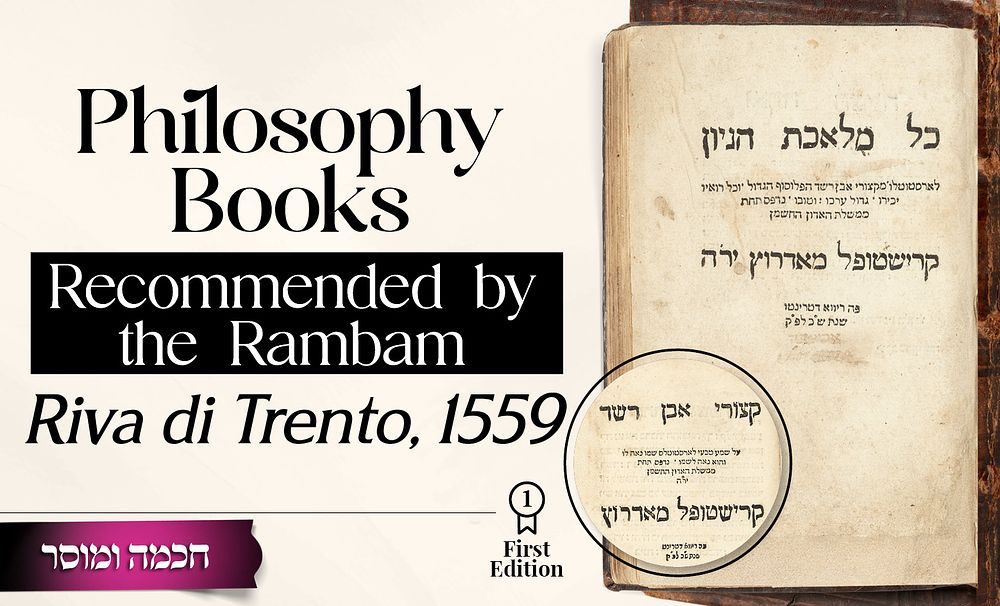
First Hebrew Printing of Aristotle’s Philosophy – Kol Meleches Higayon of Aristo / Kitzurei Ibn Rushd – Riva di Trento, 1559 * An early volume containing two significant philosophical works widely studied by the Rishonim. Both works were printed in close proximity — indeed, in the same city and the same year: Riva di Trento, 1559. The first work is Kol Meleches Higayon LeAristotle. First edition. It contains an abridgment of the collection of eight treatises on logic by the leading philosopher, Aristotle, known as the “Organon, ” which forms the foundation of Aristotelian logic. This abridgment was prepared by the Arab scholar Ibn Rushd (Averroes), a contemporary of the Rambam, and was translated into Hebrew by Rabbi Yaakov ben Machir. “Chochmah bagoyim ta’amin” — The Jewish outlook is that wisdom is not exclusive to the Jewish people, and genuine respect is accorded to truth and insight wherever they may be found. This work is one of the foundational texts for understanding Aristotelian logic and had a profound influence on the Jewish sages of the Rishonim era, who engaged in philosophy. The Rambam based his work Milot HaHigayon (Treatise on the Art of Logic) on Aristotle's system of logic, and in chapter ten he enumerates in detail the eight books of Aristotle, whose abridgment by Ibn Rushd is printed here for the first time in Hebrew. The Rambam himself was already familiar with the writings of Ibn Rushd, who was his contemporary, and in one of his letters, he writes to his student: “I have studied all that Ibn Rushd composed on the works of Aristotle… and I have found that he hits precisely upon the truth” (Rabbeinu Moshe ben Maimon, by Ben-Zion Dinur, Tel Aviv, 1935, p. 14). One of the Jewish sages deeply influenced by the writings of Aristotle and Ibn Rushd was the Ralbag, a great Jewish philosopher, who “succeeded in explaining all the works of Aristotle, and also presented most of the teachings of Ibn Rushd, the Arab, in Hebrew” (words of Simcha Luzzatto, in his translated work Essay on the Jews of Venice , Jerusalem, 1951, p. 142). In his well-known work Milchamos Hashem, the Ralbag cites Ibn Rushd more than a hundred times. The translator of this work, Rabbi Yaakov ben Machir Ibn Tibbon, was a renowned translator and astronomer, the grandson of Rabbi Shmuel Ibn Tibbon, who was an admirer of the Rambam, translated his writings, and maintained a correspondence with him. Kol Meleches Higayon is the very first work on the foundations of Aristotelian logic to be printed in the Hebrew language! The second work is Kitzurei Ibn Rushd on Shema Tivi (Physics) of Aristotle. First edition. It contains an abridgment of Aristotle’s work Shema Tivi (Physics), prepared by Ibn Rushd and translated by Rabbi Moshe Ibn Tibbon around 1250. Many Jewish scholars refer to Aristotle’s Shema Tivi, among them the Rambam, the Ralbag, the Sforno, and others. The Abarbanel cites it several times in his commentary on the Torah. In his introduction, Ibn Rushd writes that for the benefit of the reader, it is advisable to first study Kol Meleches Higayon, which is bound together with the present work. The translator, Rabbi Moshe Ibn Tibbon, was a talmid chacham, physician, translator, and philosopher. He was the son of Rabbi Shmuel Ibn Tibbon and the uncle of Rabbi Yaakov ben Machir Ibn Tibbon, who translated Kol Meleches Higayon, also included here. Both works are exceedingly rare, and together they are particularly rare! It is very interesting that these two philosophical works were printed in pocket format, measuring only about 15 cm in height. Typically, such a small format was reserved for lighter works, such as prayer books or popular ethical texts — not for deep philosophical treatises! Riva di Trento, 1559. First editions of both works. Page Count: Meleches Higayon – 68 leaves; Kitzurei Ibn Rushd – 47 leaves. Pocket format: Approx. 15 cm. Condition : Good. Paper repair at the lower margin of the first title page and in the margins of leaf 5 from Even Rushd. Stains. Antique leather binding, with slight loss to the spine. The bookplate of the philosopher Dr. Yaakov Kletzkin (son of Rabbi Eliyahu Kletzkin of Lublin) is affixed at the end of the volume. He was one of the foremost scholars of Jewish philosophy in modern times, who references these two works dozens of times in his sefer Otzar HaMunachim HaPhilosofiyim veAnthologia Philosofit (Berlin, 1926–1934). Provenance: Winner’s Auction. - - - - - - - - - - Hebrew Translations of Writings of Non-Jewish Scholars The dispersion of the Jewish people across the world throughout the generations led many Jews, who had acquired the languages of their surroundings, to become directly or indirectly exposed to the writings of non-Jewish scholars, such as Aristotle. In addition, many classic Jewish works were originally composed in Arabic, such as the Kuzari, the Moreh Nevuchim of the Rambam, and Chovos HaLevavos of Rabbeinu Bachya.