Bidspirit auction | Collection of Philosophical Works: Goren
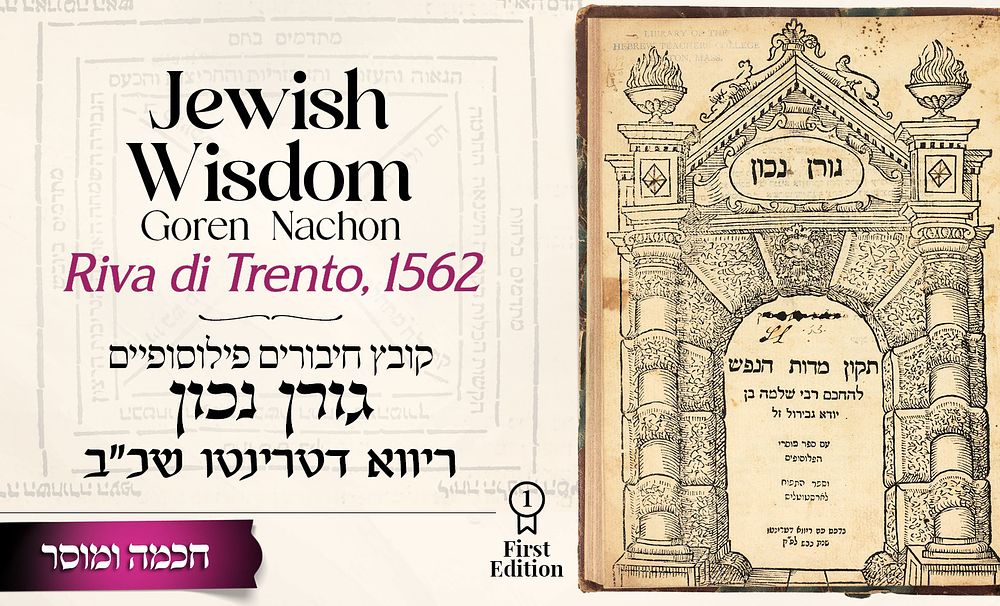
Collection of Philosophical Works: Goren Nachon First Edition. Riva di Trento, 1562 * The sefer Goren Nachon comprises three important analytical works belonging to the corpus of Jewish and Judeo-Arabic philosophy. One of these works appears here in print for the first time, while the other two are presented in new versions based on manuscripts that differ from earlier printed editions. 1. The first is Tikkun Middos HaNefesh by Rabbi Shlomo Ibn Gabirol, translated by Rabbi Yehuda Ibn Tibbon. This is a philosophical-mussar work, divided into twenty chapters corresponding to the twenty traits in a human: two positive and two negative traits for each of the five senses — sight, hearing, smell, taste, and touch. It includes charts that organize the relationships between these traits. This sefer holds an important place in the literature of philosophical ethics and has been printed numerous times. It was first printed in Constantinople in 1550, and it appears here in a newly established text based on a different manuscript, which at times diverges significantly from the earlier version. In addition, references and a brief summary (“Pratei HaKlalim”) are printed here for the first time in the margins. 2. The second work is Mussarei HaPhilosophim , authored by the Arab-Christian scholar Hunayn ibn Ishaq of Baghdad, who lived in the 9th century, and Rabbi Yehuda Alcharizi translated it. This is its first edition. (An amusing detail is that the author’s Arabic name, “Hunayn, ” was rendered in the Hebrew translation as “Chananyah, ” and thus he is referred to in the printer’s introduction as “Reb Chananyah.”) 3. The third work is Sefer HaTapuach, attributed to Aristotle and translated by Rabbi Avraham bar Chisdai HaLevi. This sefer was first printed in Venice in 1519, but here it is presented in a new and improved version based on a different manuscript, with many variations. This is the first edition in which these works are compiled together under the title Goren Nachon . Manuscripts containing these compositions together are known from as early as the late 14th century, often alongside additional works. The title Goren Nachon itself is already found in at least one early manuscript. Glosses in Italian script appear on leaves 3b, 4a, and 15a (second page count). Riva di Trento, 1562 Page Count: 17, [1] blank leaf; 30 leaves. Size : 19.5 cm. Condition : Restoration to the margins of approximately ten leaves (far from the text). Stains. Title border slightly trimmed. Old half-leather binding with marbled paper boards. Somewhat worn. Bibliography : Stefansky, Sifrei Yesod, p. 236 (addenda). Provenance : Tzfunot Auction - - - - - - - - - - - - Hebrew Translations of Writings of Non-Jewish Scholars The dispersion of the Jewish people across the world throughout the generations led many Jews, who had acquired the languages of their surroundings, to become directly or indirectly exposed to the writings of non-Jewish scholars, such as Aristotle. In addition, many classic Jewish works were originally composed in Arabic, such as the Kuzari, the Moreh Nevuchim of the Rambam, and Chovos HaLevavos of Rabbeinu Bachya. To make these writings accessible to the Jews of Europe, translators — often referred to as “copyists” — rose to the task and produced accurate, methodical Hebrew translations. Among the most prominent translators were Rabbi Yehuda Ibn Tibbon and Rabbi Yehuda Alcharizi. These translations were not limited to Jewish works written in Arabic; they also included works authored by Muslim and Christian scholars. This was, in part, because Jewish sages engaged extensively with their words, and they significantly influenced the development of philosophical and scientific thought among them. These translations were especially widespread in regions where social and cultural conditions enabled flourishing intellectual activity, such as Spain during the Golden Age, Provence, and Egypt. The translation of philosophical works should be seen as part of a broader movement to bring the wisdom of the wider world into the Hebrew language, in diverse fields such as medicine, astronomy, mathematics, and the natural sciences.