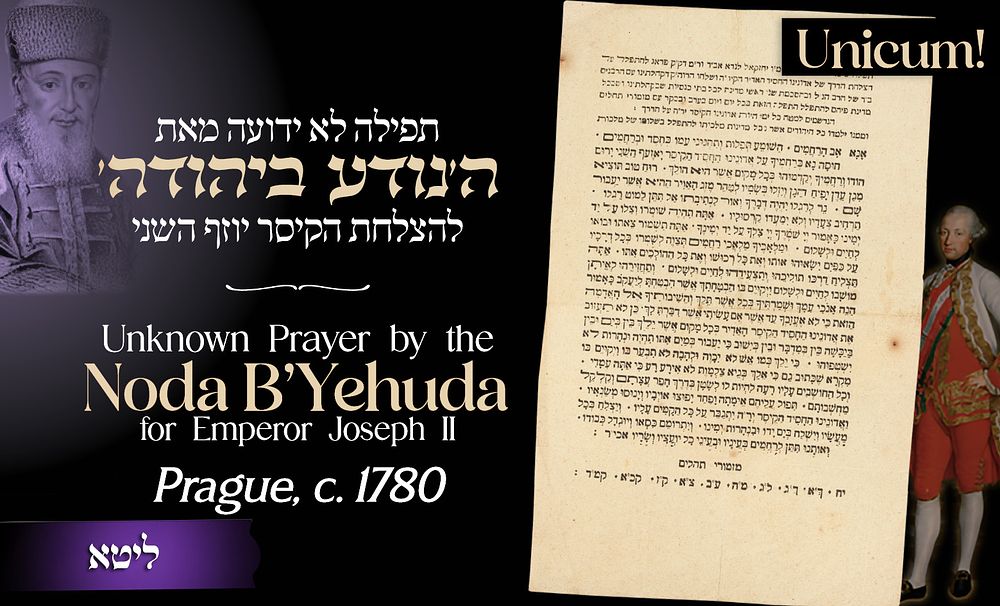
Bidspirit auction | Unicum! – Unknown Prayer by
Unicum! – Unknown Prayer by the Noda B’Yehuda for the Success of Emperor Joseph II – Prague, 1780 * A printed leaf containing a prayer composed by Rabbi Yechezkel Segal Landau, Av Beis Din of Prague, “to pray for the successful travels of our noble and gracious sovereign, His Imperial Majesty.” In the text of the prayer, the emperor is explicitly named: “Joseph the Second, ” referring to Emperor Joseph II, son of the wicked Empress Maria Theresa, who ruled between 1780 and 1790. From the prayer's content, it is evident that the emperor had set out on an important journey of great political significance, and that the Jewish community of Prague, under the leadership of the Noda B’Yehuda — who was loyal to the imperial court — established a special prayer for his success on the journey. This prayer was instituted by the Noda B’Yehuda to be recited daily, morning and evening, in the synagogues of Prague and across all of Bohemia. At the bottom of the sheet, selected chapters of Tehillim are listed to be recited following the prayer. This prayer was never publicized and has remained entirely unknown! It is not found in the National Library of Israel or in any major library worldwide. It is not recorded in the Institute for Hebrew Bibliography or in the bibliographies of scholars such as Friedberg, Ben-Yaakov, Winograd, and others. It is likewise absent from the international WorldCat database. To the best of Zaidy’s knowledge, it is not even mentioned in works documenting the history of the Noda B’Yehuda. This is the only known copy in the world of this historic prayer sheet! In general, such leaves are exceedingly rare for several reasons . First, they were printed for a temporary purpose (in this case, the emperor’s journey), and once the occasion passed, they were discarded to genizah, as they were no longer of use. Second, they were typically printed in very limited quantities — “one for a city and two for a community.” Third, the present sheet was intended for daily use, and it is therefore certain that even among the few copies originally printed, many quickly wore out. The Emperor Joseph II and the Jews The Noda B’Yehuda succeeded in forming favorable relations with the emperor already in his youth, and when Joseph II ascended the throne, it brought significant relief to the Jews in contrast to the harsh rule of Maria Theresa. He enacted numerous reforms benefiting the Jews, foremost among them the well-known Edict of Tolerance, which granted them many rights previously denied. Although from an internal Jewish perspective, this edict also posed serious spiritual challenges, the Noda B’Yehuda maintained that the emperor’s intentions were for the good, even while opposing certain elements of the decree. The Noda B’Yehuda consistently emphasized loyalty to the ruling authorities, beginning already during the reign of the antisemitic Maria Theresa, despite her persecutions. In 1756, he composed a special prayer for her success in the Seven Years’ War (printed in a similar leaf in 1757; of that rare sheet, at least three copies are known). During that war, he exerted himself greatly on behalf of the queen, even placing himself in considerable danger, as he recounted in his eulogy for her. In 1767, when Maria Theresa fell ill, the Noda B’Yehuda composed prayers for her recovery, and upon her passing in 1780, he delivered a eulogy which included blessings upon the coronation of her son, Joseph II, who was more favorably disposed toward the Jews. In 1790, he delivered a drasha of blessing marking the emperor’s success in capturing Belgrade with minimal effort (printed there and recorded in the Institute for Hebrew Bibliography based on a copy in the British Library). In his sefarim as well, he repeatedly stressed the importance of honoring the monarchy. For further information, see the chapter “The Obligation to Seek the Welfare of the Monarchy” in Drashos Noda B’Yehuda Hashalem, vol. II, Jerusalem 2021, section Aspaklaria HaMe’irah, pp. 5–8. It is not clear which journey is referred to here. It may relate to the emperor’s travels connected with the signing of the Austro-Russian alliance in 1781, together with Empress Catherine the Great. Alternatively, it may refer to his journey to the front during the Austro-Ottoman War (1788–1791), though this seems less likely, as the prayer contains no mention of success in battle. Exceptionally important and rare. Prague, 1780. Page Count: 1 leaf. Printed on one side. Size : 19.5 × 31 cm. Condition : Good. - - - - - - - - - - Anecdote Concerning the Noda B’Yehuda, the Jews, and the Emperor When Rabbi Yechezkel, author of the Noda B’Yehuda, resided in the imperial city of Prague, the Austrian Emperor Joseph II issued a royal decree equalizing the rights of the Jews with those of the other citizens. The leaders of Prague, with Rabbi Yechezkel at their head,