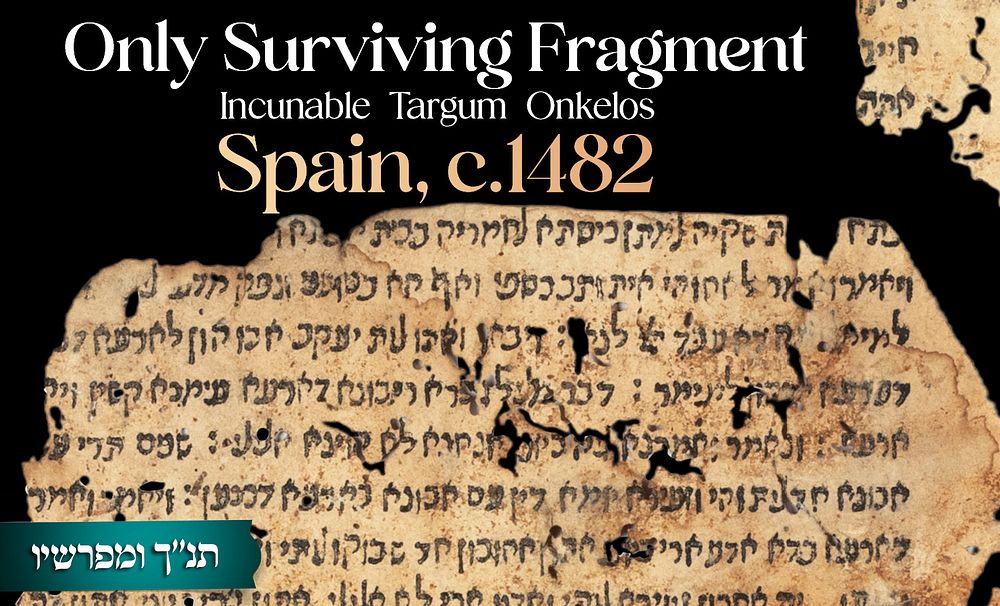
Bidspirit auction | Only Surviving Fragment of a
Only Surviving Fragment of a Spanish Incunabulum in the World! Leaf from Targum Onkelos on the Torah – Guadalajara, Spain, circa 1482 * An exceptionally rare remnant from the incunabula period, of immense significance. A printed fragment of a leaf containing the Targum Onkelos on approximately forty pesukim from Parashas Miketz in Sefer Bereishis. A comparison of the typographic features indicates that the leaf was printed in the city of Guadalajara, Spain, during the pre-expulsion period, at the printing press of the tzaddik Rabbi Shlomo Alkabetz, grandfather of the kabbalist Rabbi Shlomo Alkabetz of Tzfat, author of Lecha Dodi. Based on this leaf, an edition of Targum Onkelos printed in Guadalajara was recorded in the list “Hebrew Incunabula – Spain and Portugal: Guadalajara” (Peretz Tishbi). See below for further elaboration on the typographic features. As far as is known, this incunabulum remnant is the only one in the world, and is the only testimony to the very existence of this edition! No additional remnant is known in any of the world’s libraries or among recognized collectors. Indeed, the very existence of this edition was unknown to leading scholars for centuries, until the publication of this leaf in an article in the journal Moriah in 1983. In other words, were it not for this fragment, the existence of this edition of Onkelos would have remained entirely unknown to scholars of Hebrew printing. This leaf was preserved within a binding genizah, where discarded genizah leaves were affixed together in earlier times to serve as boards for bindings. Preserved within that same binding were additional leaves from Spanish and Portuguese printings prior to the expulsion: three leaves from Maseches Brachos printed in Faro before 1497 (they appeared in Genazym, Auction 22, item 7), and two leaves from Tur Orach Chaim, Hijar 1485. The text of the Targum printed here is largely similar to the standard version, though it contains several minor variations (see details in the article in Moriah). In general, the phenomenon of printing Targum Onkelos as an independent sefer is quite surprising; as far as is known today, it existed only in Spain and Portugal during the brief early period of Hebrew printing prior to the expulsions, after which it disappeared. Only one other such edition of Targum Onkelos is known, of which likewise only a few leaves have survived, believed to have been printed in Faro, Portugal, circa 1487. In summary, this is the only surviving fragment of Targum Onkelos in the world from approximately 1482. According to the Incunabula Census compiled by Offenberg and published in 1990, approximately 10% of known incunabula (14 out of roughly 140) survive in a single copy in a single library worldwide (half in JTSL and the other half in the National Library of Israel, Parma, and the British Library). It is possible that in the thirty-six years since the publication of the census, additional copies of some have been discovered, thereby reducing the number of incunabula that were at the time classified as “the only one in the world.” A Hebrew printing press belonging to Rabbi Shlomo ben Moshe HaLevi Alkabetz operated in Guadalajara, central Spain. His press was one of the principal centers of Hebrew printing in the region; according to what is currently known, about twenty sefarim were printed there. In three of them, dated colophons survive, attesting to activity between 1476 and 1482. The printing press was particularly known for printing an exceptionally large number of volumes of Gemara — no fewer than eleven different masechtos of the Talmud Bavli! It is possible that some were printed even before Gemaros began to be printed in Italy (in 1484, by Soncino). The Jewish community of the city was among the most ancient in Spain, with evidence of its existence already in the fifth century. Among the distinguished sages who lived there were Rabbi Yitzchak ibn Sahula, author of Mashal HaKadmoni, and the Kabbalist Rabbi Moshe de Leon, associated with the teaching of the Zohar, and others. At the time of printing, approximately 6,500 Jews resided in the city. Like the other holy communities of Spain, it was destroyed in 1492, the year of the expulsion of Spanish Jewry. Guadalajara, circa 1482 or shortly thereafter. Physical Description A printed fragment comprising approximately half of the original leaf, which was printed in a large format. Two additional small fragments from the same leaf are included. Page 1 begins at Bereishis chapter 41, mid-pasuk 50, and continues until near the end of chapter 42, pasuk 13. Page 2 begins at Bereishis chapter 42, pasuk 27, and continues until mid-chapter 43, pasuk 7. Structure of the work: At the beginning of each pasuk, there is a single word from the beginning of the pasuk in Lashon HaKodesh, followed by the full Targum translation of the entire pasuk. Column width: Approx. 139 mm.