Bidspirit auction | First Printing of Nevi’im Rishonim!
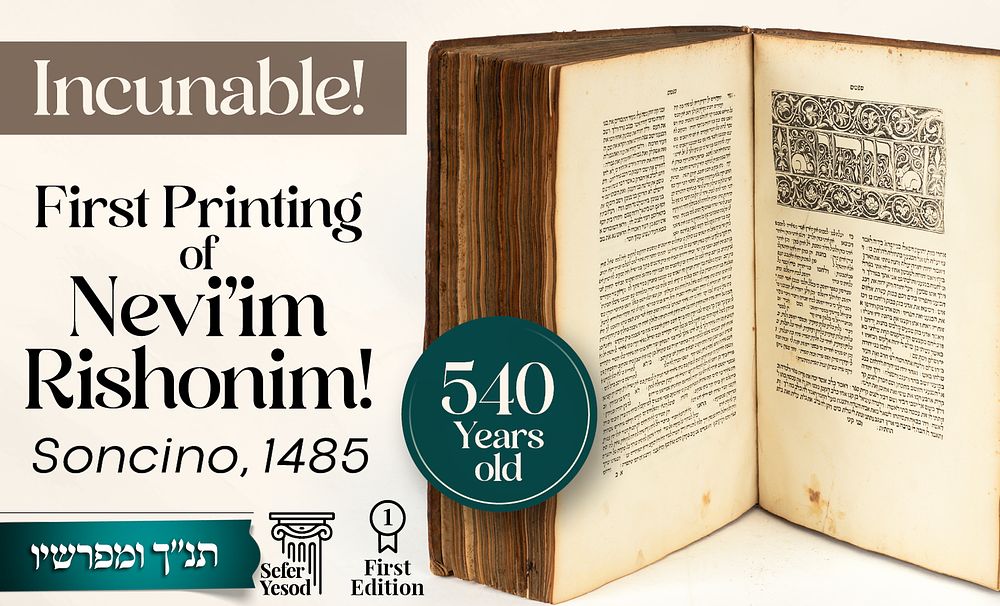
First Printing of Nevi’im Rishonim! Exceptionally Important Incunabula – Fine Copy with Wide Margins. Soncino, 1485 * This copy is missing 2 leaves, leaving 164 of 166. A volume of Nevi’im Rishonim containing the books of Yehoshua, Shoftim, Shmuel, and Melachim, with the commentary of Rabbi David Kimchi, the Radak. Historic, first-ever printing of Nevi’im Rishonim. Its significance is immeasurable! At that time, Hebrew printing was still in its infancy, less than twenty years old; until then, the complete Tanach had not yet been printed — only Chumashim and small portions of Nach. As is known, the complete Tanach was first printed by the Soncino family only in 1488. As far as is known, the commentary of the Radak — one of the most fundamental commentaries on Nach — was also printed here for the first time. (There is a known printing of the Radak on Nevi’im Achronim, without the Biblical text, in Guadalajara, Spain, in 1482. It is possible that it was also printed for Nevi’im Rishonim, but no such copy has been seen.) Included is the final leaf, which contains an important colophon from the printer regarding the printing process. At its conclusion, details of the printing are recorded: “Its completion was in the year 5246 from Creation, on the sixth day of the month of Mar Cheshvan [October 15, 1485], here in Soncino in the province of Lombardy…” A fine copy in impressive condition. Wide margins (28.5 cm height), paper mostly clean, white, and thick; the entire volume is from a single source, without any supplementation or later intervention. It has been bound for centuries in an antique cardboard binding from approximately the 15th/16th century. According to accepted estimates, incunabula were generally printed in runs of only 200 to 400 copies. (See the detailed discussion in Yakerson, Part I, p. 5 of the introduction, note 10.) This is a rare opportunity to obtain an important and beautiful incunabulum, one that any library or collection in the world would be proud to possess. The Soncino family of printers was the most famous Jewish printers in the early days of printing, and their continuous activity was unmatched by other early printers. Rabbi David Kimchi (1160–1235) , known by his initials Radak, was one of the greatest Biblical commentators and grammarians in Jewish history. He lived in Narbonne and Spain. He debated Christian interpretations of the Bible and defended the Rambam against his critics. His commentary on Nevi’im and Kesuvim is among the most foundational, to the extent that early sages praised it with the well-known expression: “If there is no flour, there is no Torah, ” alluding to his family name, Kimchi. Soncino, 1485. Printing press of Joshua Solomon, son of Israel Nathan Soncino—first edition of Nevi’im Rishonim, and the first known edition of the Radak commentary. Page Count: This copy contains 164 of 166 leaves; two leaves are lacking. This copy does include the blank leaves that are missing in some other copies. Detailed Description of the Sections of the Sefer: Yehoshua: [19] leaves + [1] partial original leaf at the end. The original structure of the Kuntress: aleph–beis⁸, gimmel⁶. Leaf [1] and leaf [8] from Kuntress Aleph are missing. Shoftim: [21] leaves + [1] partial original leaf at the end. The structure of the kuntress: aleph–beis⁸, gimmel⁶. Shmuel: [64] leaves. The structure of the kuntress: aleph–ches⁸. Melachim: [60] leaves. The structure of the kuntress: aleph–vav⁸, zayin¹². Most pages are printed in two columns: The Biblical text appears in square letters without vowels or cantillation, while the commentary is printed in medium-sized Rashi script. The four sefarim open with decorated initials featuring illustrations of rabbits. There are several handwritten corrections and censor signatures, and on the final page are a few lines in Italian, apparently a commercial contract. Size: Page height: 28.5 cm. (For comparison: Yeshiva University copy is 25 cm; British Library copy is 27.3 cm; Schocken copy in the National Library of Israel is 28 cm.) Condition: Generally good. Repairs along the inner margins of several leaves. Stains, some prominent, on several leaves (primarily in the margins). Small holes and minor tears on several leaves. - - - - - - - - - - - - - - - Bibliography: Stefansky, Incunabula, no. i-11; Stefansky, Sifrei Yesod, no. 1, with details in note 2; Yakerson, Catalogue of Hebrew Incunabula from the Collection of the Library of the Jewish Theological Seminary of America, Part I, no. 25; Treasury for the Craft of Hebrew Printing, no. A 31; Tishby, Hebrew Cradle Prints (Incunabula) – Italy: Soncino, no. 34, in: Kiryat Sefer, 1990–1991, pp. 603–608; Offenberg, no. 27; Offenberg, Catalogue of the Hebrew Incunabula in the British Library (Netherlands, 2004), pp. 33–34; Gershon Cohen, Early Printed Books (Incunabula), Yeshiva University Collection, no. 31; Habermann, The Soncino Printers, no. 7,