Bidspirit auction | Kabbalistic Manuscript – Sefer Etz
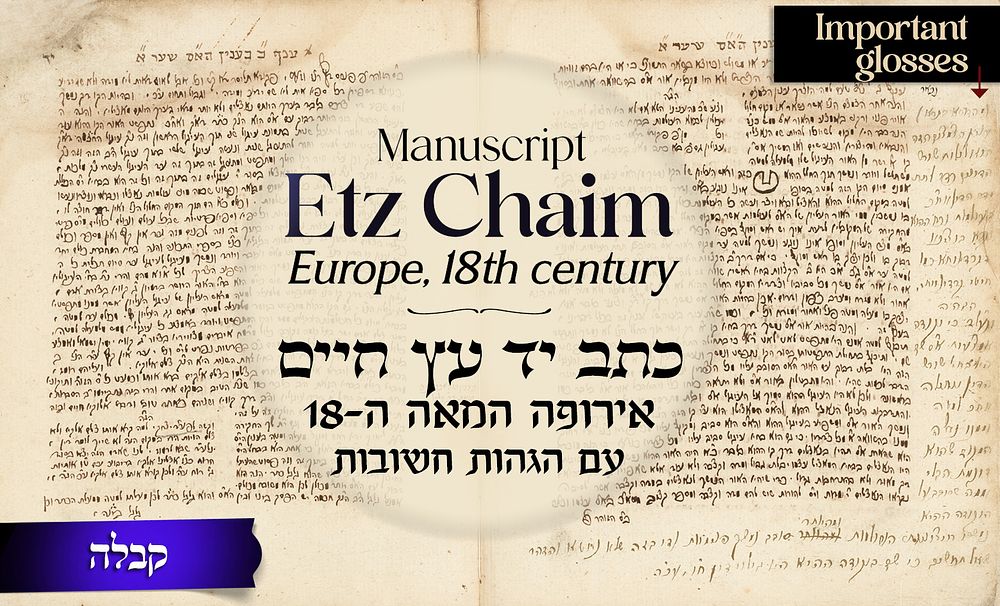
Kabbalistic Manuscript – Sefer Etz Chaim –– Important Glosses. Europe, 18th Century * Manuscript of the sefer Etz Chaim from the Arizal, arranged from the writings of his disciple Rabbi Chaim Vital, edited by the kabbalist Rabbi Meir Poppers. Written in a fine and neat Ashkenazic script, with a small number of decorative elements and kabbalistic diagrams, along with glosses inserted in “windows” (framed sections alongside the main text). The present manuscript appears to be a composite of Rabbi Meir Poppers’ editions. Rabbi Meir edited the sefer Derech Etz Chaim twice (see: Avivi, Kabbalas HaAri, vol. II, pp. 641–647), and this version reflects a combination of those two editions. In the margins and in the “windows” (framed sections alongside the main text) of the manuscript, the copyist recorded glosses opening with the phrases: “According to my humble opinion, Yitzchak” (15a), “Yitzchak” (38a, 39a), and “A.Y.” = “Amar Yitzchak” (39b). It is accepted that these glosses are those of the gaon and kabbalist Rabbi Yitzchak of Posen (c. 1610–1685) , who was unique in his generation in both the revealed and hidden aspects of Torah, and was the renowned teacher of the Magen Avraham. The kabbalist Rabbi Moshe Zacuto (the Ramaz) traveled to Poland to study Kabbalah from him, and wrote of him in his letters that he “comes and goes within the chambers of the Merkavah.” Rabbi Yitzchak possessed numerous kabbalistic manuscripts, and he wrote on them his glosses. (See more about him in the introduction to Shu”t Rabbi Yitzchak of Posen, Machon Yerushalayim edition, especially pp. 16–17). Rabbi Yitzchak of Posen’s glosses on Etz Chaim were published by R’ Yosef Avivi in his article “Glosses on Sefer Etz Chaim by Rabbi Yitzchak of Posen” (Moriah, year 13 [1984], issues 1–2, pp. 33–34). However, those glosses printed there do not include the present ones, as Avivi notes that he published only glosses explicitly bearing the name of Rabbi Yitzchak of Posen, and not those signed merely “Yitzchak.” In several places, glosses appear without attribution; these are from the glosses of Rabbi Nosson Shapiro on Otzros Chaim (see, for example, leaf 37a). In addition to these, there are further glosses and corrections in the handwriting of the copyist, which still require careful study to determine whether they originate from the copyist himself — who may have been a kabbalist in his own right — or whether he transcribed them from other sources. In the margins, in a later handwriting, there are additions, comparisons, and references noting variations relative to the printed edition of Koritz 1782, which was based on the second edition of Rabbi Meir Poppers. Poland / Germany, early 18th century. Page Count: 70 leaves (139 written pages). The manuscript is incomplete and concludes in chapter 2 of the eleventh section. Size : 17.5 × 20.5 cm. The first word of the second section is enclosed within a decorative frame. Condition : Fair to fair–good. Textual losses and restorations at the top of the initial leaves. Water stains, with darker stains along the inner margins. New half-leather binding.