Bidspirit auction | Mizrachi on the Torah Venice,
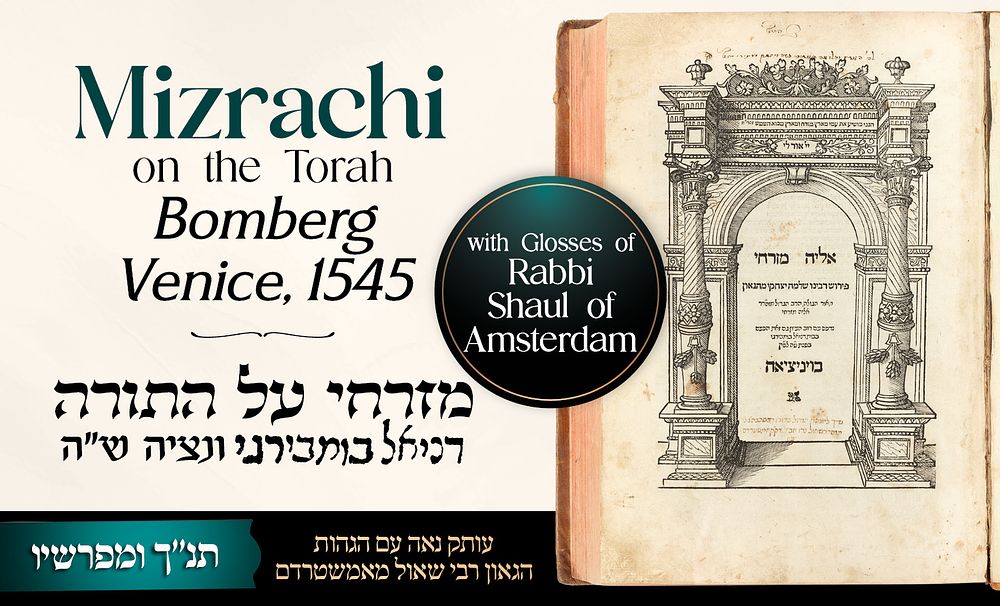
Mizrachi on the Torah Venice, 1545 With Glosses of Rabbi Shaul of Amsterdam * The foundational and comprehensive commentary on Rashi’s commentary to Chamisha Chumshei Torah, by Rabbi Eliyahu Mizrachi, the Re’em. This is the copy of Rabbi Shaul of Amsterdam, the renowned Rav of Amsterdam, with glosses in his handwriting. In the margin of the title page, there is a fine handwritten inscription: “ Belongs to the great gaon of his generation, the head of all Bnei HaGola, Ner Yisrael, our teacher Rabbi Shaul, may his light shine, Av Beis Din of the holy community of Amsterdam.” In the margins of the sefer, there are three glosses which, to the best of Zaidy’s research, are in Rabbi Shaul’s handwriting (49a / 61a / 90b). In the note on leaf 49a, there is a short and charming explanation of a piyut for the Shacharis of Rosh Hashanah. Rabbi Shaul of Amsterdam (1717–1790) , author of Binyan Ariel, was one of the greatest sages of his generation, and “his name was widely known, admired and revered” — in the words of the Vilna Gaon in his letter to him. He was of illustrious lineage, being a great-grandson of Rabbi Heshel of Cracow and a grandson of the Chacham Tzvi, the son and successor of his father, Rabbi Aryeh Leib, Av Beis Din of Amsterdam. He was the nephew of the Yaabetz, the elder brother of Rabbi Tzvi Hirsch Berlin, and mechutan with the Gedolei Hador, the Hafla’ah, and Rabbi Itzikl Hamburger. In 1755, he became Rav of the Ashkenazic community of Amsterdam, “a crown of beauty, the pride and joy of the entire region, ” as he wrote in the introduction to Binyan Ariel, and his influence spread throughout the entire Diaspora. He held this rabbinic post with distinction for about thirty-five years. The Chida, who visited his home in Amsterdam, did not conceal his admiration and wrote of him in his Shem HaGedolim (entry: Binyan Ariel): “And I, the lowly one, merited to receive the Pnei Shechina in the year 1778, and merited to delight in his Torah, his humility, and his perfection.” On leaf 280b, a map of the borders of Eretz Yisrael is printed on about half a page. Venice, 1545. Printing press of Daniel Bomberg. Second edition. Page Count: 320 leaves. Size : 31 cm. Condition : Aside from holes at the margins of a few leaves, a fine and impressive copy. A restored loss in the upper corner of the title page. Fine antique leather binding. There are a few additional glosses, inscriptions, and signatures in eastern and Italian script. Bibliography : Stefansky, Sifrei Yesod no. 10, notes. _____________ Rabbi Eliyahu Mizrachi (1452–1526) was one of the most significant spiritual leaders in Turkey during his time. He is best known for his Mizrachi commentary on Rashi’s work on the Torah, which is considered an essential commentary on Rashi’s writings. He writes in his teshuvos regarding this work: “I have been deeply occupied in extensive study of the words of the great luminary in his commentary on the Chumash, for there is not a single statement of his that does not require extensive investigation and profound analysis in all the sources from which he draws — in the Mishnah, the Braisa, the Mechilta, the Sifra and Sifrei, and throughout the Talmud, in Bereishis Rabbah and Tanchuma and all the aggadic Midrashim, which are too numerous to count, and especially in resolving the difficulties raised by the Achronim who study his words and challenge them, in particular by the great and formidable Ramban, of blessed memory... Therefore, I was not able to set aside this study, which occupies me throughout the entire day” (Shu”t Re’em, siman 80). Gedolei Yisrael throughout the ages drew from his wisdom and discussed his words, and an extensive body of literature developed around the Re’em’s commentary. In many works of the Sephardic sages, treatises called Leshonos HaRe’em can be found, which are devoted to discussions of his words.