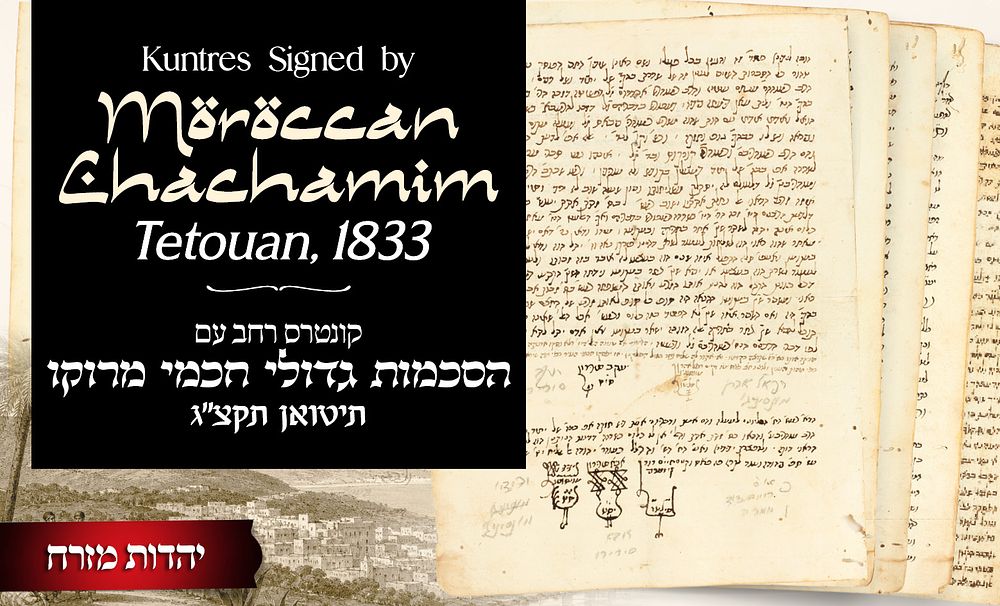
Bidspirit auction | Comprehensive Kuntres on Inheritance of
Comprehensive Kuntres on Inheritance of Communal Positions, with Approbations from Moroccan Chachamim – Tetouan, 1833 * A lengthy kuntres, never before published — 18 pages in the handwriting of Harav Hagaon Yehudah Elmaliach, one of the rabbanim of Tetouan, dealing with the halacha of inheritance and chazakah of communal positions held by the Bibas family dynasty in the synagogue of Tetouan. With handwritten approbations and signatures of the chachamim of Sefrou and Fez. Background to the Writing of the Kuntres In 1573, the leaders of the Tetouan community invited Rabbi Chaim Bibas I, a descendant of exiles from the Spanish Expulsion who had settled in Fez, to serve as a Rav in their community. In the official document of appointment issued by the city's leaders and prominent members of the community, they agreed to grant him and his descendants hereditary rights to serve in the core communal religious roles of dayanus, chazzanus, milah, and shechitah. This practice continued generation after generation in Tetouan. Over the years, individuals occasionally tried to infringe upon their rights, and members of the Bibas family came before the rabbanim of Morocco in a din Torah to protect their chazakah (rights). Before us is a comprehensive kuntres by Rabbi Yehudah Elmaliach, containing a lengthy and in-depth discussion of chazakah over positions for the performance of mitzvos, at the end of which he rules in favor of the Bibas family rabbanim. At the beginning, Rabbi Yehudah sets out eighteen points requiring clarification regarding chazakah for positions for the performance of communal mitzvos, and he explains them one by one, drawing support from the halachic rulings of earlier Moroccan chachamim who had addressed the matter. Dozens of Moroccan rabbanim and chachamim are mentioned here. Contents of the Kuntres: From leaf 1 through leaf 10, side 2, until the middle — a total of 19.5 pages — in the handwriting of Rabbi Yehudah Elmaliach (without a signature). 2–3. From the middle of leaf 10, side 2, until the end of the leaf — in the handwriting and with the signature of Rabbi Yehudah Elbaz, with the additional signature of Rabbi Amor Abitboul. 4–9. From leaf 11, side 1, until the middle — by an unidentified writer. This is followed by two lines in the handwriting and with the signature of Rabbi Refael Aharon Monsonego, and the signature of Rabbi Yaakov Serero. Afterward there is a new passage of three and a half lines, ending with the signatures of Rabbi Chaim Dovid ibn Zimra, Rabbi Abba Serero, and Rabbi Yedidya Monsonego. Leaf 11, side 2 — by an unidentified writer. Rabbi Yehudah Elmaliach was one of the rabbanim of Tetouan and one of the leading chachamim of Morocco. A prolific author, a holy man, and a kabbalist, he was likely born in Demnate around 1780. Around 1810, he established his residence in Tetouan and became counted among its chachamim. He was a close friend and colleague of the great Rav, Rabbi Yitzchak Ben Walid, author of Vayomer Yitzchak. He was revered by all the chachamim of Morocco, who wrote of him with distinguished titles and praises. The year of his passing is unknown. (For his biography and the many works he authored that remain in manuscript, see Min HaGenazim, vol. 10, p. 219 and onward.) **** The Rabbanim of Sefrou Rabbi Yehudah Elbaz, Raavad of Sefrou (1770–1847), was one of the great Moroccan chachamim of his generation and author of Shu”t Shevus Yehudah and other works. He was the son-in-law of Rabbi Shaul Yeshua Abitboul, author of Avnei Shesh, and from 1800 served as a dayan in Morocco, and later as Raavad. He was one of the leading poskim in Morocco in his generation (Malchei Rabbanan 44b; introduction to Shevus Yehudah). The second half of leaf 10b is in his handwriting and bears his signature. Rabbi Amor Abitboul, Raavad of Sefrou (1782–1854), was one of the great Moroccan poskim, and he left behind many works, some of which were printed, including Omer HaTenufah, Shirat HaOmer, and Omer Man. He embodied both deep Torah scholarship and distinguished personal stature, and he hosted the kabbalist Rabbi Yaakov Abuchatzeira during his visits to Sefrou. **** The Rabbanim of Fez Rabbi Refael Aharon Monsonego, Av Beis Din of Fez (c. 1760–1840), was from the illustrious Monsonego family and one of the leading chachamim of Morocco in his generation, author of Mei HaShiloach, Ne’os Midbar, and many other works. His son was Rabbi Yedidya Monsonego, author of Kupat HaRochlim. In addition to his signature, he added several lines in his holy handwriting. Rabbi Yaakov Serero (1769–1852), son of Rabbi Mattisyahu Serero I, was a dayan, kabbalist, and remarkable masmid. Rabbi Chaim Dovid Ben Zimra (d. 1848) was one of the dayanim of Fez, author of teshuvos, Iggros, and literary compositions. He was known for his Torah scholarship and sharp intellect. Rabbi Abba Serero (d. 1835) was one of the chachamim of Fez, a pious and holy man. Rabbi Yedidya Monsonego (d.