Bidspirit auction | Sefer Yesod. Chiddushei HaRashba on
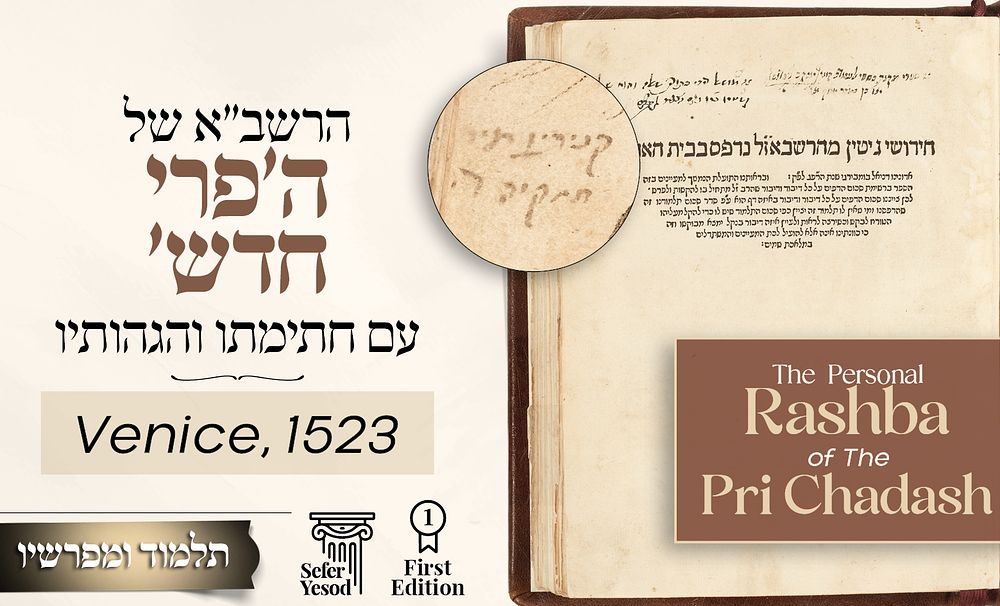
Sefer Yesod. Chiddushei HaRashba on Gittin with Signature and Glosses of Rabbi Chizkiya da Silva, Author of Pri Chadash. First Edition. Venice, 1523. * Chiddushei HaRashba on maseches Gittin, one of the most fundamental commentaries on Shas by the Rishonim, with the holy handwritten signature and glosses of Rabbeinu Chizkiya da Silva, one of the great Achronim and poskim, author of Pri Chadash. The title page features the holy handwritten signature of the Pri Chadash: “I acquired it from… Chizkiya da [Silva], ” as well as about ten short glosses and corrections in his holy handwriting. The handwriting and signature are identical to the handwriting of the Pri Chadash known from another source. The final leaf features the handwritten signature of his son, Rabbi David da Silva, who published his writings. Throughout Pri Chadash on Even HaEzer, the Pri Chadash frequently references the Rashba’s chiddushim on maseches Gittin. The present sefer is the holy copy in which the Pri Chadash learned while writing his work Pri Chadash, and upon which he recorded, in his very own holy handwriting, his signature and glosses. Rabbi Chizkiya da Silva, author of Pri Chadash (1656–1696) , was celebrated and praised for his remarkable sefer Pri Chadash by the greatest of the Achronim, including the Chida and the Chasam Sofer. His Torah greatness and breadth of knowledge are evident to those who study the sefer. His printed works include: Pri Chadash on Yoreh Deah (Amsterdam 1692). His other works were printed by his illustrious son, Rabbi David da Silva: Pri Chadash on Orach Chaim and Even HaEzer (Amsterdam 1706), and an additional section on Orach Chaim and likutim together with the sefer Mayim Chaim on the Rambam (Amsterdam 1730). Chiddushei HaRashba on Maseches Gittin. First edition. Venice, 1523. Daniel Bomberg printing press. Page Count: 133 leaves. Size: 23 cm. Condition: Artistic restorations to the margins of the title page and to the margins of additional leaves; some wormholes have been filled. New leather binding. Bibliography: Stefansky, Sifrei Yesod, no. 52. Additional signatures and glosses besides those of the Pri Chadash and his son, Rabbi David: 1) Rabbi Yitzchak Castro , son of the Maharikash, one of the sages of Egypt in the 1500s. His signature appears on leaf 2a: “Mine, the young Yitzchak Castro.” 2) A signature on the title page: “Avraham, ” apparently his son, Rabbi Avraham Castro . In the sefer Erech Lechem of his grandfather, the Maharikash, glosses from him were printed. 3) Rabbi Yaakov Lundis , one of the sages of Egypt. His signature appears on the title page, and he also provides glosses. 4) An ownership inscription states that the sefer belongs to Rabbi Eliyahu Tzvi , one of the sages of Yerushalayim from the beis din of the Maharit Algazi. Provenance: Genazym, Auction 4, Item 25. _________________ The Pri Chadash and His Works The Pri Chadash was a brilliant Torah scholar who possessed a combination of remarkable depth and sharp intellect, and he had an extraordinary ability to produce bold and original chiddushim. It is hard to believe that although he passed away at a young age — before reaching the age of forty — he merited to be counted as one of the widely acclaimed Torah greats, as the Chida testified: “To this day, all Torah scholars drink thirstily from his words.” From a young age, he devoted himself entirely to Torah study, and his son Rabbi David attests that “in truth, the body, spirit, and neshamah of my master, my father, became entirely spiritual through occupation in Torah.” Despite his young age, he served as Rosh Mesivta in Yerushalayim and was held in great esteem by the Sephardi and Ashkenazic sages alike. It is said that the Vilna Gaon regarded him as comparable to Rabbeinu the Shach. His brother-in-law, the gaon Rabbi Moshe Chagiz, testified that when the Pri Chadash presented his sefarim to one of the Gedolei Hador, the gaon exclaimed that one who sees a Pri Chadash needs to say the blessing of “Shehecheyanu.” The Semichas Chachamim likewise wrote in poetic praise regarding the chiddushim of the Pri Chadash, and described them as “pure fine flour… anyone who tastes them will experience them as an actual Pri Chadash (new fruit), holy and worthy of praise, like the finest fruits of Eretz Yisrael…” (from his approbation to Pri Chadash, Amsterdam, 1706). In many sugyos, the Pri Chadash rules differently from the approach of those who preceded him, and there were sages in his generation who challenged him, such as the Ohr Hachaim HaKadosh, who wrote an entire sefer on the chiddushim of the Pri Chadash and called it Peiros Ginosar (Amsterdam, 1742). The Chida testifies that when he was young, he went with the Ohr Hachaim and his talmidim to pray at graves of tzaddikim, and when they came to the grave of the Pri Chadash, “we saw the aforementioned Rav [the Ohr HaChaim] remain alone by his matzeivah for about a quarter of an hour,