Bidspirit auction | First Chassidic Commentary Printed on
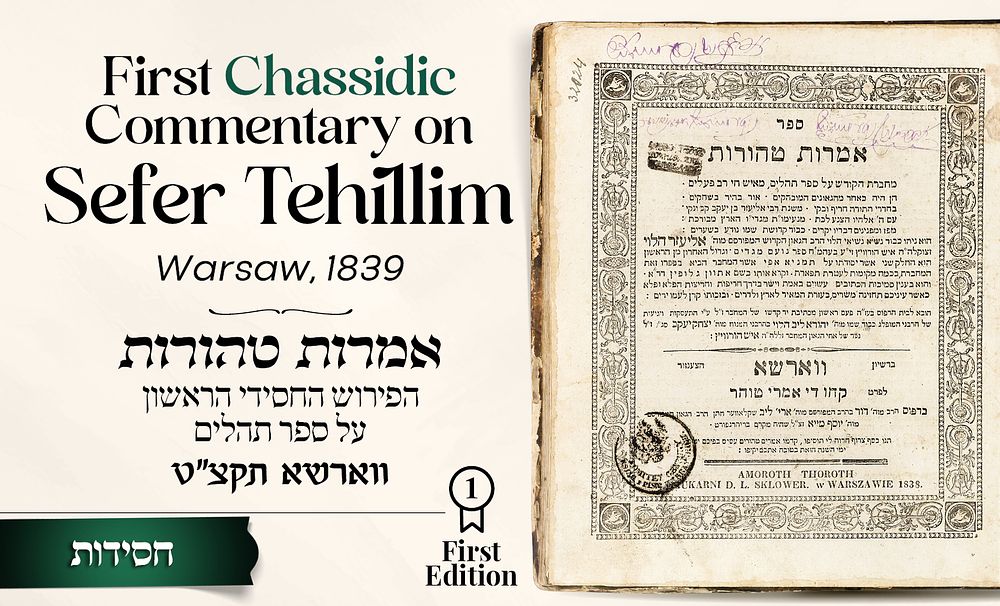
First Chassidic Commentary Printed on Sefer Tehillim – First Edition, Warsaw, 1839 * Sefer Tehillim with the Chassidic commentary Imros Tehoros, by Rabbi Eliezer HaLevi Ish Horowitz of Tarnigrad, one of the greatest disciples of the Noam Elimelech and the Chozeh of Lublin, and author of the sefer Noam Megadim. The Torah of Rabbi Eliezer reflects the teachings of his rebbi, Rabbi Elimelech of Lizhensk, in which a tzaddik occupies a central place and, in his merit, abundance descends upon all those around him and those attached to him. Rabbi Eliezer HaLevi Ish Horowitz of Tarnigrad (d. in Kozhnitz in 1806) came from the distinguished Horowitz family. He refers in the sefer to the Shelah, who was from the Horowitz family, as “my uncle, my elder, ” and to Rabbi Shmelke as “my relative.” He was one of the distinguished disciples of Rabbi Yechiel Michel of Zlotchov and Rabbi Elimelech of Lizhensk, whom he calls “our holy Rebbe” in his approbation to the first edition of Noam Elimelech. Later, he accepted the authority of the Chozeh and the Maggid of Kozhnitz, and was regarded as a “disciple-friend” to them. Gedolei Yisrael and Chassidic tzaddikim greatly praised his drashos and teachings in the sefer Noam Megadim and Imros Tehoros. It includes approbations from the Gedolei Yisrael, headed by Rabbi Shlomo Zalman Lipschitz, Av Beis Din of Warsaw, author of Chemdas Shlomo; Rabbi Meshulam Yaakov Orenstein, Av Beis Din of Lvov, author of Yeshuos Yaakov; and the author’s childhood friend, Rabbi Aryeh Leib Lipschitz of Wisznice, author of Aryeh Devei Ila’i. For the commentary on Temanya Apeh, chapter 119, the author gave a special name: “Asvan Gelufin דר”א.” Warsaw, 1839. First edition. Page Count: [2], 67; 59 leaves. Condition: Good, some stains and signs of use. Old, worn binding (slightly damaged). Bibliography: Stefansky, Sifrei Chassidus, no. 597. Owner’s signature: Avraham Nosson Nota Meizlish Rosenwasser (from the family of the holy gaon Rabbi Uziel Meizlish). Between the leaves of the sefer lies a leaf from a Sefer Tehillim, and in its margins, the above-mentioned owner recorded what he heard “from the mouth of the Shinova Rebbe shlita” in 1894. He heard from him an extraordinary account concerning the accepting of a pidyon nefesh from a sick person, including a remarkable statement about his rebbi, Rabbi Tzvi Hirsch of Rimanov: “He was able to ask the sick person for money, because he understood exactly what he was accomplishing through it — but I myself do not understand such matters at all…”