Bidspirit auction | “I am praying for you
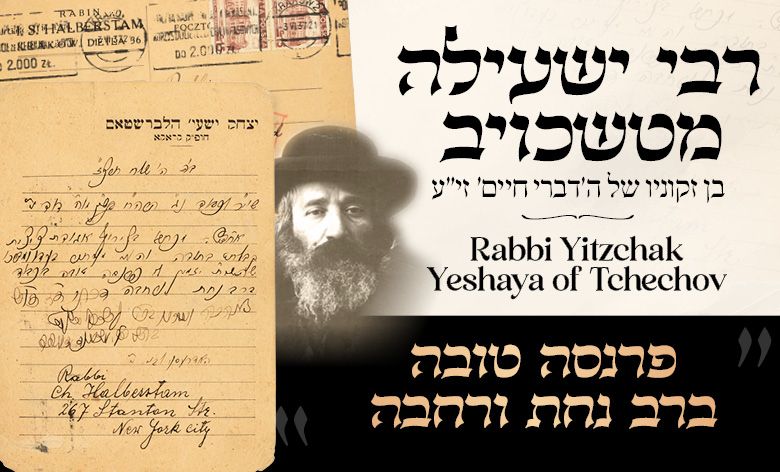
“I am praying for you and bless you that Hashem grant you a good livelihood, with great ease and abundance” Letter from Rabbi Yitzchak Yeshaya of Tchechov – Cracow, 1937 * A warm and heartfelt letter overflowing with blessings and thanks from Rabbi Yitzchak Yeshaya Halberstam of Tchechov, Hy”d, youngest son of Rabbi Chaim of Sanz. It includes additional lines of blessing and a signature in Rabbi Yitzchak Yeshaya’s holy handwriting. The letter was written in appreciation for the sending of an “Agudas Tzitzis” (see below) from the holy city of Jerusalem, and contains especially warm blessings: “I am praying for you and bless you that Hashem grant you a good livelihood, with great ease and abundance.” In the closing lines, the Rebbe added in his own handwriting: “Words of your uncle and elder, who seeks your welfare, with love, and blesses you with all good, HaKatan Yitzchak Yeshaya, son of the holy gaon of Sanz zt”l.” Rabbi Yitzchak Yeshaya was exceedingly meticulous in the mitzvah of tzitzis, and a letter from him is known in which he elaborates at length, with great precision, how to prepare the pure silver atarah of his tallis (Rabbeinu HaKadosh of Tchechov, p. 169). A moving account is told of his martyrdom al kiddush Hashem, while wrapped in his tallis: In the month of Elul 1943, Rabbi Yitzchak Yeshaya was hiding in a bunker in the Bochnia Ghetto when he was discovered by the Nazis. It was clear that he would be taken out and killed within moments. Rabbi Yitzchak Yeshaya said to those around him that whoever would bring him a tallis in which to wrap himself — he promises him a share in Olam Haba (Shefa Chaim, Reva DeRevin III, Shemos–Yisro, p. 331). And indeed, they brought him a tallis, and his soul departed in purity while wrapped in it, may Hashem avenge his blood ( Rabbeinu HaKadosh MiSanz , vol. II, ch. 25). Rabbi Yitzchak Yeshaya Halberstam of Tchechov (1864–1943) was the youngest son of Rabbi Chaim of Sanz, who said regarding him that “his soul is holy.” Concerning the younger sons of the Rebbe of Sanz, Rabbi Yehoshua of Belz remarked: “We cannot comprehend the holiness with which the holy Rebbe of Sanz brought his sons into the world, especially those born to him in his old age.” Orphaned at the age of twelve, he was raised in the homes of his illustrious brothers, Rabbi Yechezkel of Shinova, Rabbi Baruch of Gorlice, and Rabbi Dovid of Kashanov. After marrying the daughter of Rabbi Yechiel of Krilovitz, son-in-law of Rabbi Yehoshua of Belz, he became very close to his saintly grandfather-in-law, Rabbi Yehoshua of Belz. At the age of nineteen, he was accepted as Rav in Tchechov, by whose name he became known, although in 1893 he established his court in Cracow. His court numbered thousands of chassidim, and his bearing and conduct closely resembled those of his holy father. He was murdered by the Nazis while wrapped in a tallis on the 3rd of Elul 1943. (Rabbeinu HaKadosh MiSanz, vol. II, ch. 25; Encyclopedia of Chassidus, vol. II, p. 412). Cracow, 1937. Official postal card, with original postage stamps and postal lines. Condition: Small paper tear without loss, rounded corners. Not printed in the “Tchechov section” of the sefer Tehillas Chaim, vol. II (Bnei Brak, 1995). __________ “Agudas Tzitzis” Out of their immense love for Eretz Yisrael and for the mitzvah of tzitzis, the tzaddikim of that generation would make a great effort to obtain especially mehudar tzitzis made in the holy city of Jerusalem. When gazing upon the tzitzis during the words “u’re’isem osam” in the morning prayers, they would also think of Eretz Yisrael. __________ The recipient, Rabbi Dovid Perkowitz (1878–1948) , a descendant of the dynasties of the Polish Rebbes, emigrated from Warsaw to Jerusalem before the First World War. He was one of the veteran chassidim and activists in Jerusalem, and was close to the great Rebbes and Chassidic leaders of his generation. He was especially close to the Imrei Shaul of Modzitz. He devoted his life to Torah and Chassidus, and possessed a veritable treasure-house of sefarim on Torah and Chassidus. His home served as a place of lodging for Rebbes and rabbanim who came to Jerusalem in the years preceding the Second World War. (For more information about him, see the booklet Sha’ar HaZikaron printed at the end of Otzar Michtavei Kodesh Chelkas Yehoshua , containing fifty letters addressed to him by the Chelkas Yehoshua, Jerusalem 2007.)